At Design Doha, the biennale running in Qatar’s capital from November 5 to January 31, the Uzbekistan Culture and Art Development Foundation is presenting an exhibition titled “A Leaf from Gulistan.” The pavilion brings together Bukhara abru paper, silk embroidery and a contemporary glass installation, drawing on Saadi’s “Gulistan.” The project is intended to introduce Uzbekistan’s cultural heritage to an international audience through a contemporary artistic language; a Gazeta correspondent viewed the exposition on site.
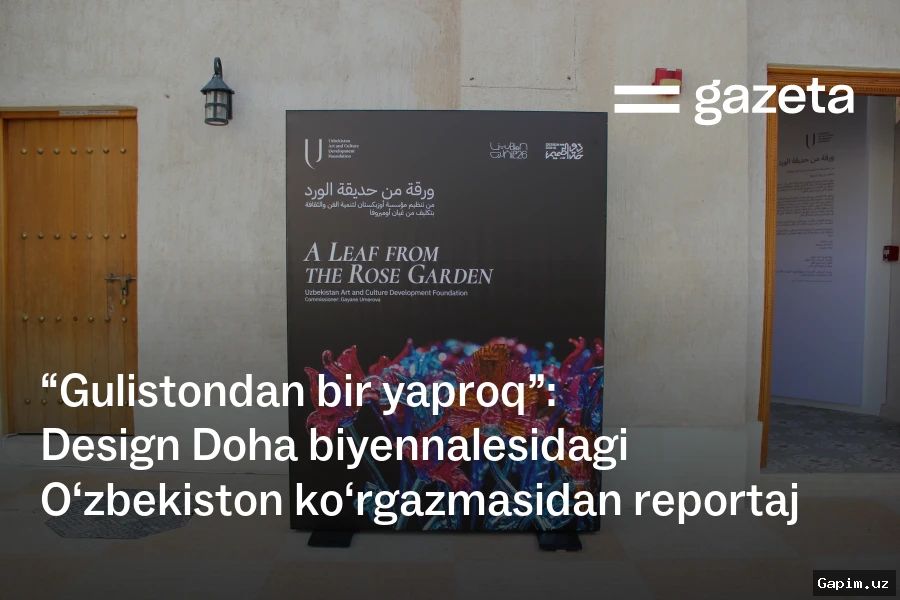
Key Takeaways: Design Doha runs from November 5 to January 31. The Uzbekistan pavilion features works by Davlat Toshev, Madina Qosimboyeva and Ruben Saakyan. The display interprets the “Gulistan” theme through abru paper, silk embroidery on adras fabric and handmade Murano glass flowers.
The exhibition title comes from the introduction to Saadi’s “Gulistan” (1258), where the brief life of a plucked flower is contrasted with the eternity of a garden preserved through words. The pavilion walls are covered with desert-toned abru paper: its patterns resemble clouds and do not repeat. The style is called “abru bahor,” or spring clouds; it was initially used mainly for book decoration and emerged in Bukhara in the 13th century. According to Toshev, the wall color is not accidental: it expresses the idea of a garden created in the desert, and each country has its own color palette.
“This style is called abru bahor, meaning spring clouds. Initially it was used mainly to decorate books. This art was born in Bukhara in the 13th century. In our interpretation of Saadi’s ‘Gulistan,’ we created a modern and improved version of abru bahor. Here every color has its own meaning,” Toshev explains. He says visitors begin to feel as if they are walking through a garden, while the compositions gradually change as they move forward. Each sheet is first drawn on the surface of water, then transferred to paper and pasted onto the wall; Toshev completed the work with three students in one week. At the entrance, a pomegranate is depicted as the tree of life and a paradise fruit at the beginning of the garden.
In the inner room, Madina Qosimboyeva’s work “Meros gullaganda” is on display: five suzani panels embroidered with silk thread on adras fabric, each showing a different flower, with compositions and patterns that never repeat. More than a thousand women have trained at her workshop, opened in 2006; Qosimboyeva learned the craft independently and teaches students mostly for free. The pavilion’s main installation is Ruben Saakyan’s “Nafis Bog”: on a long table covered with black cloth, numerous glass flowers “bloom” on sand in the center. The work was first shown at Venice Glass Week in 2024 and has been reconfigured for Doha; the flower pattern is drawn from Bukhara embroidery, and the pieces were handmade on the island of Murano near Venice at the Laguna~B workshop.
The exhibition interprets a single flower motif in three materials — silk thread, paint and glass — contrasting the transient beauty of a natural flower with the long-lasting but delicate nature of glass. Saakyan has worked with flowers for more than 30 years; at his GOODVEEN floristry school, floral design is taught as part of architecture and landscape. Design Doha continues until January 31, and the organizers expect further attention from international specialists, collectors and the wider public to Uzbekistan’s pavilion.
Source: www.gazeta.uz