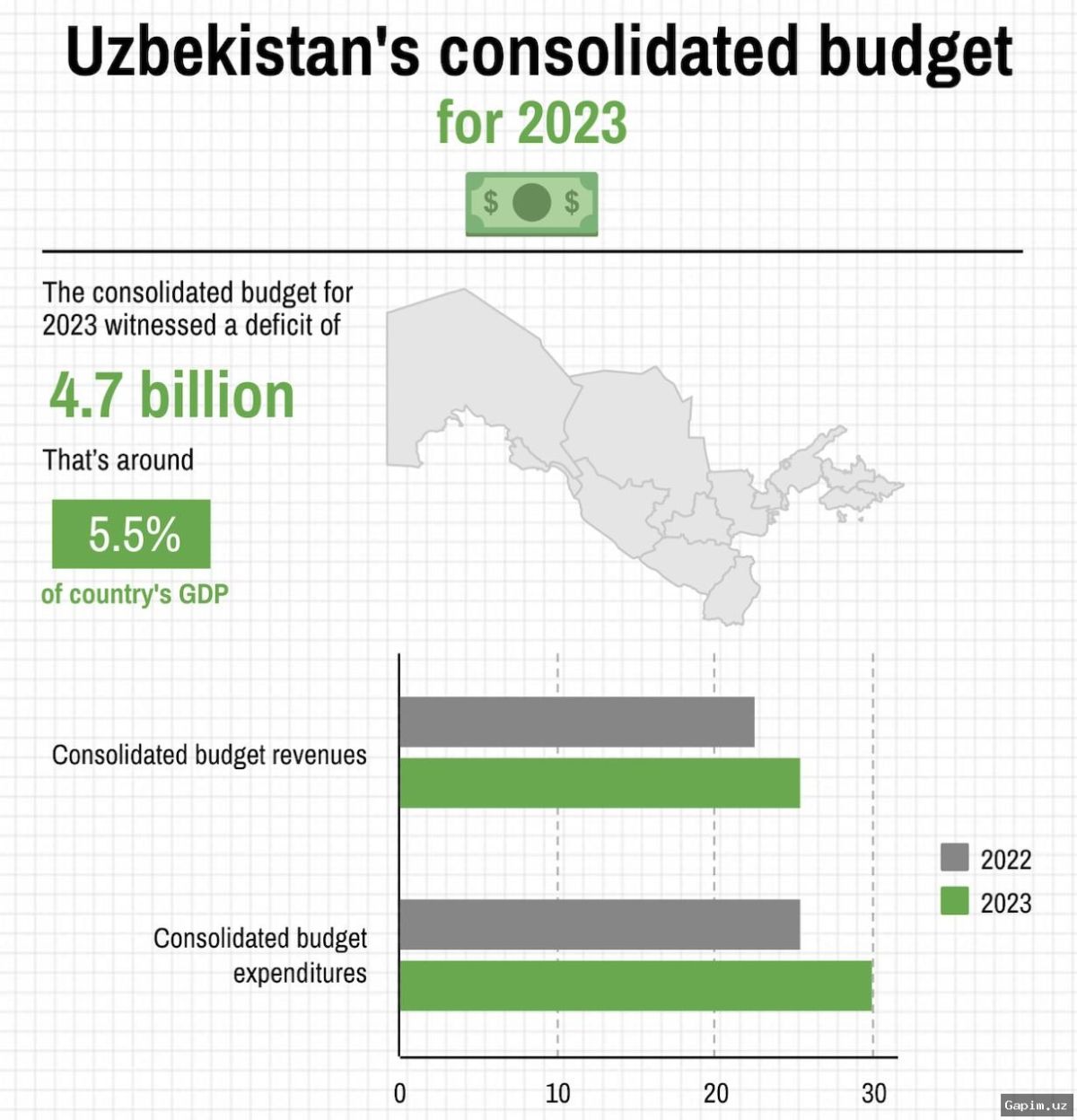
Uzbekistan's budget deficit for 2025 stood at 2.1% of GDP or 39.4 trillion soums. According to data released by the Ministry of Economy and Finance, consolidated budget revenues were 502.6 trillion soums, with expenditures at 541.7 trillion soums, indicating a reduction in the deficit from 3.3% in 2024 to 2.1%. However, the overall deficit of 39.1 trillion soums highlights ongoing financial challenges, reflecting structural economic issues and persistent fiscal pressures within the country.
The largest regional deficits were recorded in Fergana Region, where revenues of 6.38 trillion soums and expenditures of 10.77 trillion soums resulted in a deficit of 4.39 trillion soums. Andijan Region followed with a deficit of 3.56 trillion soums, and Samarkand Region with 3.41 trillion soums. In contrast, the smallest deficits were observed in Navoiy Region (1.03 trillion soums) and Tashkent Region (1.35 trillion soums), underscoring significant regional economic disparities and uneven development across Uzbekistan.
Subsidies from the state budget in 2025 totaled 29 trillion 352 billion soums, with 11.3 trillion soums allocated to the energy sector and nearly 4 trillion soums directed to preschool educational institutions. These subsidies constitute a substantial portion of budget expenditures, yet their efficiency and impact on economic growth remain questionable, pointing to potential risks for fiscal stability and long-term sustainability.
For 2026, consolidated budget revenues are projected at 515.8 trillion soums, with expenditures set at 567.7 trillion soums, leading to an expected deficit of 60.1 trillion soums, which is not to exceed 3% of GDP. These forecasts suggest continued budgetary strain and financial difficulties in the coming years, potentially exacerbating economic challenges and hindering the country's development goals.
Source: kun.uz