Abdulla Qodiriy was born in 1894 in Tashkent. He began his education at a Muslim school, then attended a Russian-native school from 1908 to 1912 and studied at the Abulqosim Sheikh Madrasah from 1916 to 1917. In 1924–1925, he completed literary courses in Moscow, which significantly contributed to his development as a writer and played a key role in the evolution of Uzbek literature.
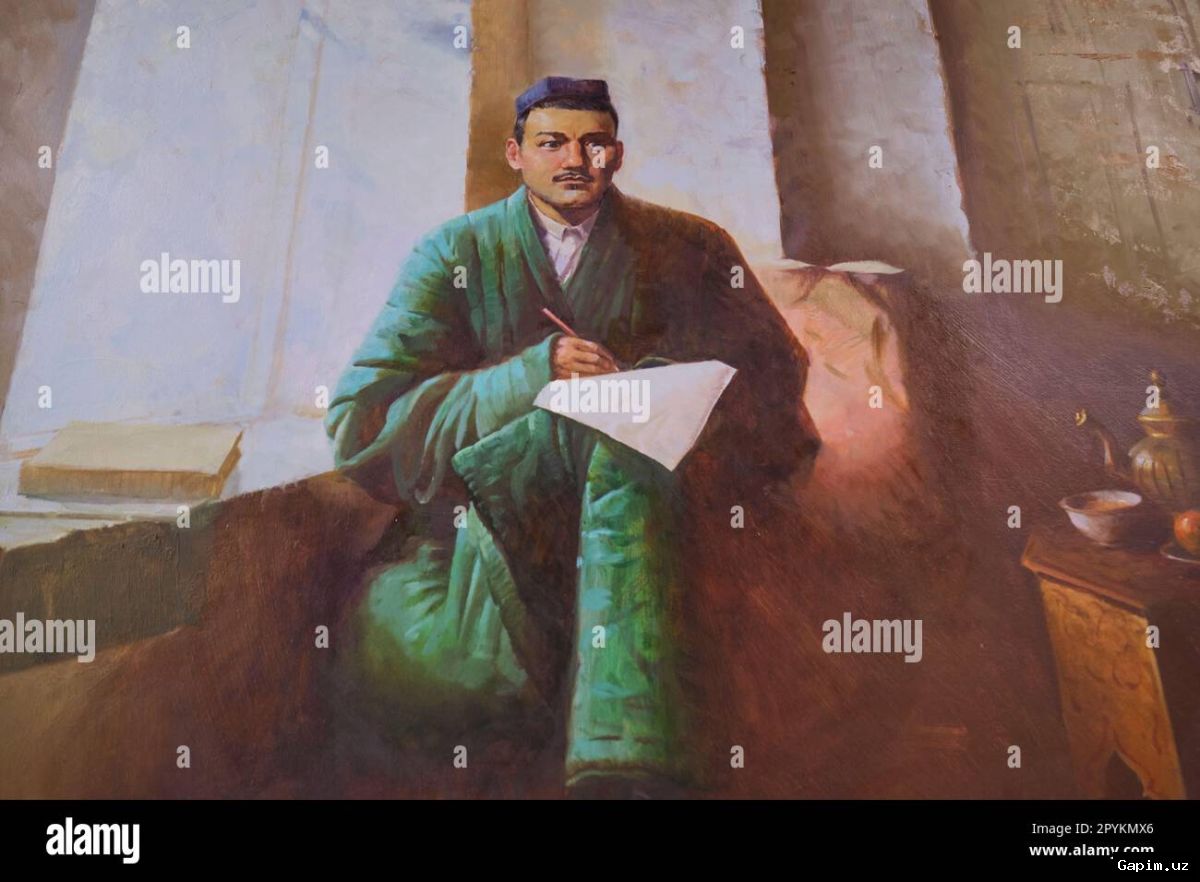
Qodiriy’s career spanned various fields: he was the founder of the “Mushtum” journal, served as an editor at the “Oziq ishlari” newspaper, and worked as a literary staff member at the “Ishtirokiyun” and “Qizil bayroq” newspapers. Additionally, he acted as a secretary in the Old Town Food Committee and the Council of Artisans. His first published work, an article titled “New Mosque and School,” appeared in the “Sadoyi Turkiston” newspaper in 1914.
His literary output is extensive: between 1915 and 1916, he completed the play “Unfortunate Groom” and the stories “Juvonboz” and “Uloqda.” From 1919 to 1925, he was active in the press with sharp articles. His novels “Bygone Days” and “Scorpion from the Altar,” written and published from 1919 to 1929, left an indelible mark on Uzbek literature. The novella “Obid Ketmon” was written in 1934.
Qodiriy’s life was marked by hardship: in 1926, he was imprisoned for 2 years due to his article “Collected Words” published in “Mushtum,” but was released by a decision of the Uzbek parliament without serving the full sentence. However, on October 4, 1938, he was executed. The document sentencing him to death was formalized the next day, October 5, a pattern common for many progressive figures of that era. Qodiriy was rehabilitated from this charge on October 9, 1956, and fully exonerated in the 1926 case in 2023.
On the occasion of this memorial date, Gazeta, emphasizing the principle of “not saying ‘eh’ even if one’s head is lost for the sake of truth,” has prepared a test based on Abdulla Qodiriy’s works, an initiative aimed at studying his legacy and preserving literary values.
Source: www.gazeta.uz