Uzbekistan is set to experience an extreme heatwave this week, with temperatures soaring to +48°C in some regions, pushing thermal stress levels close to those found in the hottest parts of Africa and the Arabian Peninsula. The heat is expected to be felt not just on thermometers but directly on the human body.
Throughout the week, the country will be under the influence of a thermal depression originating from Turkmenistan, bringing the hottest weather pattern for Central Asia. This process induces thermal exhaustion, characterized by persistent fatigue due to heat.
Cooler air is expected to arrive from the north starting from the weekend. According to foreign weather bureaus, average five-day temperatures in most of the republic will be 4-6 degrees Celsius above the climatic norm for this period.
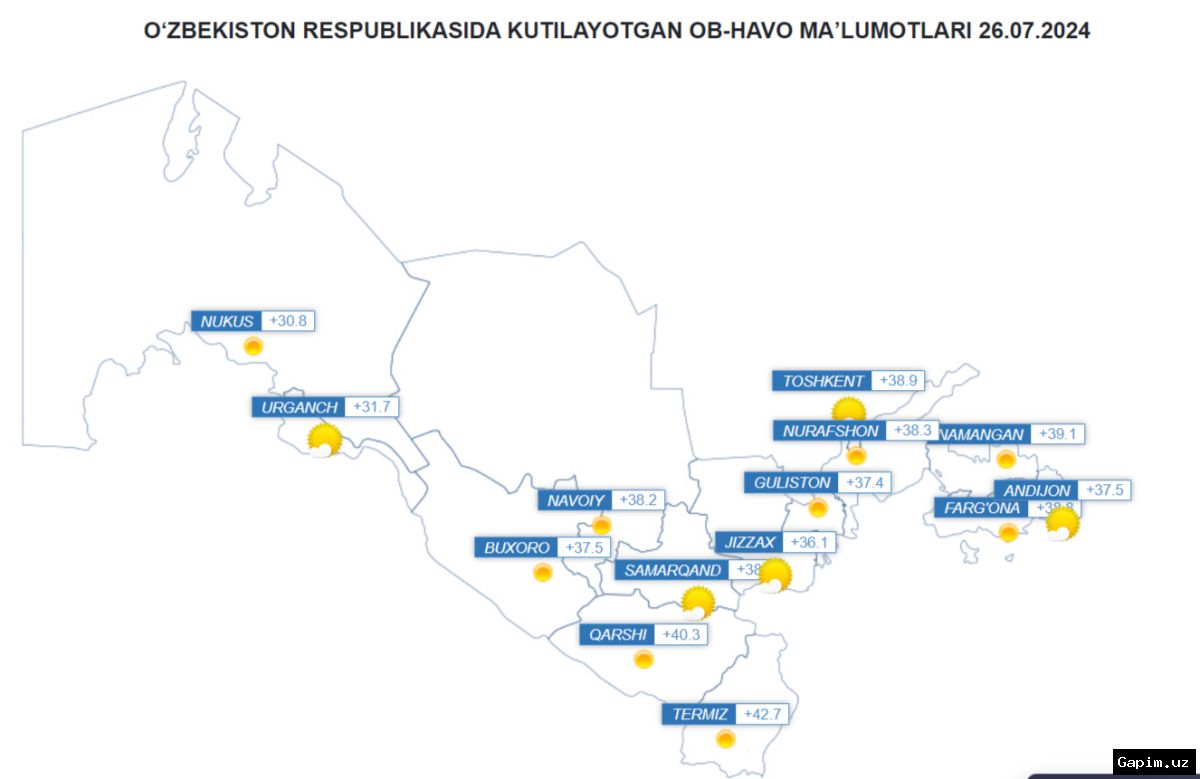
According to forecasts from Uzgidromet, the national weather service, extremely hot weather will prevail from Monday in the northern and desert regions. For instance, on Monday and Tuesday, maximum temperatures in Khorezm, Bukhara, Navoi, Surkhandarya, Kashkadarya regions and Karakalpakstan will reach +45°C, rising to +47°C from Wednesday to Friday in the same areas.
On Friday, a slight temperature drop is expected in the north. Other regions will maintain temperatures above +40°C during working days. On July 15-17, even in the valley regions, maximum temperatures will reach +43°C. In the mountains, maximums will hit +34°C at the beginning and middle of the week.
Nighttime temperatures will also be high, with minimums in desert and plain areas around +30°C or slightly lower. A daily maximum temperature forecast map for July 17 shows that many places could see temperatures exceeding +44°C, with the capital Tashkent reaching +44°C and the Kyzylkum desert up to +48°C.
No precipitation is expected during the week, except for brief showers in mountainous areas on Monday and Tuesday afternoons. In desert and plain areas, strong winds and dust storms may occur after the soil heats up in the afternoon.
According to Uzgidromet and the European Centre for Medium-Range Weather Forecasts (ECMWF), average weekly temperatures across most of the republic will be 3-6 degrees above the long-term norm. Given that this is the hottest time of the year, the current week is characterized as anomalously hot.
Consequently, absolute temperature records may be broken at some meteorological stations this week. The abnormal heatwave is expected to cause significant problems across various sectors, particularly healthcare, energy, agriculture, and transportation. An increase in emergencies and fires is possible.
During working days, air temperatures in most of Uzbekistan will exceed body temperature for a large part of the day. It is therefore crucial to take precautions to mitigate the negative effects of high temperatures. Uzgidromet forecasts that temperatures will exceed +40°C in all regions during working days. In such weather, it is recommended to limit time outdoors and physical activity.
Protecting the head from the sun is especially important, as large arteries and veins pass through the brain. Walking without a hat during the hottest part of the day can cause the head to overheat, raising blood temperature throughout the body and leading to heatstroke. Symptoms include elevated body temperature, skin redness, weakness, rapid breathing and heartbeat, headache, dizziness, nausea, vomiting, and even loss of consciousness.
Attention should also be paid to diet. Drinking plenty of plain water helps maintain the body's water-salt balance. To replenish fluid loss, it is better to choose clean drinking water rather than carbonated or sweet drinks. It is also advisable to reduce fatty meat products and opt for light meals, fruits, and vegetables.
In summer, it is recommended to wear loose-fitting clothing made from natural, breathable fabrics in light colors. Such clothing allows the skin to breathe and prevents excessive body temperature rise. Wearing a hat is also essential. White and yellow cotton fabrics transmit the least sunlight to the body.
It is advisable to avoid going outside or staying under direct sunlight during the hottest part of the day, from 12:00 to 16:00. Experts also recommend avoiding prolonged outdoor exposure from 11:00 to 17:00, drinking more water, wearing light clothing, and shifting heavy physical work to morning or evening hours. The Ministry of Emergency Situations has issued a warning urging people not to move in areas where the sun is directly overhead between 10:00 and 17:00.
Bioclimatic conditions. For the human body, this week will be not just hot summer days but a natural 'stress test'. Short comfortable periods in the morning will diminish, and from Tuesday to Sunday, the body will be forced to adapt to almost continuous high temperatures. During the most active phase of thermal depression, nighttime temperatures remain high. The absence of wind and natural increase in nighttime humidity will exacerbate the feeling of stuffiness. Residents of the valleys will begin to feel this from the second half of the week.
A bioclimatic map for July 13-17 at 14:00 shows in dark red the areas of Uzbekistan where the population will experience extreme heat stress. On Friday, such extreme heat will even prevail in the capital. The map illustrates how heat is perceived by the human body in Asian countries. During this time, residents of these areas will feel as if they are in the hottest regions of Africa, the Arabian Peninsula, as well as parts of Pakistan, Afghanistan, and Iran.
Dark red zones on the map indicate where heat is felt most intensely. A large part of Uzbekistan falls into such zones.
Space weather. The past weekend was quiet, but a powerful M-class flare occurred on Sunday. Foreign geophysical centers do not forecast strong magnetic storms of 'red' or 'yellow' danger levels for the beginning of the week.
However, the Almaty Ionospheric Center in Kazakhstan provided different estimates, indicating a 'yellow' danger level for magnetic storms on Monday and Thursday, and 'green' on Tuesday, Wednesday, and Friday.
Currently, there are no reliable methods for forecasting magnetic storms beyond two days. Therefore, people sensitive to magnetic storms are advised to base their plans on forecasts for the next two days.
Uzgidromet synoptics noted that strong winds may occur briefly in northern and plain areas during the afternoon. Therefore, the risk of dust accumulation in the air during the week is likely low.
In case of increased air pollution or fine particulate matter, it is recommended to consult the guidelines prepared by the Sanitary-Epidemiological Committee for different age groups and patients.
Thus, from July 13 to 19, Uzbekistan is expected to experience anomalously hot days. Weather forecasts are not just temperature numbers. This week's heatwave can directly impact human health, energy consumption, agriculture, and daily life. Therefore, following official forecasts and expert recommendations is more important than ever.
Source: www.gazeta.uz