The Lower Amu Darya and the Aral Sea region are spaces where water determines the fate of forests, animals, and people. Researchers emphasize that the long-term sustainability of Central Asia's economy is impossible without preserving the natural hydrological regime of the Amu Darya, making joint environmental measures a basic condition for regional security.
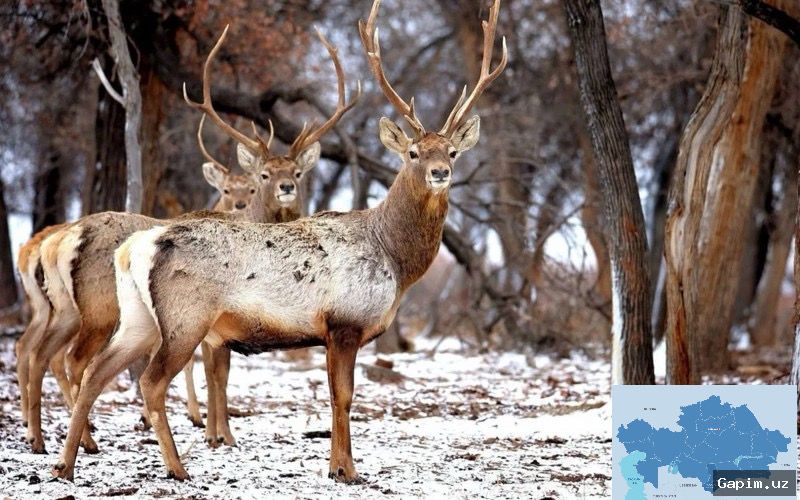
In Karakalpakstan, expedition participants visited the Lower Amu Darya State Biosphere Reserve. Here it is especially clear why a protected area is not a space cut off from the world, but a place to seek balance between nature and humans. The reserve was established on the basis of the former Badai-Tugai Nature Reserve and is part of the UNESCO World Network of Biosphere Reserves. It preserves some of the largest tracts of natural tugai forests in Central Asia and hosts the largest population of the Bukhara deer.
A biosphere reserve differs from a regular nature reserve. It has a strictly protected core, a buffer zone, and an area where regulated economic activity is allowed. This model assumes that nature conservation cannot be separated from issues of water, agriculture, local community life, and sustainable land use.
Here it is especially noticeable that ecological water releases are not just a topic for hydrologists. The forest, deer, soil, birds, pastures, and people's ability to live in a region increasingly feeling the effects of climate change all depend on it. Ecological water releases are water specially discharged to replenish water bodies, allow fish to spawn, prevent forests and meadows from drying out, and provide drinking water for people.
The tugai forests of the Amu Darya are home to the Bukhara deer, or hangul, a rare subspecies of red deer adapted to floodplain forests. According to expert Tura Kholikov, tugai thickets once stretched along the Amu Darya in an almost continuous strip. Then large areas were developed for agriculture, forests became fragmented, and animals lost their habitual habitats. The reserve is known primarily for its approximately 1,580 Bukhara deer – more than anywhere else in the world. However, a problem has arisen: there is not enough area to feed all the animals, so specialists are working on relocating deer to other reserves.
The final point of the expedition was Lake Sudochye in the Muynak district. Once connected to the Aral Sea, its single water area has split into several separate bodies of water. Today the largest is Akdzhiiyak. Despite high mineralization, Sudochye remains a critically important ornithological area. Hundreds of bird species live and stop here during migration, with tens of thousands of individuals gathering in some seasons. Brine shrimp develop in the brackish water, providing food for birds.
When discussing the Amu Darya, it is easy to fall into the usual formula: there is not enough water for everyone. The population is growing, industry is developing, and agriculture needs irrigation. At the same time, the river itself is under pressure: snow-glacial feeding is decreasing, water intake is increasing, and losses occur along canals. But the expedition showed another side of the issue. Water for nature is not a leftover that can be allocated in a good year. It is part of the country's overall water balance.
In recent years, Uzbekistan has been introducing water-saving technologies, digital accounting, canal concreting, and new approaches to growing cotton and rice. All this is needed not just for saving per se. Saved water can become a chance for a lake that holds birds on migration routes; for tugai forests that protect floodplains; for the rare Amu Darya fish, the false shovel sturgeon; for the Bukhara deer, which has nowhere else to live. Ecological water release is a technical term. But behind it stand very simple things: water in a lake, the shade of a tugai forest, a deer's footprint on wet ground, a flock of birds over reeds.
Source: podrobno.uz