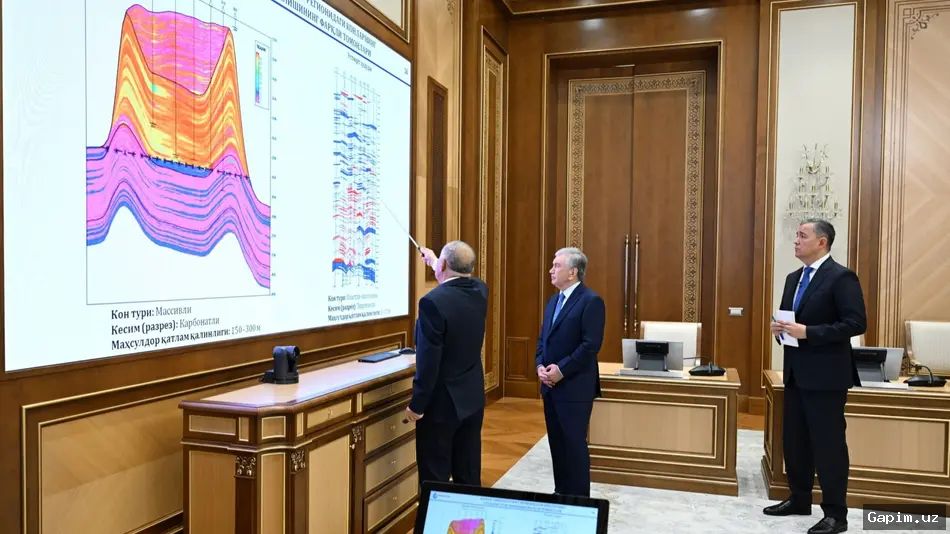
At a presentation dedicated to ensuring stability in the oil and gas market and uninterrupted supply of hydrocarbon resources to the economy and population, the President of Uzbekistan set a number of key tasks for responsible agencies.
Against the backdrop of expanding production capacities and growing population needs, demand for natural gas and petroleum products continues to rise. Therefore, the responsible structures are tasked not only with securing the necessary volumes of resources but also with preparing in advance for seasonal consumption peaks.
The President was presented with data on oil and gas production, import, processing, storage, and supply. Special emphasis was placed on accurate forecasting of regional and sectoral needs, priority supply to the domestic market, and strict adherence to delivery schedules.
The work of Uzbekneftegaz was reviewed separately. The company must maintain stable natural gas production rates, make more efficient use of the potential of existing fields, and accelerate the commissioning of new wells.
In August alone, 27 wells are planned to be launched. Work at the Yangi Kultak, Niyoz, Koratau, Marvarid, and Tegirmon fields should provide the possibility of additional production of 887 thousand cubic meters of natural gas.
Control should cover the entire production chain – from drilling wells to connecting them to the gas transmission system. The task was also set to ensure uninterrupted power supply and stable operation of production infrastructure.
Another direction is the timely delivery of hydrocarbon resources to the regions. Necessary reserves are ordered to be created in advance, without waiting for a sharp increase in seasonal demand.
Enterprises responsible for production, transportation, and sale of products must work in a coordinated manner. At the same time, it is necessary to evenly supply raw materials to oil and gas enterprises, more efficiently load existing capacities, and increase the output of products most in demand on the domestic market.
The issue of prices became a separate part of the discussion. To maintain stability, it is necessary to maintain sufficient supply of products, put them up for exchange trading taking into account real demand, and reduce production and logistics costs.
Against this background, a specific instruction was given: to establish effective control and prevent unreasonable restriction of resource supplies, creation of artificial shortages, and actions aimed at inflating prices.
In fact, we are talking about control not only over production volumes but also over ensuring that necessary resources reach consumers in a timely manner and that shortages are not created artificially.
Uzbekneftegaz was also tasked with ensuring the fulfillment of forecast indicators for oil and gas production. In addition, it was decided to increase plans for liquefied gas production.
By the end of the year, its output should amount to 606 thousand tons instead of the previously planned 520 thousand tons. Thus, the target indicator is being increased by 86 thousand tons.
Responsible managers were instructed to analyze the situation on the domestic market daily, monitor the needs of the population and economy, identify possible risks of disruptions in advance, and take prompt measures.
The instruction came amid a noticeable increase in fuel prices. In June 2026, the exchange price of AI-92 gasoline in Uzbekistan rose by 11.2% and reached a record 13.9 million soums per ton. The growth coincided with the fuel crisis in Russia, from where a significant part of the gasoline imported by Uzbekistan comes.
Official statistics also recorded growth. In May, gasoline in Uzbekistan was on average 12% more expensive than a year earlier, and propane – by 22.1%.
The dependence of the domestic market on the situation in Russia has manifested itself before. The Competition Development Committee reported that after Russia announced export restrictions, imported AI-92 and AI-95 sharply rose in price, and after the restrictions were lifted, prices for high-octane gasoline in Uzbekistan fell by an average of 500 soums.
Source: uznews.uz