Uzbekistan currently has 391 student dormitories, and by the end of 2026, an additional 14,112 new places will be created under public-private partnerships. This was announced by First Deputy Minister of Higher Education, Science and Innovation Sardor Rajabov at a press conference in Tashkent on August 18.
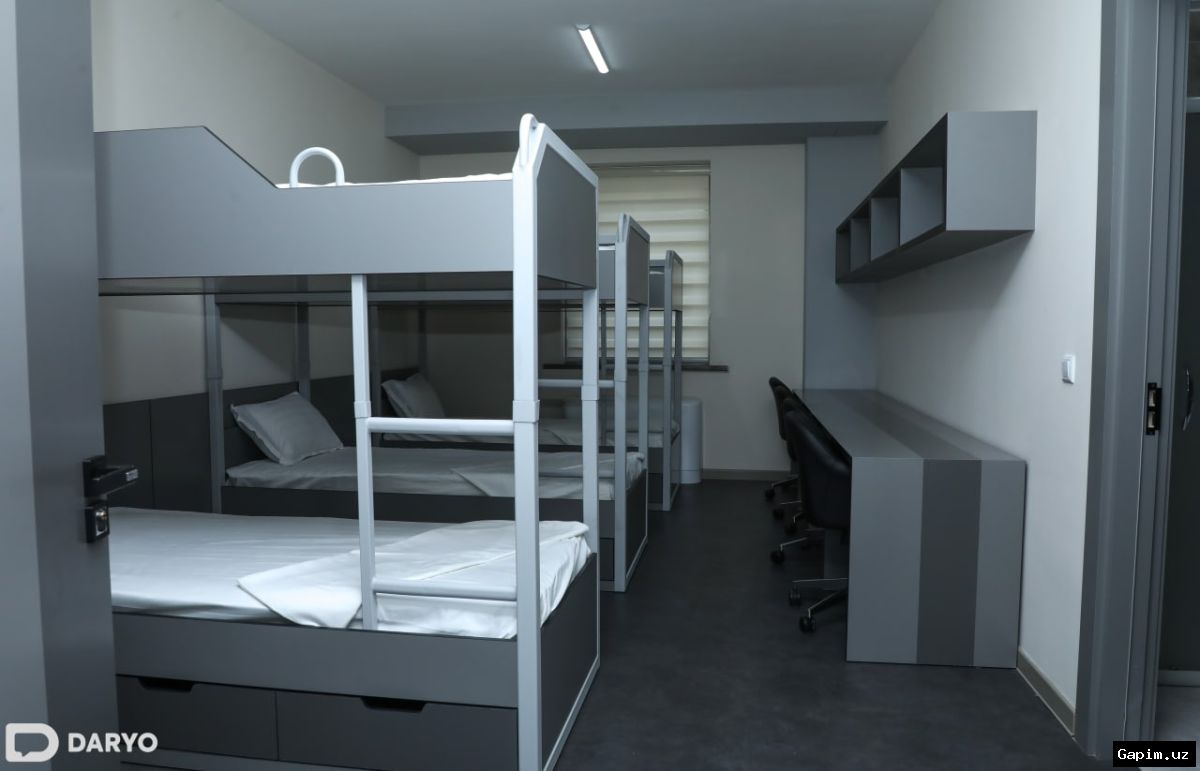
According to Nodir Kosimov, head of a department at the Ministry of Higher Education, the existing 391 dormitories provide 60,000 places. The level of student accommodation coverage has reached 58 percent.
"All students of higher education institutions, from the first year to master's degree, are placed in dormitories in accordance with the procedure established by the Cabinet of Ministers' resolution. To date, over 70,000 students have submitted online applications. Starting tomorrow, the first batch of referrals will be issued," he said.
Kosimov noted that universities unable to fully accommodate students have compiled a list of about 20,000 rental apartments, of which 10,000 are in Tashkent.
"A large contingent of students arrives in the capital. Therefore, the housing issue is acute here. From today, centers for placement in dormitories and rental apartments have started operating in all universities," he said.
Responding to a question about some dormitories housing five students per room, which does not meet sanitary requirements, Kosimov said that building dormitories, especially allocating land in Tashkent, is difficult.
"Therefore, we are trying to make efficient use of existing opportunities. The use of bunk beds and the possibilities of accommodating students in them are being fully considered," he said.
He added that work to increase the number of dormitories through public-private partnerships continues. In recent years, about 8,000 student places have been built in Tashkent on this basis.
Deputy Minister Rajabov said that by the end of 2026, 14,112 new places will be created and commissioned under PPP across the country.
"So far, 1,850 places have been created. In September, we will launch another 8,332 places. By the end of the year, another 4,300 places will be added," he said.
Rajabov stressed that providing students with dormitories is also important for the quality of education.
"The academic performance of students living in dormitories or campuses is higher than that of students living at home or in rented apartments. We have studied this. The average GPA of students living in dormitories is higher," he said.
According to him, students being in the same environment, exchanging ideas, studying together and reading books positively affects their studies. Also, crime is less common among students living in dormitories.
"Work on building dormitories at the expense of higher education institutions' own funds and on the basis of public-private partnerships is ongoing. The period of benefits has also been extended. We will not stop increasing the number of dormitories," the deputy minister emphasized.
Rajabov said that perceptions of nepotism in placing students in dormitories do not correspond to the current system.
"Recently, when discussing dormitories with employees of other organizations, they cited situations from several years ago, such as 'you put your acquaintances in dormitories' or 'the commandant places whoever he wants.' But now the system is fully digitalized," he said.
"The system is now open, and data is generated automatically. Neither I nor anyone else can place any student in any place," the deputy minister added.
He said the ministry is also working on automating the process of placing students in rooms using artificial intelligence.
Kosimov, speaking about the system of state compensation for students living in rental apartments, noted that in Tashkent one student is paid one base calculation value, and in other regions 50 percent.
He emphasized that the amount allocated for rent changes annually based on student needs.
"On average, 150 billion soums are allocated for these purposes per academic year. The exact amount varies each year. An agreement is concluded with students living in rented accommodation, and payment is made on this basis," he said.
According to Rajabov, private universities are also included in the system of providing students with housing.
"For private universities, there are requirements of Resolution No. 80. According to it, they must provide students with sufficient dormitories. During licensing and monitoring, they provide information on student housing. Some universities have their own dormitories, while others rent apartments," he said.
He said that previously there were difficulties with housing due to the large number of distance-learning students, but now that admission to distance learning has been stopped, the student population in private universities is declining.
Kosimov said that a list of rental apartments has also been compiled for private university students.
"The list of 10,000 rental apartments I mentioned includes apartments allocated for students of private higher education institutions. The same requirements we impose on state universities apply to private universities," he said.
He stressed that placing students in hostels or rental apartments, ensuring their safety, concluding contracts and studying living conditions are under the ministry's control.
"Placing a student in a hostel or rented apartment, studying the moral environment, checking with whom and in what conditions the student lives — all this is recorded and under our control. We do not divide students based on whether they study at a state or private university. If conditions that do not meet requirements are detected, we evacuate students and move them to another place. Recently, such a case occurred in Chilanzar district. One of the private universities placed students in one place. When we studied it together with the Ministry of Emergency Situations, it turned out that there were no conditions for a person to live there at all. We immediately evacuated the students and moved them to a safe place," Kosimov said.
Deputy Minister Rajabov commented on reports circulating on social networks about the sale of student dormitories of some universities.
"We have already given official information. There was no talk of selling dormitories. It is planned to rent out empty, that is, unused by students, premises such as canteens or basements to entrepreneurs. They can organize various services for students there. To do this, in accordance with the established procedure, an announcement is made through the State Assets Agency, a price is set, and a tripartite agreement is concluded with the entrepreneur who offers the most acceptable price. Due to misinterpretation on social networks, many thought that dormitories were being sold. We have no cases of selling dormitories at all," he said.
According to Rajabov, the sale of old buildings of some higher education institutions is planned, but this will be done after they move to new campuses. In particular, new modern campuses are being built for Bukhara State University, Navoi State University and the Nizami National Pedagogical University.
"A new campus for Bukhara State University is being built. The university will move there, and the existing buildings will be sold. However, the sale terms stipulate that the transfer will be made after the new building is completed and the university moves. The same applies to Navoi State University and the Nizami National Pedagogical University. We have announced this on our Telegram channel and website," the deputy minister said.
He specifically stressed that selling dormitories while students live in them is impossible.
"Selling a dormitory where students live, at a time when there is a shortage of student dormitories, is unthinkable. This is not done, that's for sure," Rajabov said.
Source: www.gazeta.uz