The Family and Gender Research Institute has conducted a comprehensive study to assess the long-term impact of internal and external migration on demographic processes and the institution of the family. As part of the study, a long-term forecast of birth rates in the country was developed, and the results have been published.
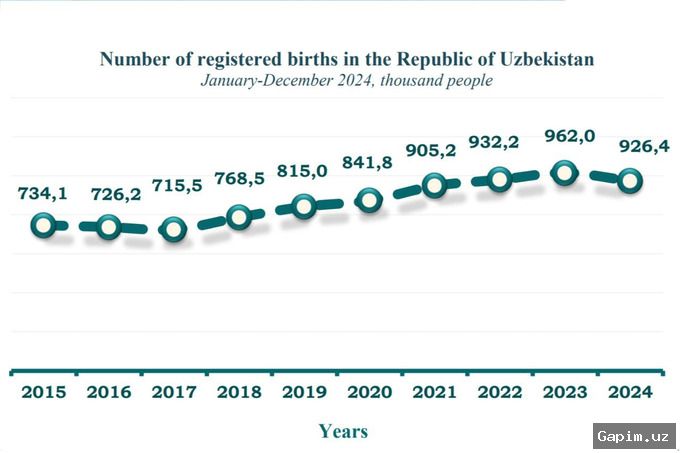
According to the forecast, the annual number of births in Uzbekistan will continue to grow steadily. Specifically, by 2050, the number of births is expected to increase by 354,500, or 40.3%, compared to 2025. This projection takes into account the age structure of the population and the influence of migration processes.
Regionally, the highest growth rates are expected in the Surkhandarya, Kashkadarya, Namangan, Samarkand, and Andijan regions. In these areas, the birth rate is projected to be significantly higher than the national average.
The total fertility rate (number of births per 1,000 population) is expected to see a slight decline in the medium term, followed by a steady upward trend. Nationwide, this indicator is projected at 21.2 per mille in 2030, 20.8 per mille in 2040, and 21.9 per mille by 2050.
Institute experts emphasize that the expected increase in births implies a growing need for education, healthcare, preschool education, housing, and labor market infrastructure in the coming years. Therefore, early assessment of demographic changes will facilitate efficient allocation of state resources and strategic planning of investments in human capital.
It is worth recalling that in the first quarter of 2026, the number of live births in Uzbekistan was 191,100. This is 7,000 fewer than in the same period of 2025. The number of deaths was 43,500, which is 2,100 more than the previous year. This trend has been ongoing since 2023.
According to the Statistics Agency, as of July 1, 2026 (excluding census results), the population of Uzbekistan reached 38,519,500. Although the population increased by 659,800 over the year, the growth rate fell from 2% to 1.7%, indicating a slowdown in demographic growth.
Source: www.gazeta.uz