The Tashkent city administration's press service announced that modern filtration equipment worth 9.5 billion soums (approximately $1.2 million) has been installed at the 'Salar' wastewater treatment plant to combat the unpleasant odor that has been affecting nearby residents. This initiative follows numerous complaints from the local population.
According to the city administration, the wastewater basins have been hermetically sealed, and the air is now being purified through special filters. The equipment has been operational for over 15 days, and as a result, the noxious smell around the facility has disappeared. Residents living in the vicinity have confirmed the improvement.
Dononboy Kazibekov, chief technologist of 'Toshkent Shahar Suv Ta'minoti' (Tashkent City Water Supply), explained that the second stage of the treatment plant receives wastewater from the Sergeli, Yangihayot, Mirobod, and Yashnobod districts. The purification equipment was imported from Russia.
Kazibekov detailed the system's operation: 'Air is drawn in by a fan. The system contains 11.5 tons of catalytic sorbent material. Ultraviolet radiation allows for ozonation and oxidation of the air. Subsequently, the air passes through 2.5 tons of activated carbon. As a result, the concentration of hydrogen sulfide in the exhaust air drops to zero, and the ammonia content also falls to zero.'
It is worth recalling that the President of Uzbekistan had tasked authorities with eliminating the foul odor emanating from the treatment plants in Sergeli and Yangihayot by September 1. In May 2021, Gazeta.uz, citing 'Toshkent Shahar Suv Ta'minoti', reported that the primary cause of the stench in the O'zgarish neighborhood in Sergeli was the discharge of wastewater and waste by enterprises into the aeration station and the Bo'zsuv canal.
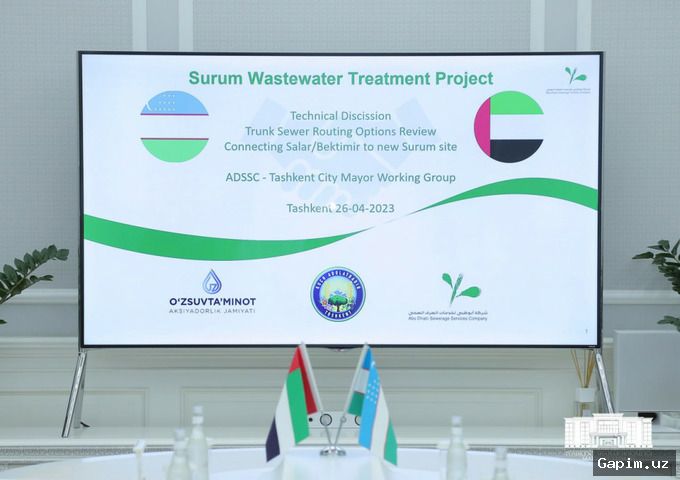
Subsequently, a Senate committee announced the development of a draft government resolution that would involve the reconstruction of local treatment facilities at enterprises and the relocation of five leather production plants outside Tashkent. Additionally, the UAE-based Abu Dhabi Sewerage Services Company (ADSSC) had planned to commence construction of a new water treatment station for Tashkent in January 2024.
In August 2024, it was reported that a new treatment facility with a capacity of 1 million cubic meters of wastewater per day would be built in the Tashkent region. The project is expected to connect over 500,000 city residents and 100 enterprises to the centralized sewerage system. A consortium of companies from the UAE, France, and Japan will implement the project.
Source: www.gazeta.uz