TASHKENT/ANTALYA — President Shavkat Mirziyoyev of Uzbekistan held talks with Prime Minister Tariq Rahman of Bangladesh on the margins of the 31st UN Climate Change Conference (COP31) in the Turkish city of Antalya, according to the presidential press service. The two leaders reviewed the state of bilateral relations and mapped out priorities for expanding trade, industrial cooperation and political dialogue, with both delegations describing recent contacts as showing positive momentum and mutual trade turnover as rising in recent years.
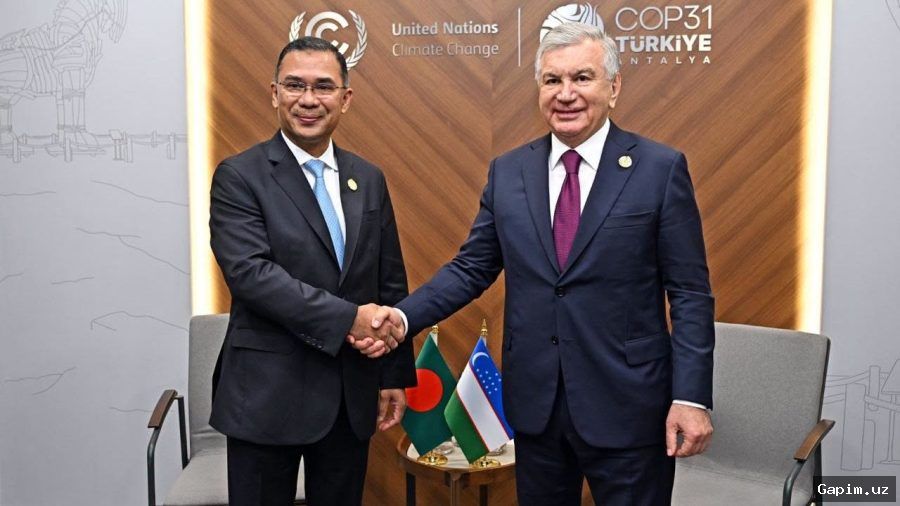
Key Takeaways: Mirziyoyev and Rahman agreed to intensify political dialogue, widen trade, economic and industrial cooperation, and give bilateral ties more practical content. The sides reaffirmed their intention to continue mutual support within international organizations and exchanged views on regional issues. No agreements or contracts were signed at the meeting, and no deadlines for new arrangements were announced.
The meeting fits into a broader Uzbek strategy of diversifying economic partnerships beyond Central Asia and reaching into South Asia. Uzbekistan and Bangladesh have maintained diplomatic relations since the early 1990s, but two-way trade remains modest relative to the size and complementary structure of the two economies. Bangladesh's garment sector is a large and steady consumer of cotton fibre and yarn — traditional Uzbek export items — while Tashkent has signalled interest in supplying textiles, fertilisers, agricultural machinery and in developing transport and logistics routes towards South Asian ports.
According to the official readout, the leaders discussed industrial cooperation specifically, implying plans for joint production facilities rather than purely commodity trade. The Uzbek statement said the conversation covered regional affairs and confirmed both sides' interest in continued mutual backing inside international bodies. On the same day, Mirziyoyev met President Nataša Pirc Musar of Slovenia to discuss expanding trade and economic cooperation and launching new joint projects — part of a packed bilateral schedule on the summit's periphery.
COP31 in Antalya has put climate finance, adaptation and the phased retreat from fossil fuels at the centre of its agenda, with delegations from nearly 200 countries in attendance. For Central Asia, the stakes are concrete: accelerating glacier melt, water scarcity and exposure to drought pose long-term risks to agriculture, hydropower and regional stability. Uzbek officials have increasingly framed climate diplomacy as a lever for attracting adaptation finance and for building new partnerships with climate-vulnerable economies in South and Southeast Asia.
What happens next remains undefined. Follow-up work is expected to fall to the foreign and economy ministries, with the possibility of an intergovernmental commission session and exchanges of business delegations. Analysts caution that the practical value of such summits-side meetings depends on whether declarations are converted into signed contracts and measurable trade growth; previous Uzbek-Bangladeshi expressions of intent have yielded limited commercial follow-through, and officials have not indicated how progress will be tracked.
Source: podrobno.uz