A pilot artificial glacier in Uzbekistan’s Kashkadarya region has demonstrated a practical way to store winter moisture for the warmer months, with project results presented at the UN climate conference COP31 in Antalya, Turkey. The experiment, launched in January 2026 in Sarchashma mahalla of Shahrisabz district, produced about 800 cubic meters of ice, and meltwater was used by roughly 60 households, according to the National Committee on Ecology and Climate Change. The project is based on the Ice Stupa approach, which creates large ice structures without refrigeration equipment or electric pumps, and it is being implemented with FAO and financial support from the Global Environment Facility.
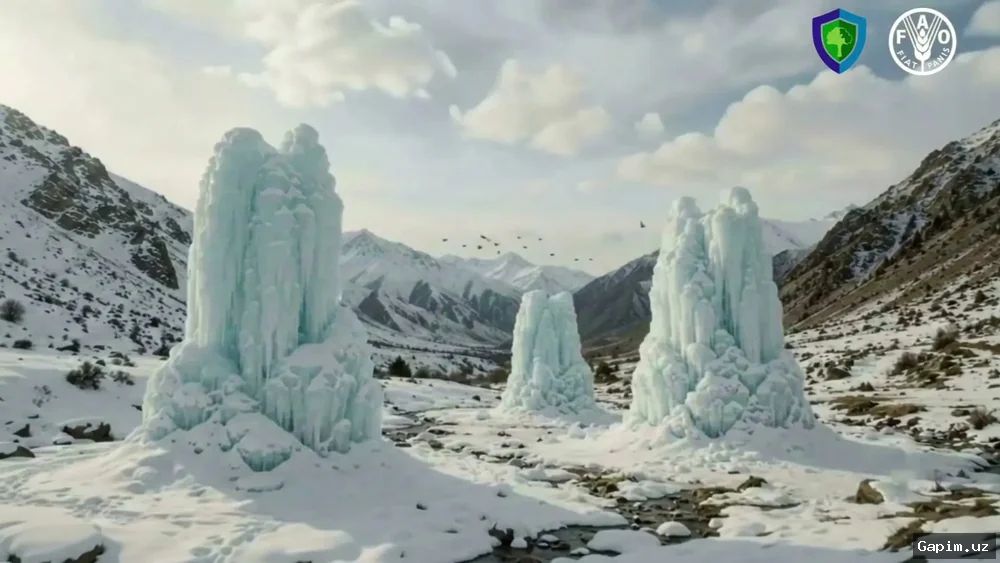
Key Takeaways: The Sarchashma pilot generated around 800 cubic meters of ice and supplied meltwater to about 60 households; the first structure appeared in January 2026; the system uses gravity and pressure rather than electricity. Officials are considering the technology for other water-scarce foothill areas of Uzbekistan as climate projections warn of a possible 15 billion cubic meter water deficit.
The initiative addresses a broader water-security challenge in Uzbekistan and Central Asia. According to forecasts cited by the committee, by 2050 Uzbekistan’s water availability could fall by 30–40 percent, while irrigation demand may rise by a quarter. The expected water deficit could reach 15 billion cubic meters, putting pressure on agriculture, rural incomes and household water supply. In this context, low-cost, locally maintained solutions that capture winter water and release it during the growing season are attracting attention from environmental agencies and international partners.
The Ice Stupa method relies on simple physics rather than costly cooling systems. In winter, water from a natural spring is piped upward and sprayed into freezing air; small droplets freeze and gradually form an ice tower that grows as more water is added. The system uses natural elevation differences and pressure to deliver water, so it does not require electricity. When spring arrives, the ice melts slowly, and the resulting water can be directed to orchards, household plots and other farm or domestic needs.
The project is led by Uzbekistan’s National Committee on Ecology and Climate Change together with the UN Food and Agriculture Organization, with financing from the Global Environment Facility. In February, the committee reported the construction of four ice structures in Sarchashma. Organizers say the pilot has shown how winter water can be held back for the warm season, when demand rises, and they are now assessing how the approach could be adapted to other foothill districts facing similar shortages.
The COP31 presentation in Antalya also links the pilot to regional climate diplomacy. Earlier, President Shavkat Mirziyoyev proposed that Central Asian countries combine efforts to combat droughts and glacier melting. If expanded, artificial glaciers could become one part of a wider adaptation strategy that includes water-saving irrigation, improved forecasting and closer regional cooperation. Further decisions on scaling the technology are expected after the pilot’s results and cost-effectiveness are reviewed.
Source: podrobno.uz