Vegetable farming remains one of the main pillars of Uzbekistan's agriculture: the country produced 13.7 million tonnes of vegetables in 2025, including more than 4.1 million tonnes of potatoes, while exports of fruit and vegetables exceeded 2.1 million tonnes over the year. Growing the crop is only the first step; potatoes, onions and carrots must be carefully received, cleaned, graded by size and neatly packed, and the smoother this stage is, the more valuable the produce becomes on the market. Russian-made Sematika equipment is presented as one of the tools helping farmers and processors handle that stage.
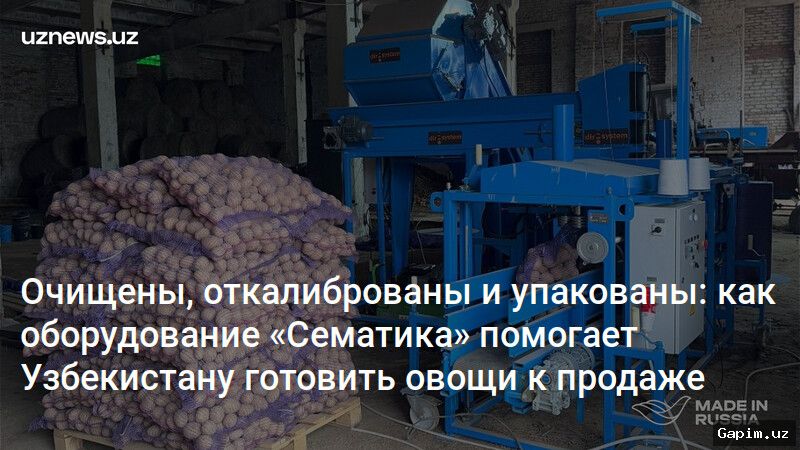
Key Takeaways: Uzbekistan produced 13.7 million tonnes of vegetables and more than 4.1 million tonnes of potatoes in 2025, with fruit and vegetable exports exceeding 2.1 million tonnes. Dir System, founded in Kstovo in 2015, has produced serial equipment under the Sematika brand since 2017. Its systems cover the full cycle from receiving and sorting to washing and packaging, with manufacturing times of 14 to 60 working days and a 12-month warranty.
Context and Background
Dir System was founded in 2015 in Kstovo, Nizhny Novgorod Region, with the idea of creating equipment that could match foreign analogues in quality while remaining affordable. Since 2017, it has manufactured serial equipment under its own Sematika brand and, over a decade, has developed solutions for agriculture as well as food and warehouse industries. Today the company designs, manufactures and services equipment for calibration, washing, inspection, dosing and packaging of vegetables. It is a member of the Chamber of Commerce and Industry and the Club of Young Industrialists, and regularly participates in specialised exhibitions, from Potato and Vegetables in Moscow to YUG AGRO in Krasnodar and the All-Russian Field Day. Its conveyors are even used at a domestic automotive plant in Izhevsk, while its equipment supports the training of engineers and programmers at universities in Nizhny Novgorod and Yekaterinburg.
Key Details and Outlook
The handling line begins with receiving: bunkers with capacities from 1 to 20 cubic metres and hydraulic container tippers with lifting capacities from 0.5 to 2 tonnes. Belt conveyors from 6.5 to 16 metres long — straight, inclined and telescopic — move produce into storage or processing. Dry cleaning machines with 10 and 16 rollers gently remove soil from tubers, roller graders divide the harvest into fractions, and inspection tables from 3 to 6 metres allow workers to select the best vegetables. Washing machines with capacities from 5 to 30 tonnes per hour are available where needed, followed by felt dryers that remove surface moisture. Final packaging is handled by automatic packing machines that place produce into nets and bags weighing from 2.5 to 25 kg, while weighing dosers provide throughput of up to 17 tonnes per hour. Separate cabbage lines are offered with two, three or four workstations.
Each project is developed individually: conveyors are designed for a specific premises, and the contract includes a detailed specification and engineering drawing. Production takes from 14 to 60 working days depending on complexity, all equipment carries a 12-month warranty, and machines can be powder-coated in any colour requested by the customer. The company also produces spare-part analogues for equipment made by German, Dutch, Polish and Danish manufacturers, while a dedicated specialist handles delivery across Russia and CIS countries. Russian engineering for Central Asian fields is supported by the Russian Export Center, which implements the national Made in Russia brand programme; for Uzbek farmers, the bird-marked logo is presented as a convenient way to find a supplier to whom they can entrust their harvest. Further attention is likely to focus on expanding cooperation in the Central Asian market and modernising agricultural logistics.
Source: www.uznews.uz