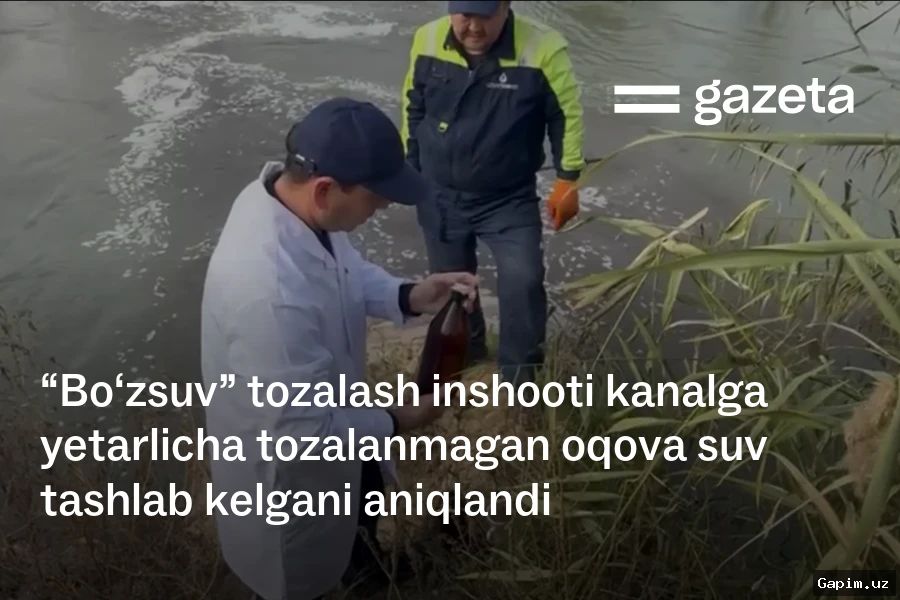
Authorities in Uzbekistan have identified a series of environmental violations linked to damage to the surrounding environment at the “Bozsuv” wastewater treatment facility in Zangiota district, Tashkent region. According to the National Committee on Ecology and Climate Change, environmental police carried out an ecological inspection at the strategic first-hazard-category facility following public complaints. The inspection found that technological processes had broken down, treatment efficiency had fallen from the required 70 percent to between 47.6 and 51.5 percent, and insufficiently treated water was being discharged into the Bozsuv canal. Laboratory analyses taken on November 11 and 13, 2026, showed that nine of 13 pollutants exceeded permissible levels by several tens of times, causing a strong foul odor in nearby areas.
Key Takeaways: Inspectors found treatment efficiency had dropped to 47.6−51.5 percent and nine pollutants exceeded norms by several tens of times. Facility management accepted wastewater from large textile, paper-recycling, poultry and other industrial enterprises containing heavy chemical dyes and toxic substances without local treatment, while 23,541 tons of waste were reportedly dumped illegally on open land each year. Additional compensation was assessed for environmental damage, a financial sanction was imposed, and a mandatory 15-point remediation order was issued.
Context and Causes
The inspection found that facility managers violated requirements of Cabinet of Ministers Resolution No. 11 of February 3, 2010, by accepting wastewater from large textile, paper-recycling, poultry and other production enterprises containing heavy chemical dyes and toxic substances without local treatment. Management did not disconnect those enterprises from the network or notify ecological authorities. In addition, requirements set out in the 2024 conclusion of the State Environmental Expertise remained unfulfilled, including modernization of the facility, construction of an additional treatment complex and introduction of automated monitoring of wastewater quality. These failures are described as the main reason technological processes broke down and insufficiently treated water entered the canal.
Measures and Next Steps
On November 17, 2026, facility employees obstructed environmental police and irrigation specialists from measuring the volume of water discharged into the Bozsuv canal at discharge point No. 3. Company reports showed annual wastewater volume reduced by 131.3 million cubic meters, or 54 percent, compared with 2023, but the reason was not supported by documents. Nine of 15 pollutants — including petroleum products, heavy metals, synthetic surfactants, chromium and others — had been concealed in reports for years, while no reports were submitted for the first and second quarters of 2026.
According to the committee, 23,541 tons of waste generated annually at the facility, mainly hazardous sludge, was not disposed of in the established manner and was illegally dumped on open land. Although the facility is located in Zangiota district of Tashkent region, responsible officials of the Tashkent City Ecology Department accepted incorrectly prepared reports. The department’s laboratory did not conduct control analyses during 2026 and did not require results for 15 substances, allowing the enterprise to avoid large compensation payments.
A recalculation was carried out and additional compensation was charged for damage to the environment. A financial sanction was applied under Article 55 of the Law on Nature Protection, and a mandatory 15-point order was issued to eliminate deficiencies. If the requirements are not fulfilled within the set period, a lawsuit will be filed with the Economic Court seeking suspension of the facility’s operations. A service inspection has been appointed for responsible employees of the Tashkent City Ecology Department, and all collected documents have been sent to the Prosecutor General’s Office for legal assessment.
Source: www.gazeta.uz