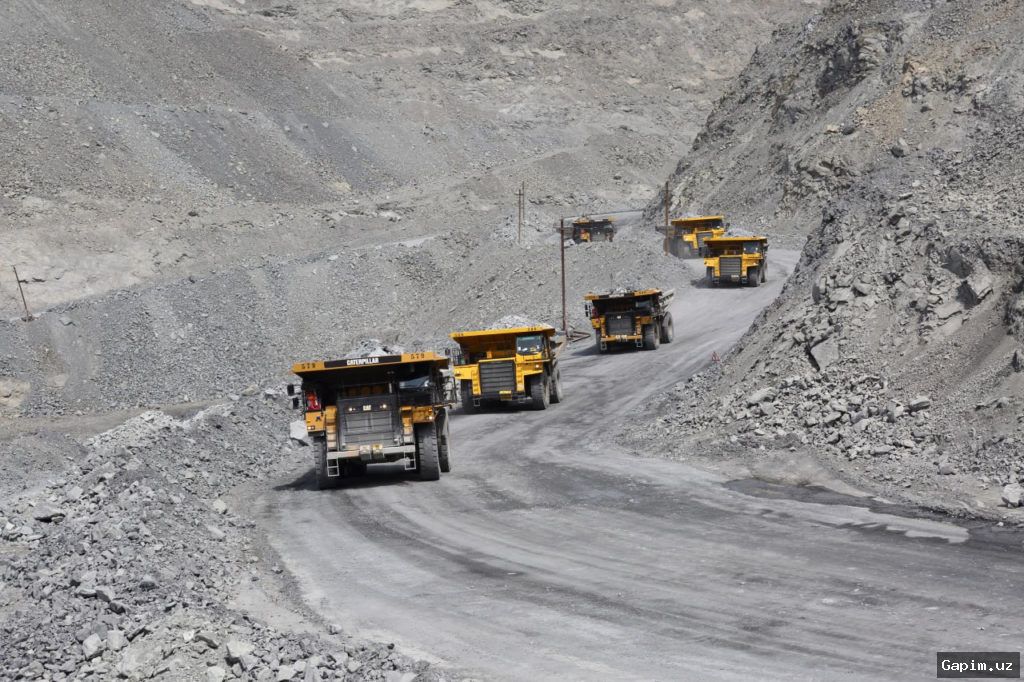
Large mining enterprises in Uzbekistan have identified 137 production tasks requiring scientific solutions, while research institutes and universities have offered 45 developments and patents in response. The interaction between science and industry was discussed on November 24 at a meeting hosted by the Center for Economic Research and Reforms (CERR), attended by representatives of the Academy of Sciences, relevant ministries, the Innovation Development Agency, the Uzbek Technological Metals Combine (TMK), research institutes and universities. The meeting focused on deep processing of mineral raw materials, adoption of new technologies and production of high value-added goods.
Key Takeaways: Uzbekistan's major mining enterprises identified 137 production challenges requiring scientific solutions, and research organizations proposed 45 developments and patents. Seven specialized research and educational institutions have been engaged in joint work with enterprises, while TMK is developing more than 140 projects worth $4.2 billion. Uzbekistan plans to expand critical materials production from five to 16 types and expects output of 16 critical materials to exceed $2.7 billion by 2030.
Context and Background
Shahlokhon Turdikulova, vice president of the Academy of Sciences, said enterprises had set out 137 production tasks and research organizations had proposed 45 developments. The next stage is expected to be testing the proposed solutions directly at production sites. Joint work with enterprises has already involved seven specialized research and educational institutions, with key areas including higher production efficiency, lower costs and development of new product types. Deputy Minister of Mining Industry and Geology Ural Yusupov said that under presidential decree No. PP-276 of July 24, 2026, a special system for identifying technological problems at enterprises and finding scientific and innovative solutions has been developed; it is currently operating in test mode, and production combines across the republic have generated more than 50 ideas through the mechanism.
Key Details and Outlook
Amir Abidov, deputy chairman of the TMK board, said the combine has mastered production of five critical materials, including tungsten, molybdenum and rhenium, and is developing more than 140 projects with total investment of $4.2 billion, including projects related to ultra-pure metals. Participants also discussed development of tungsten and molybdenum clusters, creation of joint research centers and startup consortia, and mechanisms for financing scientific projects and purchasing technological solutions. The push is linked to Uzbekistan's plan to expand critical materials production from five to 16 types, a task set by President Shavkat Mirziyoyev at a meeting on November 5. The new directions include nickel, cobalt, graphite, antimony, tin, manganese, platinum, vanadium, mercury and copper, and production of 16 critical materials is expected to exceed $2.7 billion by 2030.
The broader context includes talks with foreign partners: on October 19, Mirziyoyev met leaders of U.S. companies Wabtec and Traxys to review projects on critical mineral processing, locomotive supplies with long-term servicing and a service center for mining equipment. The CERR meeting ended with preliminary agreements on further science-industry cooperation and training seminars on public procurement. Next steps include testing the 45 proposed solutions at production sites, launching joint projects with the seven engaged institutions and moving the problem-identification system out of test mode, which could help scale enterprise ideas into deployable technologies.
Source: podrobno.uz