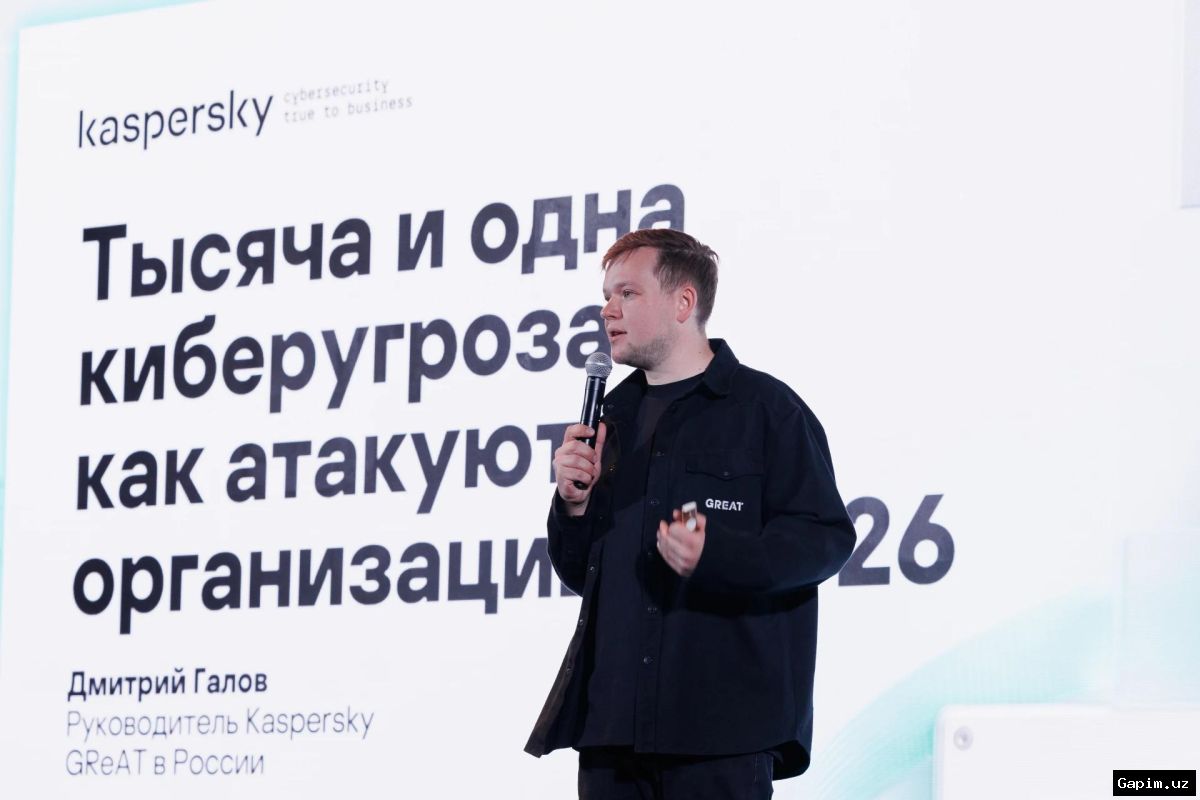
In November, experts at Kaspersky Laboratory said they had detected for the first time in their practice a cyberattack carried out independently by artificial intelligence: after several days of unsuccessful attempts, hackers handed the task of accessing administrators' data to the CyberStrikeAI system, and the language model independently studied the victim's network and gained access to administrators' accounts — that is, to the entire organization's network — within three days. The finding was announced on November 16 at the Kaspersky CyberSecurity Weekend meeting in Tashkent, an event devoted to cybersecurity culture, where experts discussed AI-assisted attacks, threats to businesses and ordinary users, online risks for children, and "cyber fatigue."
Key Takeaways: From January to September 2026, local threats affected 53.2% of devices with Kaspersky products in Uzbekistan, while malware attempted to reach 29.4% of users and nearly 14% of corporate clients through the internet; corporate customers faced infection attempts in 44.1% of cases; over nine months, protection software blocked almost 2.1 million attempts to open phishing sites, stealer-based attacks rose 19%, and the number of scammers increased 36%.
Context and Background
Kaspersky presented Uzbekistan statistics and singled out local malicious files delivered via USB drives, encrypted documents, or fake software installers as a separate risk; infection attempts among corporate customers were recorded in 44.1% of cases. Company employees also fall for traps even in training mailings: 13% opened fake emails about expired passwords, 7% opened emails about approval of a corporate ChatGPT account, and 6% opened emails about violations related to voluntary medical insurance policies. The figures show that phishing attacks still exploit the human factor effectively.
Outlook and Key Details
Anna Kulashova, vice president for business development in Russia and the CIS, compared Tashkent to a city with more than 2,000 years of history that has repeatedly "restored" itself and can recover; she said business today needs the same resilience. Taking into account AI's ability to find vulnerabilities and the speed with which they are exploited after discovery, she warned: "We can no longer say that we are building walls and they cannot be overcome; unfortunately, they most likely can be." She sees potential new threats in AI agents: unlike a chatbot, an agent makes decisions itself, launches tools, and gains access to data, so it combines risks related to AI itself, cybersecurity, operations, insider activity, and corporate governance at the same time.
Vibecoding, or creating applications through text prompts to AI, is also unsafe: according to Veracode, 45% of code generated by models contains vulnerabilities. Kulashova advised treating it as a "cheat sheet" that still must be checked, and if code is written by one agent within one large language model, checking it through another agent in another model, preferably one belonging to another country. In an interview with the newspaper, she listed consequences of attacks on companies, saying everything begins with fraud and phishing and then continues with theft of corporate secrets; the problem of "cyber fatigue" caused by constant protection rules was also noted, and organizations were urged to strengthen not only technology but also employee literacy and security culture.
Source: www.gazeta.uz