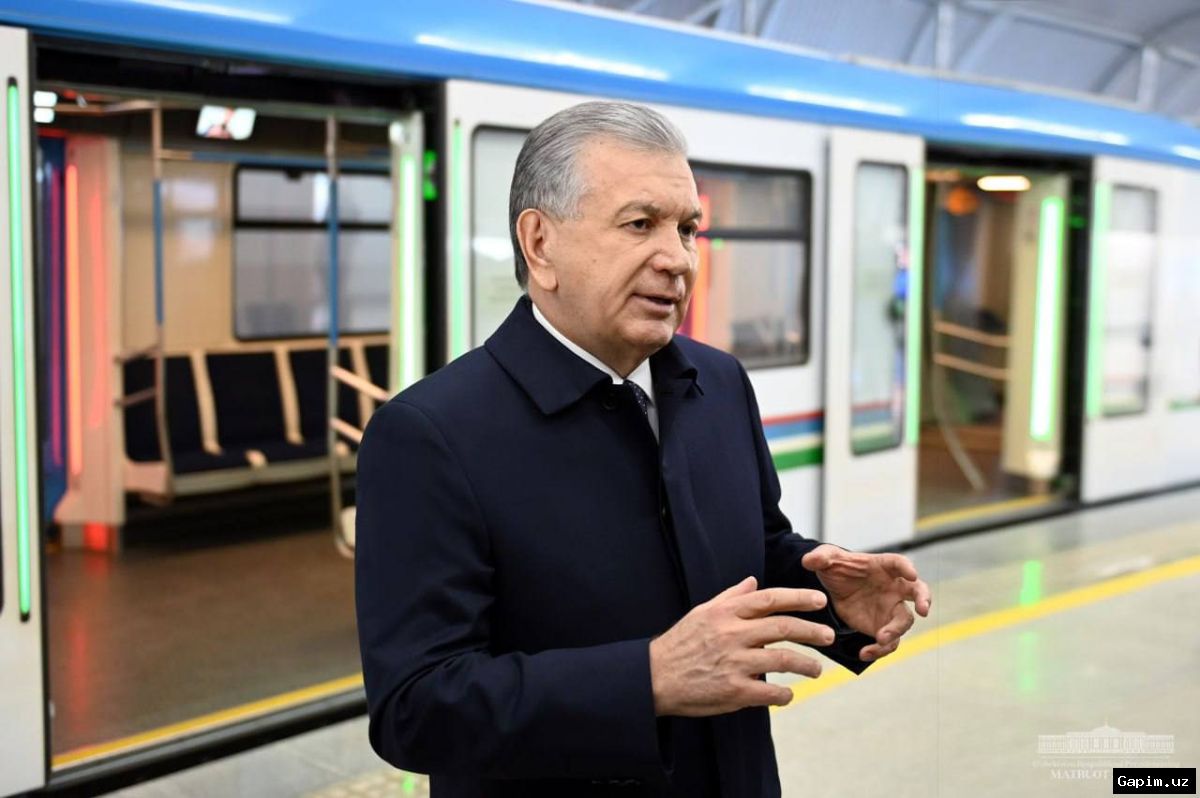
In Tashkent, 46% of passenger traffic is accounted for by the metro, while daily metro use has increased by 25%, President Shavkat Mirziyoyev said at a meeting on Nov. 27. According to the head of state, the number of daily metro passengers is expected to reach 1.3 million by the end of the year. The president noted crowding at stations and queues when boarding trains, emphasizing that renewal of the metro fleet will continue.
Key Takeaways: The metro accounts for 46% of passenger traffic in Tashkent, and daily use has risen by 25%. Daily passengers are expected to reach 1.3 million by the end of the year. Next year, 28 new five-car trains are to be delivered, while 40 existing four-car trains are to be converted into five-car trains.
Context and Historical Background
The Tashkent metro currently has 50 stations, including 19 surface stations. The capital’s metro consists of four lines — Chilonzor (17 stations), Uzbekistan (11 stations), Yunusobod (8 stations) and the “30th Anniversary of Uzbekistan’s Independence” surface ring line (14 stations) — with a total route length of about 71 kilometers. Construction of the surface metro in Tashkent began in 2017 on the initiative of President Shavkat Mirziyoyev; on Aug. 30, 2020, the first section of the ring line, from “Dostlik-2” (now “Technopark”) to “Qo’yliq,” covering 11 kilometers and seven stations, was launched, and on Dec. 26 of the same year the 6.2-kilometer Sergeli surface line with five stations opened as a continuation of the Chilonzor line. In the next phase, five more stations over 7.7 kilometers opened on the ring line between “Qo’yliq” and “Quruvchilar” on April 25, 2023, and on March 11, 2024, the final two stations, “Turon” and “Qipchoq” (3.8 km), were launched, connecting the surface ring line with the Sergeli branch of the Chilonzor line.
Outlook and Additional Details
“If we had not built the metro from the first day, there would be a collapse on the surface in Tashkent today,” Shavkat Mirziyoyev said. The president noted crowding at stations and queues when boarding trains, emphasizing that renewal of the metro fleet will continue. Specifically, 28 new five-car trains are to be delivered next year, while 40 existing four-car trains are to be converted into five-car trains. These steps are aimed at strengthening the metro’s role in the capital’s transport system.
Going forward, fleet renewal and passenger-flow management are expected to remain key priorities. Officials plan to bring daily passengers to 1.3 million by the end of the year, while the 50-station network of about 71 kilometers remains an important part of Tashkent’s transport infrastructure.
Source: www.gazeta.uz