On March 5, 1946, former British Prime Minister Winston Churchill delivered a historic speech at Westminster College in Fulton, Missouri, USA, before thousands of listeners, including then-US President Harry Truman. Although Churchill called this address the "Sinews of Peace," it entered history as the "Iron Curtain Speech." The speech was primarily dedicated to the post-war world order and preventing new global conflicts.
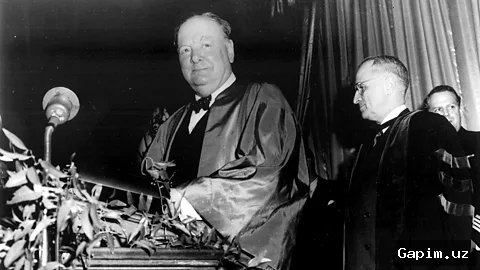
In his address, Churchill particularly focused on the political and ideological ambitions of the Soviet Union, which continued after the war ended, and declared that an "iron curtain" had descended across Europe between East and West. He expressed concerns about the USSR's aspirations to strengthen its influence in Central and Eastern Europe, increasingly promote communist ideology, and even impose it by force. Churchill also called for close cooperation between the US and the British Commonwealth to preserve peace, deepening the "special relationship" of English-speaking nations, and enhancing military and strategic collaboration, including through the United Nations.
In short, through this speech, the politician emphasized the necessity of agreements with the USSR within the UN framework, precisely that the alliance of Western democratic states must become a factor containing Soviet influence and preventing a new world war. However, Churchill was not in any government position at the time of the speech—he had served as Prime Minister from 1940 to 1945, but by 1946, the authority to make key decisions was no longer in his hands. His visit to the US was unofficial—not as a head of state or official representative of Great Britain, but as a private individual at the invitation of Westminster College and personally President Truman.
Nevertheless, his words were received as a manifesto about a new stage in international politics, provoked a sharp reaction in the USSR, and became one of the symbols of the start of the "Cold War." Stalin openly responded to Churchill, calling his words "a dangerous act aimed at sowing seeds of discord between allied states and complicating their cooperation." Not content with this, he equated Churchill with Adolf Hitler: if Hitler preached the superiority of the Aryan race, Churchill, in Stalin's view, was a proponent of the world domination of English-speaking peoples.
Despite Stalin's refutations and justificatory statements about the USSR's position, Churchill's warnings and appeals proved justified. In 1944-1945, Soviet troops had entered Central and Eastern European countries. But the Red Army was in no hurry to leave the region after the war ended, instead consolidating its de facto position as the main military force and preparing the ground for subsequent political pressure. In March 1946, in Bulgaria, Romania, Czechoslovakia, Poland, and Hungary, despite the formal preservation of multi-party systems, conditions were being created to establish stable Soviet control over local authorities.
Source: www.gazeta.uz