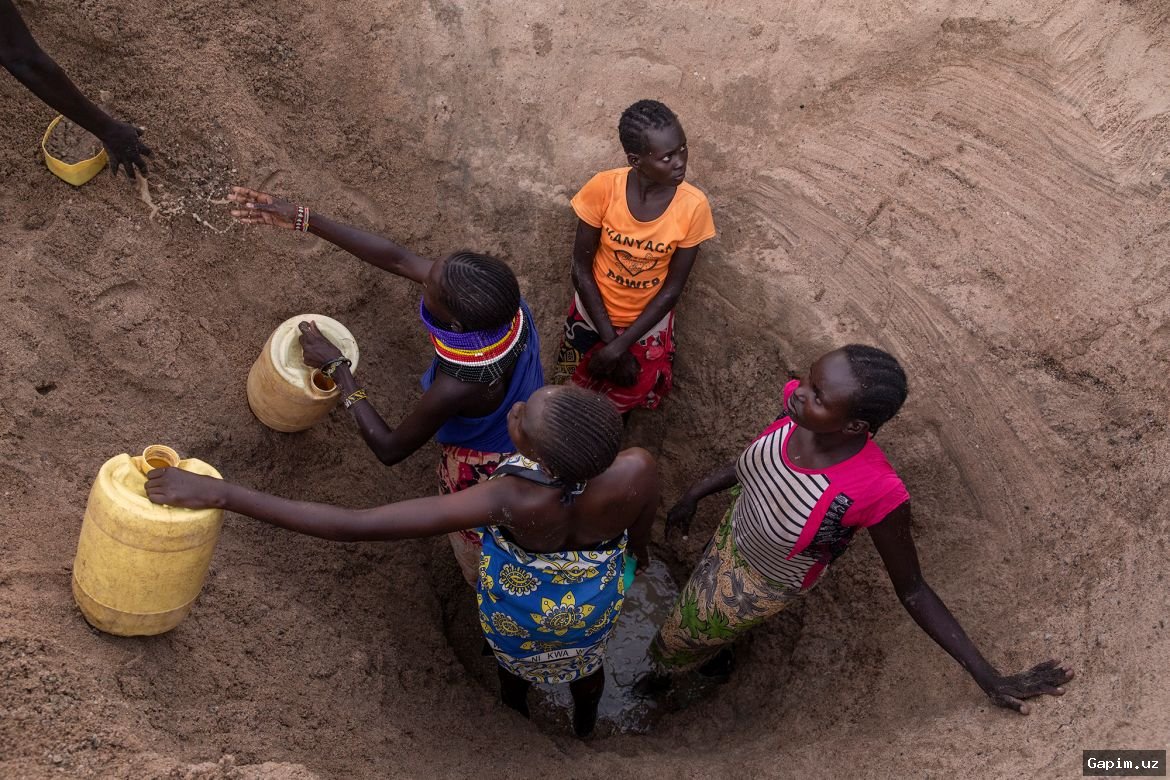
In Kainama, Turkana County, Kenya, Veronica Akalapatan and her neighbors walk several kilometers each day to a half-dried-up well surrounded by the parched earth of northern Kenya. This dug-out hole in the ground with a wooden ladder is the only water source in the area. Hundreds of people from several villages and their livestock share the well, most waiting hours to fill small plastic buckets with meager amounts of unclean water. Akalapatan states, "Once we get here, we dig for water in the well and collect fruit. We wait for the water to fill the well. We take turns to fetch it because there is so little. There are many of us, and sometimes we fight over it."
Despite it being the rainy season, weather experts warn that Turkana and other arid regions may receive little relief. Authorities say drought is once again occurring, with 23 of Kenya’s 47 counties affected. An estimated 3.4 million people do not have enough to eat, at least 800,000 children show signs of malnutrition, and livestock – the backbone of pastoral life – are dying. In Turkana alone, 350,000 households are on the brink of starvation. Turkana elder Peter Longiron Aemun tells Al Jazeera, "We are suffering from hunger. We don’t have water. Our livestock have died. We have nothing. We used to burn charcoal, but there are no acacia trees any more."
Kenya is still recovering from one of its worst droughts in 40 years, which gripped the country between 2020 and 2023. The new weather crisis will likely worsen the situation. But at the same time, experts note a stark paradox: scarcity amid abundance. While families face acute water shortages and hunger – with boreholes broken down, and wells and streams dried up – Lake Turkana’s water levels have risen in recent years, displacing some shoreline communities. In other areas, sudden heavy rains trigger flash floods in normally dry riverbeds – known locally as luggas – yet the land remains largely barren. The water comes too fast, runs off too quickly, and cannot sustain agriculture.
At the same time, while droughts lessen food supplies and global donor funding cuts have reduced food aid, not too far away, experts say, there is a surplus of food that does not reach those who need it. According to a September report by the World Resources Institute (WRI), in Kenya, a quarter of the population faces severe food insecurity, even as up to 40% of the food produced is lost or wasted each year. WRI researchers noted that food loss occurs on farms, and during the handling, storage, and transportation of supplies, while food waste occurs in households, restaurants, and in the retail sphere.
Security adds another layer of strain. Competition over water and pasture fuels tensions, cattle raids persist, armed bandits operate in remote areas, and security forces struggle to contain violence amid logistical and political challenges. Joseph Kamande, a food trader in Wangige in central Kenya, says, "The biggest problem in drought areas is security." Still, he believes the country has the potential to feed itself with better planning.
In Turkana, though there is severe drought, there are also untapped natural resources. Hundreds of meters underground are multiple aquifers, layers of rock and soil containing water. The government is hoping to tap into these sources. In 2013, two major aquifers were discovered – the Napuu aquifer and the Lotikipi aquifer. The largest covers roughly 5,000 km² and holds about 250 trillion liters of water. It is said to have the capacity to supply Kenya with water for decades. However, much of the water is salty and expensive to purify, so the project has stalled. Turkana County Water Director Paul Lotum states, "The big challenge is salinity. The national government and partners are mapping out pockets where water is safe and reliable. We are working bit by bit to harness it for communities."
Until then, relief food remains essential for Turkana communities. The government’s disaster management teams and other agencies are distributing water and food. But supplies are stretched thin. And getting aid to those who need it most is nearly impossible in some areas. Jacob Ekaran, Turkana’s coordinator for the National Drought Management Authority, says, "Most government organizations are either closed or running leaner programs. The resource basket has shrunk. But the government is trying to do more with what it has."
When supplies run low, many people turn to wild berries and fruits. In Lopur village, resident Akal Loyeit Etangana harvests berries that she then cooks in a small pot over an outdoor fire. She says she has not had a proper meal in two weeks, so the fruit mixture keeps hunger away. Still, it carries almost no nutritional value. In another village, Napeillim, resident Christine Kiepa worries that there is no food. She asks, "I try to look for food. Sometimes it’s not there. If I can’t find food, how do I survive?"
Villages in the region are slowly emptying. Male herders, who are usually the providers for their families, have moved to neighboring counties in search of pasture and water for their dying livestock. Only the elderly, women, young children, and the weakest animals remain in the homesteads. Still, there have been some gains in the region. Since Kenya adopted a devolved system of government in 2013, Turkana has seen new schools and health centers built, irrigation schemes launched, boreholes drilled, and some roads tarmacked. Officials say investments in drought response have strengthened resilience.
Ekaran from the drought management authority notes, "In the past, drought always degenerated into disaster. You would see reports of deaths. We are coming from one of the worst droughts in 40 years, but we did not record deaths. That is because of resilience building." For generations, northern Kenya’s nomadic communities have depended on livestock. But climate change is forcing a reckoning. Calls for diversification – irrigation, drought-resistant crops and trees, large dams – have grown louder. Turkana coordinator for the Red Cross, Rukia Abubakar, states, "We can change our community mindset. We can plant drought-resistant trees. We can do irrigation. Our soil is good for crop farming."
These proposals are not new. They have surfaced after every drought, repeated in policy papers and political speeches. Yet for many people in Turkana, the cycle feels painfully familiar, and daily survival remains precarious. Back in Kainama, Akalapatan and her neighbors walk back from the water well through the vast, arid landscape, carrying a collection of filled yellow plastic buckets. They finally return to their small community of thatched huts. Akalapatan has managed to collect 20 liters of water for her family for the day. Her son eagerly fills a cup and gulps it down. But she knows that what she has is barely enough for everyone, and she will soon have to make the journey to the well again.
Source: www.aljazeera.com