US President Donald Trump issued a typically combative statement following recent events in the war with Iran. Israel struck the South Pars gas field, part of the world's largest natural gas reservoir shared by Iran and Qatar, prompting Tehran to retaliate against an energy complex in Qatar. These attacks caused a spike in energy prices and fueled Trump's anger, as he took to his Truth Social platform to respond.
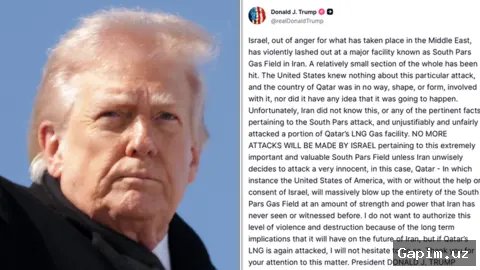
In his post, Trump threatened Iran again and claimed he had no knowledge of Israel's attack plans. However, Israeli newspapers, including Yedioth Ahronoth and Israel Hayom, reported that the strike was coordinated in advance with the United States and agreed upon between Prime Minister Benjamin Netanyahu and Trump, contradicting the president's assertions and casting doubt on the veracity of his statements. This aligns with a pattern where Trump's claims often face scrutiny and alleged inconsistencies.
Trump described Israel's action as lashing out "out of anger," using language typically reserved for Iran's retaliatory moves rather than a deliberate military operation by a close ally. He also resorted to all caps in writing, "NO MORE ATTACKS WILL BE MADE BY ISRAEL pertaining to this extremely important and valuable South Pars Field," unless Iran attacks Qatar, which could be seen as a rebuke to Netanyahu or an attempt to assert control. This reflects the growing tensions within the US-Israel alliance, as the Trump administration allegedly struggles to manage the war's unpredictable dynamics.
Strategic divergences between Israel and the US are becoming more apparent. Israeli officials, such as embassy spokesman Alex Gandler, emphasize that the two countries are aligned on goals regarding the Iranian government, the IRGC, and nuclear programs. Yet, Israel has been more consistent in seeking regime change in Iran, framing the South Pars attack as part of efforts to undermine Tehran's authority, while the US has focused on degrading Iran's missile and drone capabilities. This highlights the friction in their wartime strategies, with Israel pushing for more aggressive measures against the Iranian leadership.
Trump's statement underscores the war's impact on US politics. Rising oil and gas prices, partly due to the tit-for-tat attacks, and lack of progress in securing shipping through the Strait of Hormuz have increased impatience within the administration. Support for the war remains high in Israel but is less pronounced in the US, potentially costing Trump's Republican Party in upcoming elections. The conflict continues to present unforeseen challenges, complicating the alliance and revealing the difficulties of coordinating military efforts between the two nations.
Source: www.bbc.com