The United States National Aeronautics and Space Administration (NASA) announced the release of the first photos taken by the 'Artemis II' mission crew during a flyby of the Moon's far side. As part of this mission, the 'Orion' spacecraft orbited the Moon for approximately seven hours, flying at an altitude of about 6,400 kilometers from its surface. The astronauts traveled 406,771 kilometers from Earth, setting a new record in the history of human spaceflight, marking a significant milestone in space exploration efforts.
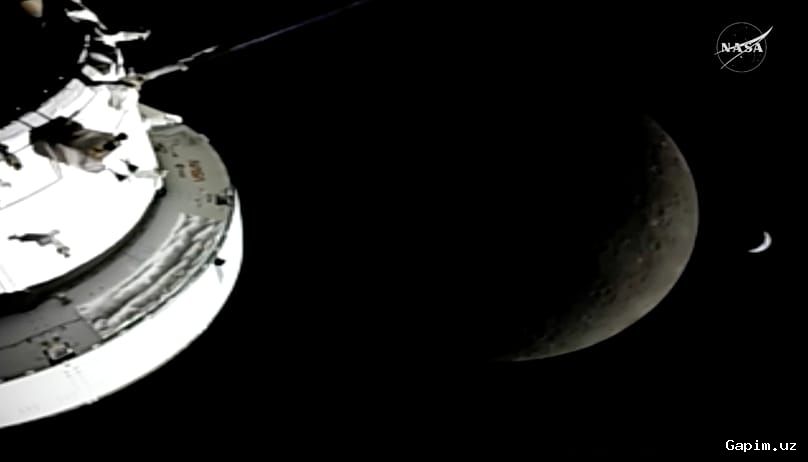
While flying over the Moon's far side, the crew captured images of its surface and witnessed the phenomena of 'Earthset' and 'Earthrise'. During 'Earthset', our planet disappeared behind the lunar horizon, providing the astronauts with a unique view. Additionally, they observed a solar eclipse lasting nearly an hour when the spacecraft, Moon, and Sun aligned, offering valuable insights into cosmic events.
On April 6 at 6:41 PM Eastern Time in the US, a sealed photograph of 'Earthset' was taken through the 'Orion' spacecraft's window. The image shows Earth's dark side shrouded in night, with dense clouds visible over the Australia and Oceania region on the daylit side. During the total solar eclipse, the Moon completely blocked the Sun, allowing stars to appear clearly, which are typically dimmed by lunar brightness.
The photos also depict the beginning of the Sun emerging from behind the Moon and other celestial objects, such as the planet Venus. The eastern edge of the South Pole-Aitken Basin was photographed, which is the largest known crater on the Moon's far side. The 'Artemis II' crew—Reid Wiseman, Victor Glover, Christina Koch, and Jeremy Hansen—posed for a commemorative photo inside the 'Orion' spacecraft, highlighting the mission's importance for humanity.
Source: www.gazeta.uz