Fitch Ratings, the international credit rating agency, reported that Uzbekistan privatized approximately $5.1 billion in state assets between 2021 and 2025. Consequently, the agency revised its outlook on the country's rating from 'stable' to 'positive'.
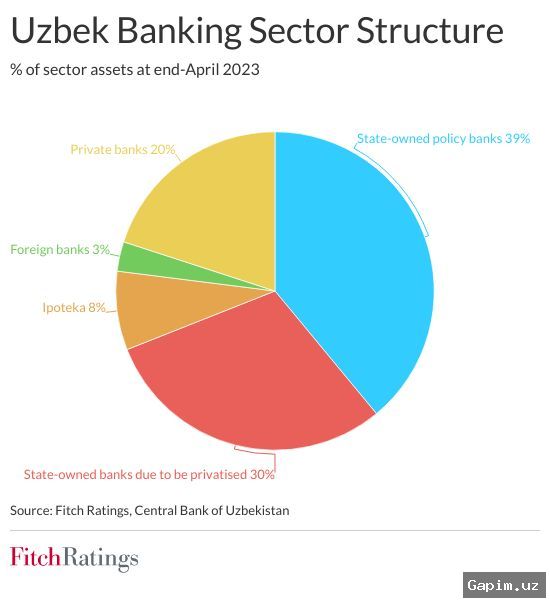
According to preliminary estimates, privatization volumes reached $1.6 billion in 2025 alone. Fitch noted that reforms and privatization of state-owned enterprises continue in Uzbekistan, with a reduction in the number of companies where the state holds a 50% or greater stake.
The agency also highlighted the placement of the National Investment Fund on international capital markets in May of this year. Fitch expects further reductions in energy and gas subsidies in 2026, from approximately 1.4% of GDP in 2023 to 0.3%.
Fitch projects Uzbekistan's economy to grow by 6% in 2026, with average growth of 6.4% in 2027-2028 and about 6.3% in the medium term. The agency believes that ongoing reforms, favorable commodity demand, and stable remittances will support the economy.
However, Fitch's 2026 forecasts incorporate uncertainties related to the war in Iran, primarily through indirect channels. While Uzbekistan's direct trade dependence on Iran is minimal, about 8% of imports and 4% of exports pass through Iranian ports. Alternative routes are currently being explored.
Rising oil and gas prices could impact economic growth and inflation, but long-term energy contracts mitigate some risks. Fitch also noted Uzbekistan's significant dependence on Russia: in 2025, Russia accounted for 12.8% of exports and about 70% of remittances, despite their geographical diversification.
In 2025, Uzbekistan's consolidated budget deficit stood at 2.1% of GDP, below the 3% target. Fitch attributed this to revenue overperformance, particularly due to high commodity prices, especially gold.
The agency expects the budget deficit to remain around 3% of GDP in the medium term. Fitch forecasts government debt to gradually decline from 32% of GDP in 2027-2028 to about 28%, well below Uzbekistan's statutory debt limit of 60% of GDP and the median for 'BB' rated countries (around 53%).
About 80% of debt is foreign-currency denominated and mostly concessional. However, in 2025, non-guaranteed external debt of state-owned enterprises amounted to 6.2% of GDP, and public-private partnership obligations to 4.9% of GDP, totaling approximately 11.1% of GDP.
A public financial management reform strategy for 2025-2030 is being implemented to strengthen budget and debt management. Assets of the Uzbekistan Fund for Reconstruction and Development (the sovereign wealth fund) stood at about 12.4% of GDP in 2025 (down from 14% in 2024), with foreign currency assets reaching about 4.2% of GDP.
Fitch also highlighted Uzbekistan's continued high dependence on commodities, making the external balance vulnerable to shocks. Gold's share in merchandise exports reached 41% in 2025, driven by a significant rise in global prices.
Source: www.gazeta.uz