Thailand has formally terminated a 2001 agreement with Cambodia, known as MOU 44, which was meant to provide a bilateral framework for resolving overlapping maritime claims in the Gulf of Thailand and jointly managing offshore resources.
The pact had largely failed to deliver results since its signing, despite five rounds of talks spanning over two decades. Even so, it remained one of the few standing mechanisms for dialogue between the two countries over the disputed maritime space.
Both Thailand and Cambodia claim ownership of the waters around several islands in this area, including Koh Kood. The popular tourist destination, controlled by Thailand, is believed to be sitting atop considerable — and so far untapped — oil and gas reserves.
The termination of MoU 44 is a "significant regression in bilateral relations, signaling a shift from collaborative resource management toward unilateral nationalist posturing," Pavin Chachavalpongpun, a professor at Kyoto University, told DW.
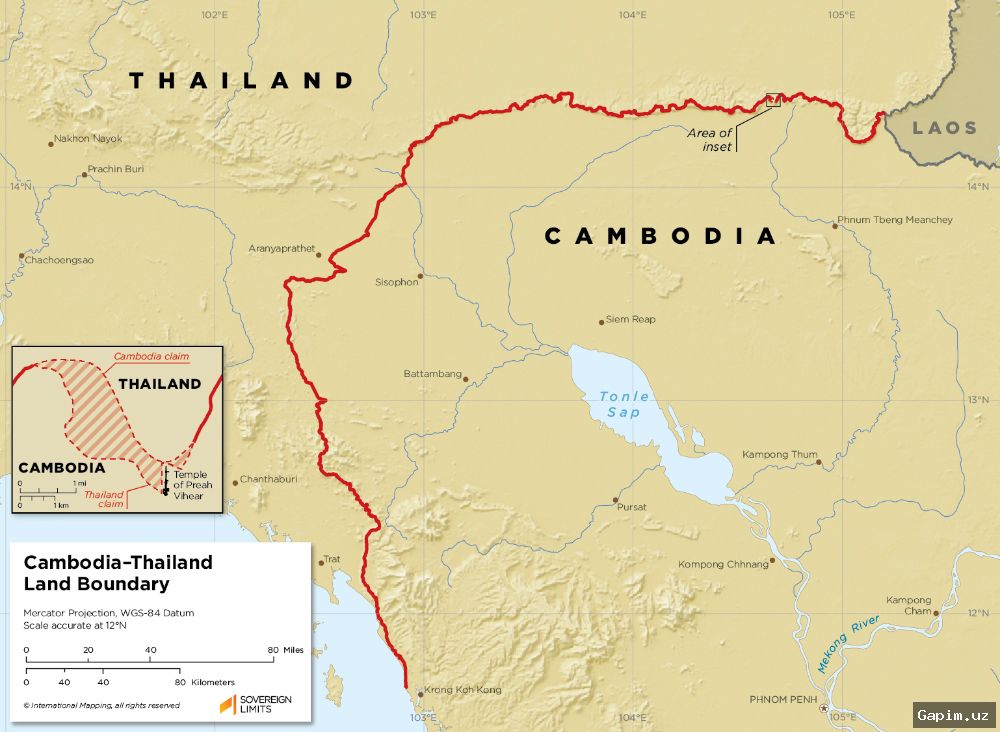
Since last July, the two countries have been locked in a deadly land conflict over ownership of several pieces of territory along their 800-kilometer border, with clashes killing at least 150 people and displacing hundreds of thousands.
The conflict has triggered a political crisis which ousted the Paetongtarn Shinawatra government in Thailand, with her critics accusing her of being too deferential to Cambodia's Hun Sen. Thailand now has a new prime minister, Anutin Charnvirakul, who took power as a caretaker leader in September before being voted in as the official head of government in March.
Anutin's government insists that the cancellation is not linked to the border fighting. Instead, they argue that MOU 44 failed to move forward after 35 years.
The Thai military benefits from the continuing tensions to boost pro-military nationalism, giving the Royal Thai Army independence from civilian government pushback, according to Paul Chambers, associate fellow at Singapore's ISEAS–Yusof Ishak Institute.
In December, Thai forces struck Cambodian casino and hotel complexes that Bangkok claimed were being used as scam centers and by the Cambodian military, allegations Phnom Penh rejected as a pretext for violating Cambodian sovereignty.
Cambodia has applied to the International Court of Justice and appealed to the US and China to pressure Thailand to accept international mediation. Cambodia previously succeeded against Thailand at the ICJ over Preah Vihear temple.
Last week, Phnom Penh said it would initiate a compulsory conciliation process under the UN Convention on the Law of the Sea (UNCLOS) after Bangkok backed away from MOU 44.
However, Cambodia is trying to fight in the court of international opinion while suffering from "reputational liabilities," said Sophal Ear, associate professor at Arizona State University. The country has become a major hub for transnational scam operations, with reports suggesting the illicit industry could be worth $12.5 billion annually.
Last year, the US and UK imposed unprecedented sanctions on Prince Group, one of Cambodia's largest conglomerates, and its chairman Chen Zhi. The Wall Street Journal recently used the term "Scambodia" in a headline, angering Phnom Penh.
"Scam compounds and criticism on Cambodia's restrictive political environment have been damaging Cambodia's ability to call out Thailand's aggression internationally, as Cambodia's soft power is probably at its lowest in decades," Virak Ou, founder of the Future Forum, told DW.
Source: www.dw.com