About an hour southeast of Konya, Turkey, lies one of the most exciting Neolithic finds of the 20th century – the densely populated settlement of Çatalhöyük. Occupied for 1,000 years from about 7000 to 6000 BC, it has drawn archaeologists since its discovery in 1958.
A recent genomics study published in Science revealed that Çatalhöyük’s gender dynamics made it unique among European Neolithic settlements. The discovery centers on matrilocality – women remained in their homes while males were more likely to move away upon reaching adulthood.
The study’s 46 authors estimated that “70 to 100% of the time, female offspring remained connected to buildings,” in contrast to other European Neolithic communities, which were patrilineal and patrilocal.
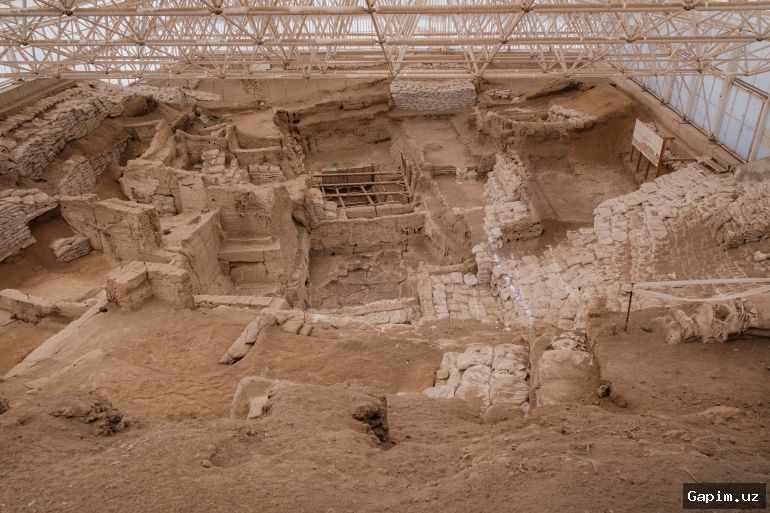
Çatalhöyük, a UNESCO World Heritage Site, is possibly the world’s first city with clusters of buildings, agricultural production, rituals and ornamentation. Its remains lie in two large tells formed over successive generations of building, demolition, and rebuilding.
Homes were built directly on top of one another; excavations have found about 18 layers. Inhabitants filled in lower levels, demolished upper structures, and built new homes on top. The two tells lie east and west of a now-dry river.
Population estimates range from 3,500 to 8,000. Housing clusters were so tightly packed that there were no streets or front doors; people moved across roofs. Entry was through ceiling hatches leading to a hearth.
On the opposite end from the hearth, clay platforms covered burial pits. Çatalhöyük lacked obvious worship or governance buildings, but some homes were more ornate with wall paintings and bull’s horns.
The genomic study screened 395 skeletons and found that female offspring remained in homes while males moved away. Grave goods analysis showed young females received up to five times as many items as boys.
Polish archaeologist Arek Marciniak: “We managed for the first time to identify sex of all these children’s skeletons. Girls and boys were in equal proportion, but all girls had highly sophisticated burial goods, not the boys.”
The study examined genomes of 131 individuals from 35 houses – the largest genomic dataset for Neolithic Anatolia. Most European Neolithic communities show patrilocal and patrilineal patterns, seen as precursors to patriarchy.
Ian Hodder, who directed excavation for over 20 years: “Why is Çatalhöyük matrilineal while soon after European Neolithic societies were patrilineal?” He noted matrilineality did not mean men were treated poorly; evidence points to social egalitarianism.
Female figurines, including the “Seated Woman of Çatalhöyük” (1961), hint at women’s high status. Debates continue whether they represent mother goddesses, ancestral women, or societal ideals.
Çatalhöyük shows no signs of organized violence, unlike other Neolithic communities. By 5700 BC, the east mound was abandoned. Today, matrilineal cultures persist among the Mosuo in China, Minangkabau in Indonesia, and Khasi in India.
Source: www.aljazeera.com