A new phase of restoration of the Sherdor Madrasah, one of the most recognizable monuments on Samarkand's Registan Square, has begun. The project, spanning 2025–2028, is supported by the U.S. Ambassador's Fund for Cultural Preservation (AFCP) with a $500,000 grant – the largest AFCP grant ever awarded in Uzbekistan.
The restoration is part of a broader Cultural Heritage Protection Agreement signed between Uzbekistan and the United States in 2023. A signing ceremony for a letter of intent to continue the project was held, attended by U.S. Under Secretary of State for Public Diplomacy Sarah Rodgers, Head of the Department of Creative Economy and Tourism of the Presidential Administration of Uzbekistan Gayane Umerova, and U.S. Ambassador to Uzbekistan Jonathan Henick.
Ambassador Henick and Umerova signed the letter, reaffirming commitment to the Action Plan under the 2023 cultural property agreement. Rodgers, Henick, and Umerova signed fallen facing tiles as a symbol of joint efforts in restoration and preservation.
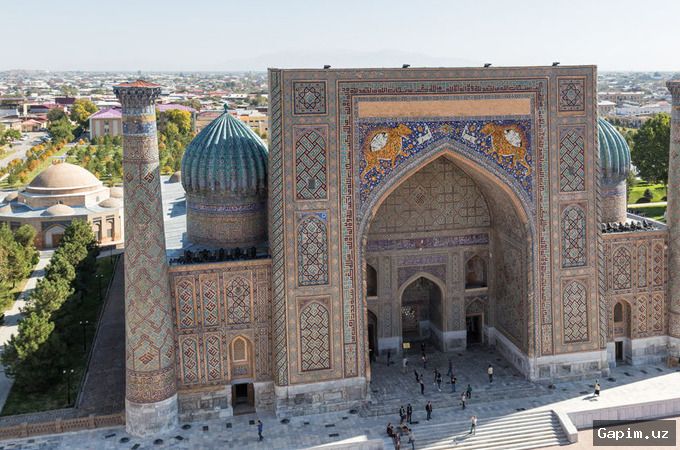
Built in the 17th century, the Sherdor Madrasah, along with the Ulugh Beg and Tillya-Kari madrasahs, forms the architectural ensemble of Registan. Its portal features predators, gazelles, and sun faces, making it globally recognizable. Guide Armida Nazaryan explained that while Islam prohibits depicting living beings in religious buildings, this tradition is broken here: the tiger is interpreted as a symbol of power or a student seeking knowledge.
Restoration is necessary due to decades of accumulated problems. Ceramic cladding renewed in the 1960s–1970s is deteriorating due to climate, moisture, temperature fluctuations, seismic activity, and groundwater. A 35-centimeter void between the cladding and main wall complicates work. Domes suffer from birds and vegetation.
Evren Rutbil, Director of the International Institute for Central Asian Studies, emphasized that the work is not a 'new build' but targeted intervention: only damaged areas will be restored, while preserved elements will be conserved and strengthened. The goal is to maintain historical appearance and technical safety.
One of the most challenging elements is the calligraphic inscription above the main entrance, which has sustained damage and inaccuracies from previous restorations. It is being recreated using traditional techniques to ensure new fragments do not clash with the monument.
Traditional knowledge is used for ceramic production, while conservation employs modern methods. Paints and glazes are fired at 1000–1300 degrees Celsius. Previously fired on saxaul wood, now gas and electric kilns are used. Masters strive to match historical samples in color and composition.
About 40 specialists, mostly local craftsmen, are involved in the project. This is crucial for preserving the continuity of Samarkand's ceramic, majolica, and mosaic traditions.
According to U.S. Embassy representative Anne Pirrelli, the Sherdor restoration is the largest of 14 AFCP projects in Uzbekistan, with total funding of about $1.5 million. Previous projects include the Tash-Khovli Palace in Khiva and the Langar-Ota complex in Kashkadarya.
In 2026, a new project 'Eternal Registan' is expected to launch, combining cultural heritage with digital technologies: creating 3D models of Registan for virtual tours and educational purposes.
Gayane Umerova expressed gratitude for the partnership, stating: 'Together we preserve not only one of the world's most outstanding architectural ensembles but also the traditions and craftsmanship that give it authentic meaning.' Ambassador Henick added: 'The masters are not just restoring tiles and mosaics – they are mastering methods that will preserve Uzbekistan's monuments for future generations.'
Source: podrobno.uz