Oil prices fell on Thursday after the United States and Iran signed an interim peace agreement, resuming a slide that was briefly interrupted by US President Donald Trump's warning that he could restart his military campaign. Brent crude dropped as much as 1.6 percent in Asian trading, returning to levels seen 24 hours earlier.
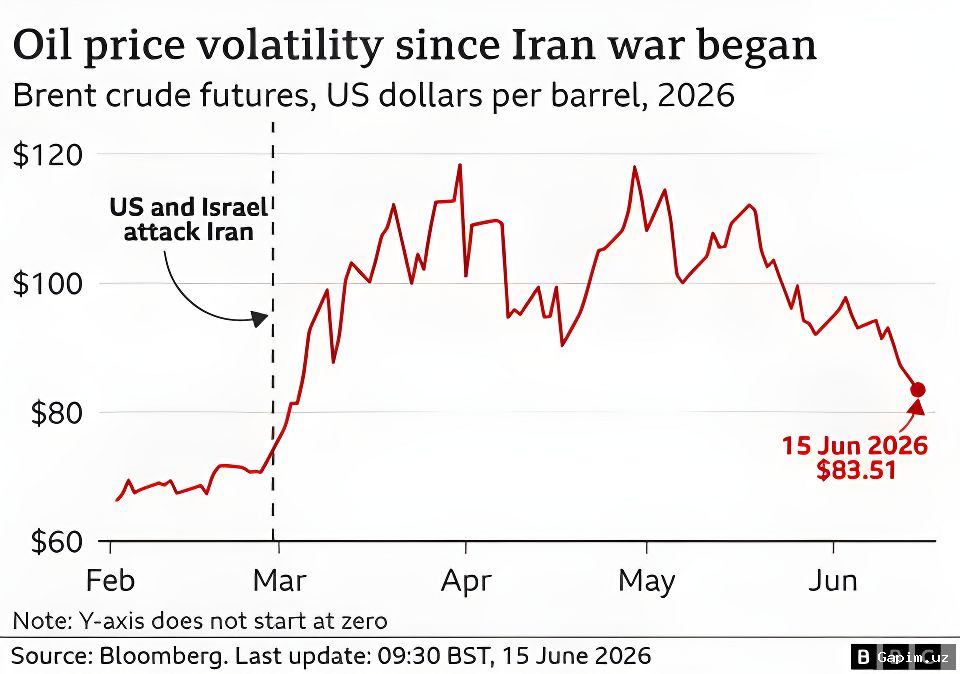
Brent futures for July delivery stood at $78.43 per barrel at 02:00 GMT, only about 7 percent higher than before the US and Israel launched their war on Iran on February 28. The decline followed several days of losses, though prices briefly spiked above $81 on Wednesday after Trump warned that the US could "go right back to dropping bombs" on Iran if it doesn't "behave."
Asian stock markets opened higher on renewed optimism for an end to nearly four months of disruption to global energy supply chains. Japan's Nikkei 225 rose 1.9 percent to an all-time high, South Korea's Kospi gained over 1 percent, and Taiwan's Taiex climbed about 1.3 percent. Hong Kong's Hang Seng Index bucked the trend, dropping 1.7 percent. US stock futures also climbed, with S&P 500 and Nasdaq Composite futures rising about 0.8 percent and 1.3 percent, respectively.
Pakistani Prime Minister Shehbaz Sharif, who mediated the negotiations, announced Wednesday that the US-Iran memorandum of understanding (MoU) had entered into force with "immediate effect." Sharif said Iran would "instantly reopen" the Strait of Hormuz and the US would "immediately" lift its naval blockade of Iranian ports. However, it remains unclear whether the announcement has had any tangible impact on maritime traffic in the critical waterway.
Shipping in the strait has been reduced to a fraction of peacetime levels due to the threat of Iranian missiles, drones, and mines, as well as the US blockade. While over 500 vessels are estimated to be waiting to exit the Gulf, shipping companies have expressed concern about the lack of clarity on how to ensure safety. The Baltic and International Maritime Council (BIMCO) said the US and Iran had yet to provide information on "key aspects such as timings and safe routes."
"Due to lack of details and a history of overly optimistic reassurances, we believe the security situation for the shipping industry remains volatile, and we still consider it very risky for ships to commence transits at this point," said Jakob Larsen, chief safety and security officer at BIMCO. "We advise shipowners to continue doing thorough risk assessments and appeal to all parties to put the safety of seafarers first."
Source: www.aljazeera.com