Toronto, Canada’s largest city, has recorded the worst air quality among major global cities as smoke from wildfires raging in northwestern Ontario drifts across the region and into the northeastern United States, prompting health warnings and evacuations.
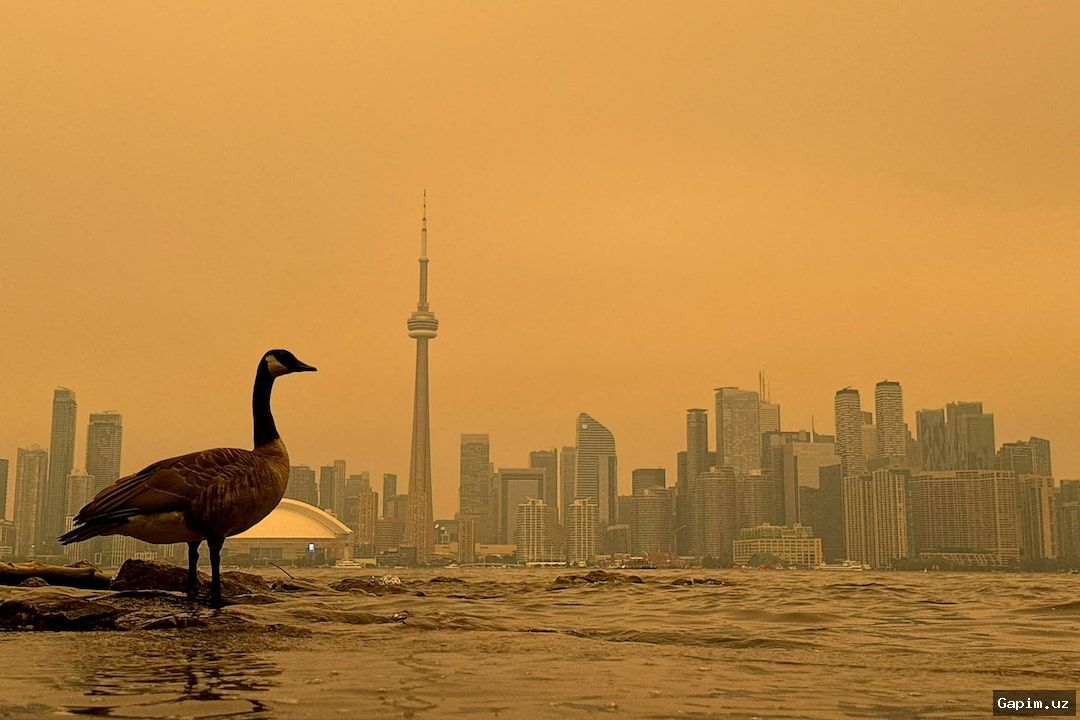
Environment Canada reported an Air Quality Health Index reading of 10+, classified as “very high risk,” for Toronto, with forecasts suggesting hazardous conditions could persist through Thursday night.
Swiss air quality technology firm IQAir ranked Toronto as having the most polluted air globally, surpassing Kinshasa, Democratic Republic of the Congo, and New Delhi, India.
“The biggest contributor to Toronto’s spike in air pollution right now is wildfires, though the higher-than-average temperatures are also playing a role,” IQAir’s Armen Araradian told AFP.
While Canada’s wildfire season has been relatively subdued compared to recent years, over 800 active fires are burning nationwide, with 112 considered out of control, mostly in Manitoba, Saskatchewan, and Ontario.
A viral social media video showed a Canadian National train engulfed in flames near Armstrong, Ontario. The railroad operator evacuated employees and local residents Monday night and suspended rail operations as a precaution.
Smoke has worsened air quality across several U.S. states, including Pennsylvania, New York, Connecticut, Massachusetts, Maine, and New Hampshire. New York City authorities urged residents to limit strenuous outdoor activities.
“We probably haven’t seen the worst of it yet for New York City… for the Great Lakes and upstate, and New England yet either,” said Dan Westervelt, Lamont associate research professor at Columbia University.
The FIFA World Cup final, scheduled for Sunday at an open-air stadium in New Jersey, is expected to draw 80,000 attendees, with another 50,000 watching from New York City’s Central Park, where skies appeared hazy.
Canadian officials noted that while the wildfire season started slower than in 2023 or 2025, warmer-than-usual temperatures have increased fire risk. So far, 1.9 million hectares (4.7 million acres) have burned.
Greg Evans, a professor at the University of Toronto, warned that cities must prepare for more frequent occurrences of combined extreme heat and wildfire smoke in the coming decades.
Source: www.aljazeera.com