In Gaza, the Israeli military only needs to move a yellow concrete block a few meters to rewrite the geography on the ground. Originally placed as field markers following the ceasefire to separate Israeli forces from areas slated for withdrawal, these blocks have transformed into an advancing front line.
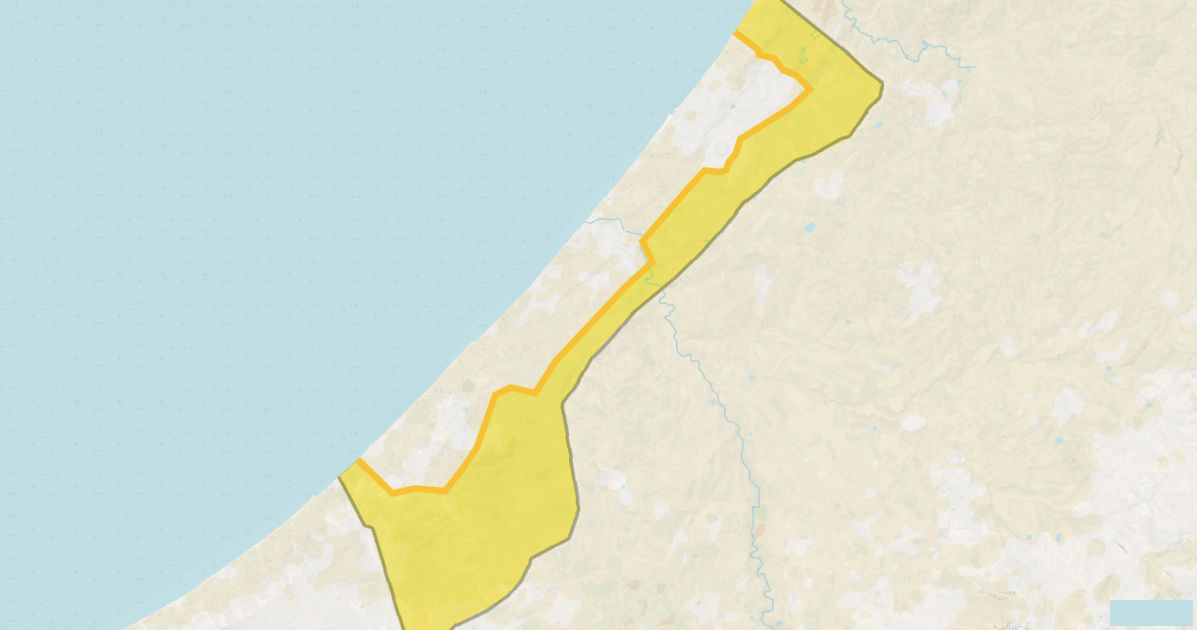
According to the Office for the Coordination of Humanitarian Affairs (OCHA), this restricted access zone, which Israel calls the 'Yellow Line', expanded to cover 64.9 percent of the Gaza Strip by June 2026, up from 53 percent earlier in the year.
For Palestinians, these shifting markers are a daily reality of forced displacement. The Government Media Office in Gaza has recorded 3,795 Israeli violations of the ceasefire, resulting in 1,168 Palestinians killed since the 'ceasefire' agreement in October last year. UN data indicates that roughly a third of these deaths occurred in areas near this advancing demarcation line.
Following evacuation orders broadcast by Israeli quadcopters on the evening of Friday, July 17, Hazem Saeed, a resident of eastern Deir el-Balah, told Al Jazeera that military vehicles advanced under the cover of darkness. They pushed the yellow blocks between 300 and 350 meters westwards, threatening to shoot anyone who refused to leave.
The sudden shift placed the concrete barriers directly on Sultan Othman Street, confiscating vast agricultural and residential lands belonging to the Abu Ghraba, Abu Ghaliba, Abu Blima, and al-Tarhouni families. Saeed explained that the yellow cube is now placed two to four meters from citizens' homes.
In the Zeitoun neighborhood, east of Gaza City, 71 displaced families set up a makeshift camp called Ahl al-Sumud (People of Steadfastness) on Salah al-Din Street, just 70 meters from the 'Yellow Line'. Camp supervisor Ramadan Abu Ammo told Al Jazeera that they did not choose the location for safety, but they had nowhere else to go. He added that his parents remain buried under the rubble of his nearby home, as rescue teams are barred from accessing the newly restricted area.
In northern Gaza, the advancement of the 'Yellow Line' is accompanied by a complete erasure of the landscape. Resident Suhail Ouda told Al Jazeera that the line had advanced up to 1.5 km, and Israeli bulldozers flatten homes daily, while quadcopters detonate remaining structures behind the line.
Political analyst Ahmed al-Tanani observed that Israel is transitioning from a phased withdrawal to expanding its territorial grip. He warned that creating military posts along the line mirrors what followed the 1967 war, when the West Bank was occupied. An investigation by Al Jazeera's Open Source Unit identified 40 permanent Israeli military outposts across Gaza, with several built entirely from scratch after last year's 'ceasefire'.
The intent to annex is openly echoed by Israeli leadership. During a recent rally, National Security Minister Itamar Ben-Gvir declared, 'If someone had said three years ago that we would control 70 percent of the Gaza Strip, no one would have believed it... Gaza is ours.' Meanwhile, humanitarian aid into Gaza and civilian travel out of the territory remain severely restricted, with Israel's compliance rates for both hovering around 35 percent.
Source: www.aljazeera.com