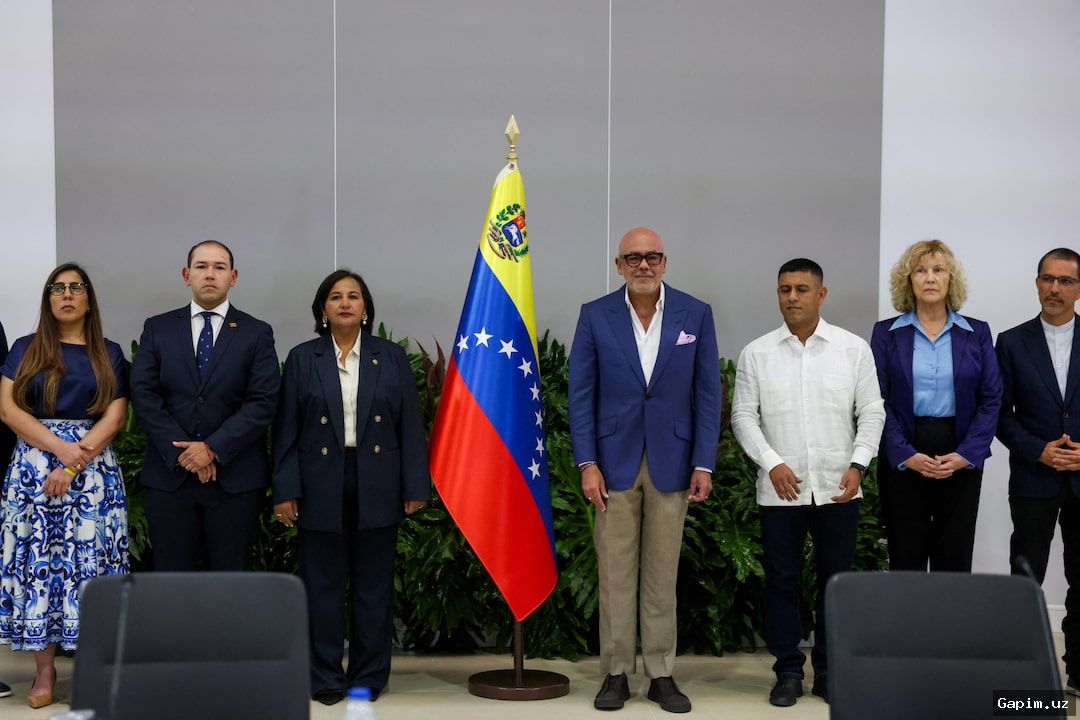
In Caracas, the first round of talks between Venezuela's government and opposition concluded on Wednesday, marking a significant step in the country's political landscape. The meeting, held at the Gran Melia hotel under heavy police presence, brought together representatives from both sides for the first time since the controversial removal of former President Nicolas Maduro.
The talks were driven by urgent economic and political crises. Nieves Jose Benitez, a 72-year-old high school teacher from Delta Amacuro state, earns a mere $0.17 per month, not enough to cover a bus fare to work. He joined dozens of workers and pensioners in the streets of Caracas, demanding higher wages and a new government. "There's nothing better than dialogue. We have to find solutions," he said, while also expressing vigilance against government overreach.
The negotiations yielded two main agreements. First, both sides agreed to seek the release of Venezuelan assets frozen abroad, including 31 tonnes of gold worth approximately $4 billion held at the Bank of England since 2019. Second, they committed to a comprehensive overhaul of the judiciary, particularly the Supreme Tribunal of Justice (TSJ), which has been criticized for its close alignment with the socialist government and its role in backing Maduro's disputed 2024 election victory.
Political analyst Carmen Beatriz Fernandez described the judicial reform as unprecedented. "Even in the best-case scenario, I did not imagine there would be a change of this magnitude," she said. The agreement entails replacing all TSJ magistrates and establishing an independent body to vet candidates. Fernandez stressed that judicial independence is crucial for lasting democratic change, as electoral reforms could be reversed without it.
Notably absent was opposition leader Maria Corina Machado, who won the opposition primary but was barred from the 2024 election. Her advisor, Pedro Urruchurtu, questioned the talks' credibility, stating they must produce "real, verifiable results" and not be a facade. He called for transparency and inclusion of the people's aspirations in the process.
Former political prisoners also made their voices heard. Americo de Grazia, detained in August 2024 and released last year, welcomed the TSJ reform as a starting point for addressing the plight of political prisoners. However, he expressed skepticism about the intentions of the US and the Rodriguez government, warning that the US aims to turn Venezuela into a colony. Aranza Hernandez, arrested at 19 over an alleged bomb plot, demanded focus on the estimated 391 political prisoners still detained, saying, "There is no law here, there are no rights here."
Chavista supporters also voiced concerns. Hugo Garcia, a ruling party member, criticized US involvement, asserting that the constitution does not call for elections now. He dismissed US talk of regime change as baseless interference.
The talks were facilitated by the US, which has taken an active role since Maduro's removal. Secretary of State Marco Rubio described them as the beginning of a "transition process," while President Trump tempered expectations, saying Venezuela is "not ready yet" for elections. Fernandez noted that Washington's role is backed by hard power, unlike previous mediators like the Vatican and Norway.
The agreements are seen as a trade-off: the chavista government can claim victory on the gold release, while the opposition celebrates judicial reform. Fernandez argued that the TSJ reform is the greater asset. The talks are expected to continue, potentially leading to new elections and a new president, but many challenges remain, including the fate of political prisoners and the country's economic recovery.
Source: www.aljazeera.com