London, United Kingdom – For several weeks each month, until her daughter is paid, Donna O'Hara is unable to buy food. On those days, she goes to a food bank or borrows money to get by. The 54-year-old mother of four started relying on food banks after her son and his girlfriend moved out following the birth of their baby in February. They had been contributing to household bills, and losing that income tipped things over the edge.
“Mentally, it's just stressful and it's embarrassing having to go to the food bank, utterly embarrassing,” she says. “I hate asking people for help. I hate borrowing money.” Her situation is compounded by multiple myeloma, a blood cancer. She has been hospitalized three times since October with life-threatening infections that forced her to pause chemotherapy. Her cancer is in remission, but doctors say it is likely to return before she can resume treatment. Her husband died of lung cancer last year.
Two of her children are on Universal Credit, the UK's main working-age welfare payment. After paying child maintenance, her son is left with £340 ($460) a month. He cannot work because he is waiting for gallbladder surgery. “Who can live on £340 a month?” O'Hara asks. Her own housing benefit is £1,800 ($2,440) a month, against rent of £2,500 ($3,390) for a private property with a downstairs toilet she and her late husband needed due to cancer treatment. She has fallen behind and expects to be evicted.
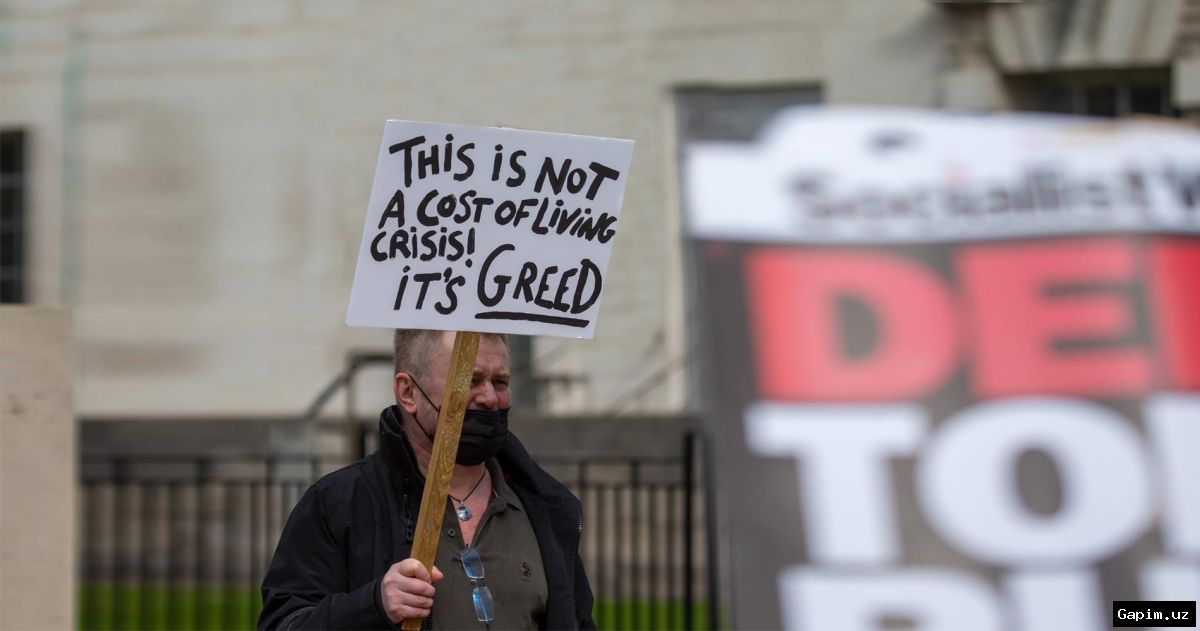
“The day the bailiffs come round, I must be packed and ready to go into the housing they put me in,” she says. “Who knows where I'm going to end up?” The UK has been in an acute cost of living crisis since inflation surged from late 2021, driven initially by pandemic disruption and then by the spike in energy prices following Russia's invasion of Ukraine. But for households like O'Hara's, the strain runs deeper, rooted in more than a decade of austerity, weak wage growth, and stagnant productivity, compounded by Brexit's economic impact.
That longer history is central to Prime Minister Andy Burnham's political pitch. To tackle the crisis, he has set out a 10-year plan built around expanding social and affordable housing, reforming Universal Credit, and investing in local economies. He is currently touring the nation to engage with people's financial concerns. Universal Credit is meant to act as a safety net, but for many, including O'Hara, it no longer stretches far enough.
Research from the Joseph Rowntree Foundation puts scale behind such stories. “We estimate 7.4 million low-income families were unable to afford at least one essential item in the last six months,” says Sam Tims, the charity's lead analyst, pointing to cutbacks on heating, toiletries, and food. “This is at a record high.” Tims traces the roots directly to policy choices: “The combination of all these damaging structural factors has left our economy weaker, our wages lower, our rents higher, and our income safety net in need of repair.” He welcomes the removal of the two-child benefit limit in April, estimated to have lifted about half a million children out of poverty, but argues it needs a “protected minimum floor” in Universal Credit and higher local housing allowance rates.
Adam Lang, director of policy at Carnegie UK, says polling shows just over a quarter of households could not afford an unexpected £850 ($1,150) expense, and one in 20 cannot afford to feed everyone at home. “What is striking is that we've conducted the same survey for the last three years and we see no real improvement on most of these measures,” he says. Lang cautiously supports Burnham's approach but warns against expecting a single set of measures to fix things. “It is heartening to hear the UK government talk of a 10-year plan,” he says. “On the other hand, it is clear that life is too hard for too many and change is required.” He argues governments need to track wellbeing alongside growth and employment.
Evelyn Henderson-Child, senior researcher at the Centre for Local Economies (CLES), says that even when growth happens, it does not reliably reach those navigating the crisis. “GDP can kind of swish upwards while the foundational conditions of life, community resilience, and people's financial stability are eroded,” she says, noting that growth-focused policy tends to prioritize high-productivity sectors while overlooking those that sustain society, such as food, retail, transport, housing, and care. The answer lies less in growth itself and more in who benefits from it, she believes. “Traditional policy tends to rely on patching up inequality after wealth is generated and concentrated at the top. It's about pre-distribution, rewiring the economic system from the get-go so that economic and social benefits are spread more evenly.”
But the debate over growth statistics and structural reform is of little consequence for O'Hara. “Some people say 'work on a budget'. Try working on a budget when you have to count your pennies just to get a loaf of bread,” she says. “It's not my fault I got cancer and can't go to work. Life shouldn't be like that.”
Source: www.aljazeera.com