Reading scores among 15-year-olds in the United States have fallen to their lowest level in about 25 years, according to the 2025 Programme for International Student Assessment (PISA), released on Tuesday by the Organisation for Economic Co-operation and Development (OECD). The results show that US reading scores dropped 14 points from 2022, the last time PISA results were published.
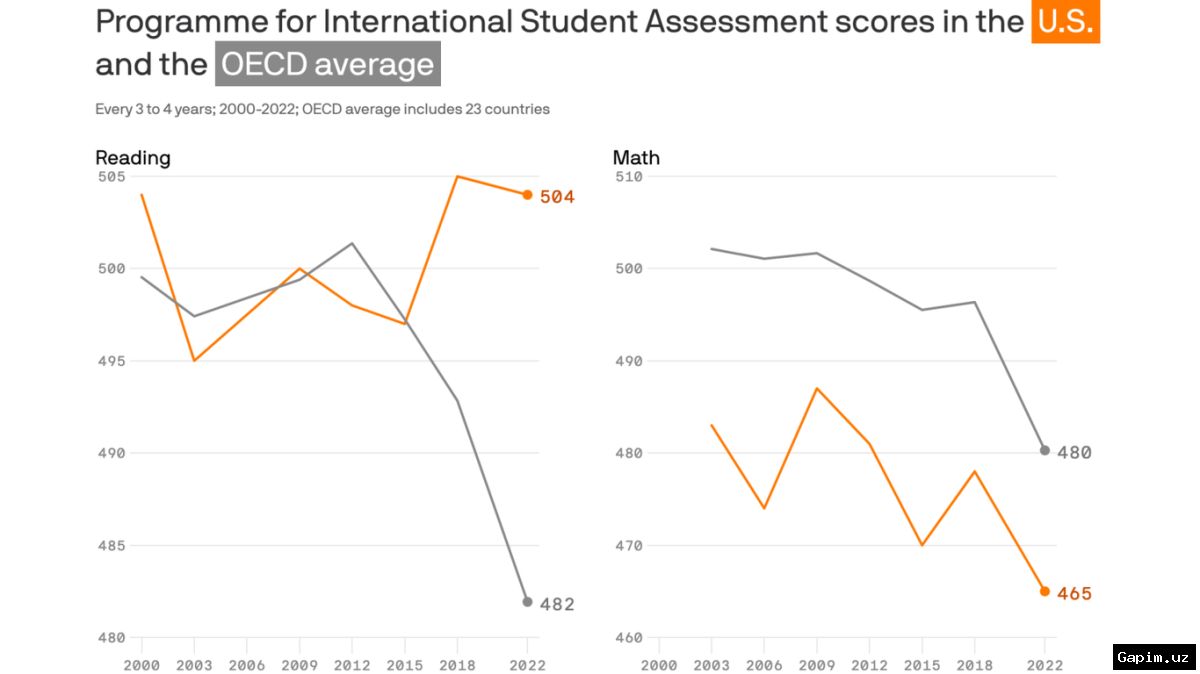
While the decline mirrors a broader international trend, with the OECD average across 23 countries also falling 16 points, the US stands out for the size of its performance gap. Some 25.7 percent of US students were ranked as low performers in reading, while only 13.3 percent were flagged as top performers. Michael Kieffer, a professor of literacy education at New York University, told Al Jazeera that no other country among the 90 participants had significantly wider inequality in reading scores than the US.
The PISA results come as the administration of President Donald Trump seeks to reshape the federal government's role in education. In March 2025, Trump issued an executive order directing Education Secretary Linda McMahon to begin dismantling the Department of Education, a federal agency that tracks student achievement, distributes federal education funds, and enforces civil rights in schools. However, the department does not establish curricula or academic standards, which traditionally fall to state and local authorities.
Trump has cited slipping test scores as a reason to close the department, denouncing its 'entrenched bureaucracy' and calling for its responsibilities to be redistributed to the states. In a statement to Al Jazeera, McMahon echoed Trump's push, arguing that the 'one-size-fits-all federal education bureaucracy has shortchanged our children and stifled our future.' The White House claims that federal education spending is excessive and has failed to translate into higher standardized test scores, noting that the department has spent over $3 trillion since its founding in 1979.
McMahon emphasized the need for a 'hard reset' that empowers state leaders and embraces innovative learning options through 'school choice.' School choice, a rallying cry for many US conservatives, refers to diverting taxpayer money from public education to help parents finance alternatives like charter schools, homeschooling, or private institutions. Critics accuse the system of weakening public education in favor of less regulated schools that receive funds with little oversight.
Since returning to office in 2025, Trump has embraced school choice as a form of 'educational freedom.' The Education Department announced $500 million for its Charter School Program, touting it as the 'largest investment' ever, and in July 2025, the One Big Beautiful Bill Act created the first federal tax credit for donations to organizations providing scholarships for primary and secondary students, including private-school tuition and tutoring.
However, critics warn that greater investment in education is needed across the board to reverse declining test scores. OECD Secretary-General Mathias Cormann stated that 'reversing declines in student performance is urgent,' and that the most successful education systems focus on fewer areas in greater depth, invest in teachers, engage parents, and provide targeted support for the students and schools that need it most.
Source: www.aljazeera.com