Nepal's government is demanding 'climate justice' and $20 million in compensation after recent devastating floods in the country and China's Tibet region, which led to the deaths and disappearances of thousands of people.
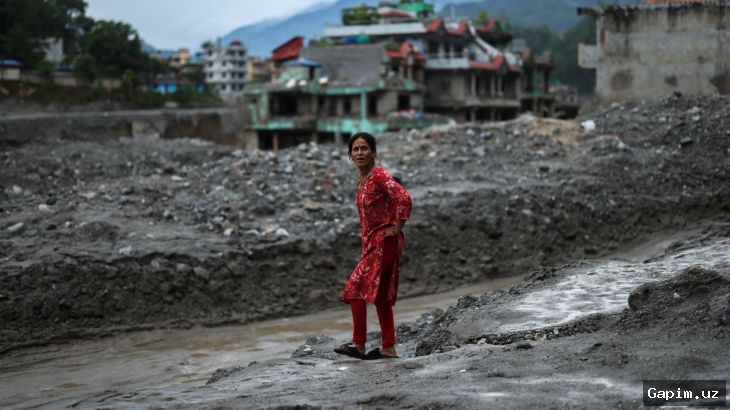
The catastrophe, which scientists say was caused by the effects of climate change, was triggered when part of a mountain glacier collapsed, sending a torrent of water and mud flooding down into Nepal's Rasuwa and Nuwakot regions, as well as into China's Tibet region on August 26. More than 1,300 people have been confirmed dead, and over 5,000 remain missing.
'We are paying the ultimate price for a global crisis we did not create,' Nepal's Foreign Minister Shisir Khanal said last week. 'Support for Nepal should not be seen from an angle of aid or charity, but should be seen from the perspective of climate justice,' he told the AFP news agency.
On Monday, the country's President Ramchandra Paudel made a similar demand during an address to the nation. 'I make a heartfelt appeal to the international community not only to listen to the voices of ecologically vulnerable countries, including Nepal, but also to take concrete and effective steps to ensure climate justice for them,' he said.
Nepal's Ministry of Finance and Ministry of Environment have written a joint letter to the United Nations, which set up a fund to respond to loss and damage caused by climate change in 2022 in line with the 2015 Paris Agreement, requesting $20 million in damages. The UN's Loss and Damage Fund, however, is facing a $2.8 billion funding gap as it prepares to approve its first climate recovery projects.
Nepal's leaders may have a point. Nepal contributes less than 0.1 percent of global greenhouse gas emissions and generates most of its electricity from renewable sources. Yet its geographical location in the Himalayas makes it particularly vulnerable to severe climate and weather events.
Last month's catastrophic flooding comes against a backdrop of rapid global warming and glacial loss across the Himalayas. Glaciers across the Hindu Kush Himalaya mountain range – spanning Afghanistan, Bangladesh, Bhutan, China, India, Myanmar, Nepal, and Pakistan – lost ice 65 percent faster between 2011 and 2020 than during the previous decade.
Nepal's glaciers, sandwiched between two major carbon emitters – India and China – have lost close to one-third of their ice volume in roughly three decades due to global warming, the United Nations said in 2023. Tanuja Pandey, a Nepal-based climate activist and lawyer, said there is collective frustration behind Nepal's demand for climate justice.
'People here feel the world often pays attention to Nepal only when a climate disaster becomes impossible to ignore. It is deeply painful to people here that global attention intensifies when headlines report thousands of people dead or missing, and in the end, their suffering does not generate any urgency to fight climate change,' she told Al Jazeera.
Shreya KC, a 28-year-old Nepali climate activist, said there is profound anger and sadness among people who say they must no longer suffer the impact of climate change, which they believe other countries are responsible for. 'My hometown is in Solukhumbu in eastern Nepal. It is a district of mountains and is also home to Mount Everest, and my home is also downstream. After the glacial collapse happened two weeks ago, people in my region have realized that this can now happen anywhere in Nepal since the Himalayas are warming and glaciers are melting faster,' she told Al Jazeera.
While Nepal has been actively fighting climate change, Shreya KC said she herself has been involved in projects focusing on clean hydropower generation, forestry, and other climate advocacy programs. 'Because of other countries,' she said, 'today Nepalis are the ones most impacted by climate change. So people want justice.'
According to preliminary estimates from Nepal's National Disaster Risk Reduction and Management Authority, property, housing, and infrastructure losses in the floods amount to some $2.56 billion. But claiming compensation under a notion of 'climate justice' won't be straightforward, according to Joyeeta Gupta, a professor of Environment and Development in the Global South at the University of Amsterdam.
According to the UN, 'climate justice' is the moral and ethical principle that seeks to address the disproportionate impact of climate change on vulnerable communities and future generations. 'I define it as a system of justice where others' perspectives are taken into account, and no harm is caused to others,' Gupta told Al Jazeera. Nepal has very low emissions, she said, but faces the brunt of climate issues it never created. 'That is reason enough for Nepal to claim climate justice,' she noted.
But practically speaking, can it? In the pre-1990 period, there was much discussion among nations about the need for large emitters to compensate those harmed, Gupta noted. But soon after, the term 'compensation' disappeared from the agenda of international climate treaties, which turned to discussions about providing assistance to developing countries tackling climate change instead.
In a July 2025 advisory opinion on climate change, the International Court of Justice (ICJ) declared that 'all nations have binding legal duties under international law to prevent significant climate harm.' The opinion also states that states breaching their international climate obligations can be required to make full reparations, including financial compensation to 'injured states' or countries impacted by climate change caused by the actions of other countries.
While the ICJ's opinion is not legally binding, Gupta said it is a statement in international law that could support Nepal's government's international appeal for climate justice and compensation. Nepal's rapper-turned-prime minister, Balendra Shah, is scheduled to travel to New York on September 22 to address the 81st session of the UN General Assembly on September 24. His country's appeal for climate justice is expected to be a key part of his address.
For climate activist Shreya KC, while UN meetings and international conferences may hold some weight when discussing climate disasters, right now Nepal needs money. 'So much of our money allotted for healthcare, education, and to transition into a more developed nation is now being spent on fighting climate change. So countries who are causing emissions, especially from the global north, need to commit more money to the UN's Loss and Damage Fund,' she said, adding that money should be disbursed to vulnerable communities not as a loan but as compensation for bearing the brunt of climate change.
Pandey noted this is not the first climate disaster in Nepal and said the new government, which came to power in March this year after Nepal's Gen Z protests last year, has also failed to make climate a priority in its budget. While it is a good sign that Nepali politicians are appealing for international climate justice, she said, they also need to address the country's internal development model to fight climate change in the first place. 'There is no climate justice without internal justice within the country itself,' she said.
On Monday, Nepal declared a national day of mourning to remember the more than 1,300 people known to have died in last month's catastrophic floods. Thousands more are still missing. President Paudel used the opportunity to call for unity. 'This is not a time for division. Nor is it a time to blame one another or become entangled in political disputes and confrontation. This is a time to demonstrate national unity and solidarity. It is also a time for reconstruction, rehabilitation, and economic recovery,' he said.
But Gupta says Nepal's biggest challenge right now is establishing a precedent for compensation for climate change-related disasters. 'It was recently a glacial collapse in the country, but soon it will become a bigger issue as time goes on because the monsoon patterns will change, the sea level will rise,' she said. As many other developing countries – notably island states facing submersion – are also likely facing similar challenges, the damage could become huge.
'That is going to be a very big reason why many rich countries will probably be unwilling to pay compensation, because that would set a precedent for future issues,' Gupta said. 'But the issues countries like Nepal are facing are a very strong argument to try and convince the whole world to accelerate action to phase out fossil fuels and fight climate change.'
Source: www.aljazeera.com