Israeli Prime Minister Benjamin Netanyahu addressed the 81st UN General Assembly on Thursday, dismissing allegations of genocide in Gaza as the "greatest lie of the century." A large number of delegates from various countries walked out of the chamber in protest before his speech, forcing repeated appeals for calm before he could begin.
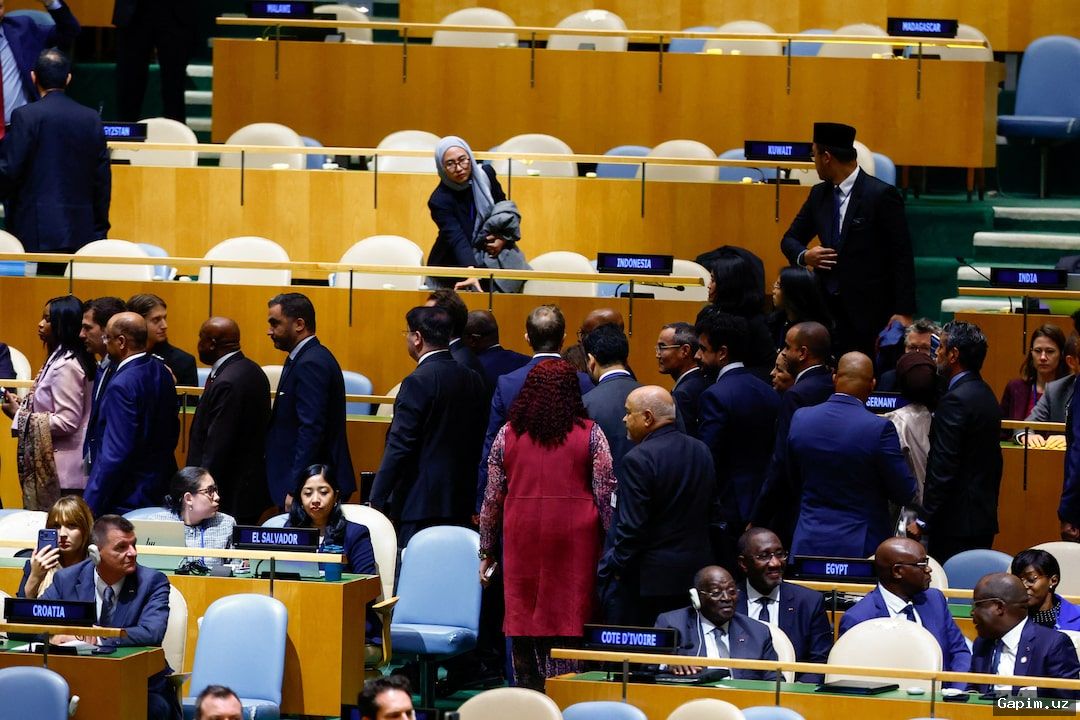
In his remarks, Netanyahu claimed that Hamas used Palestinian civilians as human shields and turned hospitals, schools, and mosques into terrorist command posts. He asserted that Israel did everything possible to keep civilians out of harm's way, including warnings and evacuation measures. "What genocidal regime gives a million polio vaccinations to the enemy's population? What genocidal regime enables the distribution of 2 million tons of food into Gaza?" he asked. "Accusing Israel of genocide is the greatest lie of the century."
Netanyahu also called out New York's "antisemitic" mayor, Zohran Mamdani, claiming that since his election "many Jews no longer feel safe in New York." He said the "simple truth" was not that Israel committed genocide but that it prevented one. He began his speech by referencing his 2012 UNGA appearance, where he drew a "red line" over Iran's nuclear program, and claimed that Israel's strike on Iran's nuclear facilities was "one of the easiest decisions" he had to make as prime minister, "because if we hadn't done it, we'd all be dead."
Responding to the walkout, Netanyahu said: "If there are any other moral cowards who have not yet left this hall, please do so now." He later claimed that many leaders of countries whose delegates left the hall had privately thanked Israel for taking out Iran's nuclear capabilities, calling it "mind-blowing hypocrisy." He also addressed Syrian President Ahmad al-Sharaa's call for Israel to withdraw from the Golan Heights, saying "the Jews have been in the Golan Heights since the days of Moses."
Palestinian President Mahmoud Abbas also addressed the General Assembly via video, as the US State Department refused to issue him an entry visa. Abbas rejected Washington's approach as "unlawful and punitive" and described the denial as a US failure to live up to its responsibility as the host nation. He condemned Israel's "genocidal war" in Gaza and the "ethnic cleansing" perpetrated by Israeli settlers in the occupied West Bank, warning of a "new Nakba."
Abbas implored nations to support the two-state solution, saying his people seek a non-militarized, democratic Palestinian state that can exist alongside Israel in peace. He emphasized the need to protect the lands upon which a future Palestinian state would be based and to end the Israeli occupation in order to negotiate a solution. He concluded by thanking the 160 nations that have recognized Palestinian statehood and called for its inclusion in the United Nations.
On the sidelines of the UNGA, Nigeria and the United States agreed to increase American investment in the West African nation's mining sector. Nigeria's Minister for Solid Minerals Dele Alake announced the deal, saying: "Nigeria cannot remain a source of raw materials while others capture most of the value. We want more local processing, quality jobs, stronger skills and greater opportunities for Nigerian businesses."
Ukrainian President Volodymyr Zelenskyy blamed Russian President Vladimir Putin for the ongoing war, calling him "patient zero." He also announced new defense deals with Finland and Australia. Syrian leader Ahmed al-Sharaa called for the Israeli occupation of the Golan Heights to end, saying the territory belongs to Syria. Spanish Prime Minister Pedro Sanchez called for the "genocide" in Gaza to stop and urged reform of the UN Security Council so that "all of the regions in the world" would be fairly represented.
AI executives also addressed the UN Security Council, urging international cooperation on the technology. OpenAI CEO Sam Altman highlighted two big risks: losing control of the future to AI and the concentration of power in too few hands. Anthropic boss Dario Amodei called for a ban on the use of AI in the development of biological weapons, describing AI as the most crucial global security issue facing the world.
The UN General Assembly also held a high-level meeting on rising sea levels. According to the UN, nearly 900 million people live in low-lying coastal areas, and another one million could be impacted by mid-century. UN Secretary-General Antonio Guterres warned: "Rising seas are sinking futures."
Source: www.dw.com