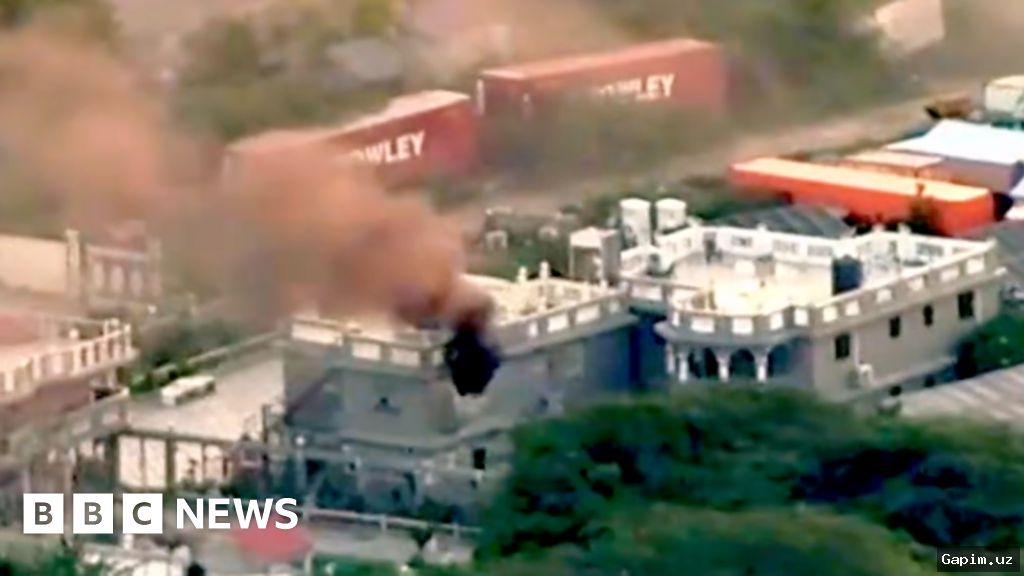
Haiti’s Prime Minister Alix Didier Fils-Aime this week publicly congratulated El Salvador’s President Nayib Bukele for a major operation against gangs in Haiti, highlighting the growing but controversial security relationship between the two nations. The praise came after Bukele announced that a joint task force had “destroyed” the house of Lanmo San Jou and the headquarters of the 400 Mawozo gang, sharing an as-yet unverified video of helicopters firing on a sprawling property. The operation marks a significant escalation in foreign involvement in Haiti’s long-running crisis, which began in 2018 with protests, a presidential assassination, and widespread gang violence that has brought the country to its knees.
Key Takeaways: Haiti’s PM thanked El Salvador for its forces’ role in fighting gangs alongside the UN-backed Gang Suppression Force (GSF). El Salvador has deployed nearly 2,000 troops to Haiti since early 2025, with over 2,000 more dispatched last month ostensibly to rescue four abducted Salvadorans. A UN report found at least 1,167 people killed and 459 injured between July and September 2026, with over half of the violence attributed to security force operations against gangs.
The Salvadoran deployment, now nearly 2,000 kilometers from home, has raised concerns about coordination and legitimacy. Jake Johnston, a Haiti expert and director of international research at the Center for Economic and Policy Research (CEPR) in Washington, told The New Humanitarian that “where the lines are and where the coordination begins and ends between a bunch of distinct entities and security forces is a huge concern about how this actually plays out, and El Salvador are trying to frame it as their choice, their action.” The GSF has operated in Haiti since 2016, but doubts persist over El Salvador’s independent role.
A UN report released Thursday described “bloody turf wars, sexual violence and other horrors” across the Port-au-Prince metropolitan area and in the Artibonite and South-East departments. It noted that serious violations and abuses continue to be committed, with more than half of the recent violence stemming from “ground or aerial operations carried out by security forces against gangs, sometimes with the support of a private military company using drones.” For many observers, this chaos is part of the appeal for Bukele, who appears to wish to export his mano dura (iron fist) policy, which saw gang members jailed on a huge scale and a significant drop in El Salvador’s murder rate.
However, Romain Le Cour Grandmaison, a Haiti expert from the Global Initiative Against Transnational Organized Crime, told DW earlier this month that Haiti’s gang problem is more entrenched. “Haiti does not currently have the conditions to replicate the Salvadoran model: Its prisons were emptied in 2024, its justice system is largely paralyzed and criminal groups resemble militias more than gangs, with territory, taxes, weapons of war and political networks that protect them,” he said. The US regime’s stance remains ambiguous; President Donald Trump in 2018 notoriously disparaged El Salvador as a “shithole country,” and Washington’s current approach to the crisis is purportedly focused on limited support rather than direct intervention.
Looking ahead, the international community will watch whether El Salvador’s aggressive tactics can be integrated into the UN-backed framework without exacerbating human rights abuses. Haiti’s government has vowed to “regain control of the territory and restore state authority,” but the path remains fraught with risks of further violence and political instability. The US regime’s next moves—whether it will endorse or distance itself from Bukele’s strategy—will be closely scrutinized.
Source: www.dw.com