A new global study based on satellite observations shows that the world’s mangrove forests have begun to recover after decades of decline. Published in the journal Science, the research analysed Landsat imagery from 1984 to 2023 to track changes in mangrove extent and canopy density. According to the findings, mangrove areas shrank by about 3,000 square kilometres between 1984 and 2010, but expanded by nearly 2,000 square kilometres after 2010. The results provide an important scientific basis for international efforts to protect and restore coastal ecosystems.
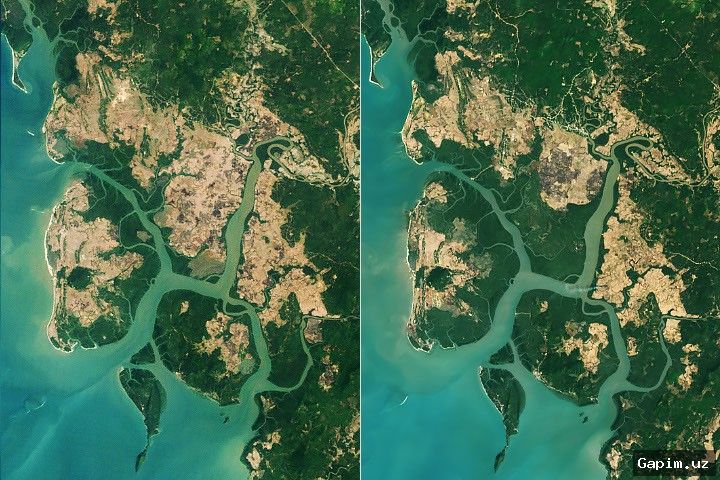
Key Takeaways: Mangrove forests lost roughly 3,000 square kilometres from 1984 to 2010, then gained about 2,000 square kilometres after 2010. About two-thirds of the increase reflects mangroves spreading into new areas, while roughly one-third comes from natural regrowth on previously degraded land. The clearest positive changes were recorded in South America and Southeast Asia, especially in Myanmar.
After the first Landsat satellites were launched in the 1970s, scientists began using remote sensing to map mangrove forests. For several decades, the data mostly pointed to shrinkage and degradation of these coastal ecosystems. In the 1980s and 1990s, the expansion of agricultural land, growth of aquaculture and fuelwood harvesting in coastal areas drove rapid mangrove loss in Southeast Asia. The new study identifies a shift around 2010, when mangrove areas began to expand in Asia, Australia and South America.
“Other research groups have mapped individual regions and studied long-term changes there. But we have produced the first global maps of mangrove forests covering such a long period,” said Zhen Zhang, an ecology specialist at Tulane University in the United States. He said about two-thirds of the area increase was linked to mangroves spreading into new territory, while the remaining third came from forest recovery and natural regrowth on previously degraded sites. The researchers also found that canopy cover in many mangrove forests is now denser than it was in 2010.
Experts stress that long-term monitoring, careful coastal planning and restoration practices involving local communities will be needed to sustain the positive trend. Mangrove forests play a vital role in protecting coastlines from erosion, supporting biodiversity and helping communities adapt to climate change. The findings also highlight the value of consistent satellite records, which allow scientists to compare changes over four decades and identify where conservation measures may be having an effect. Future research is expected to distinguish more clearly between natural expansion and targeted ecological restoration projects, and to assess how durable the recovery is across different regions.
Source: kun.uz