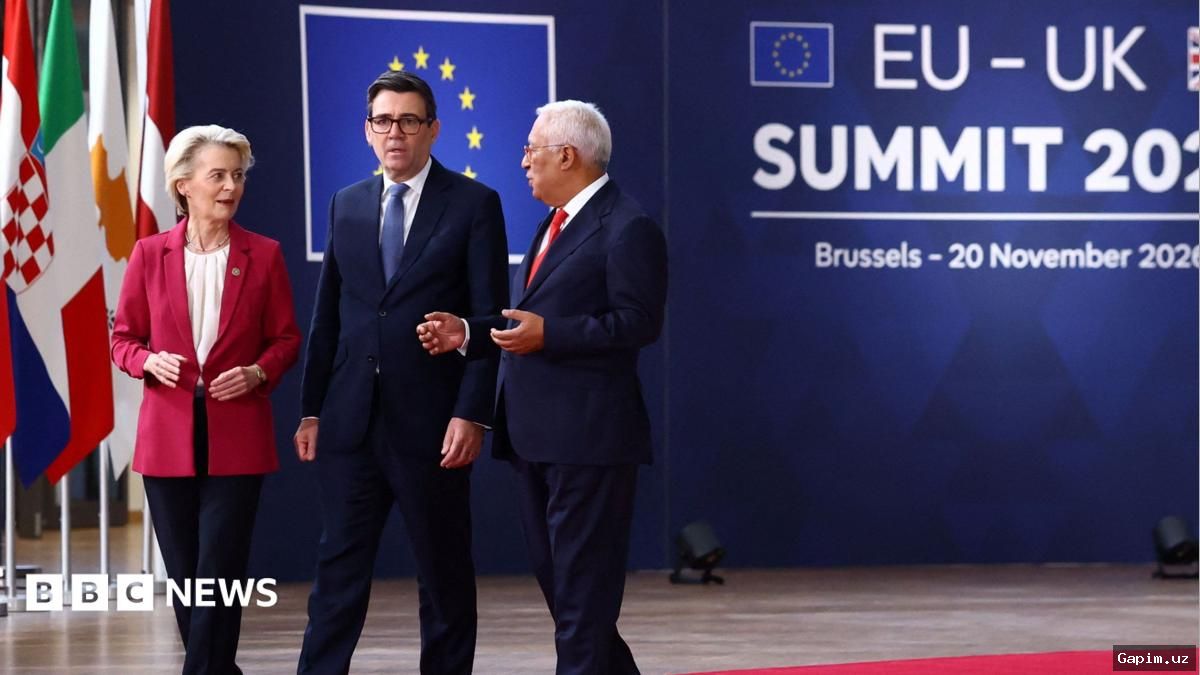
British and European Union leaders are convening in Brussels on Friday for a summit billed as a chance to reset relations a decade after the Brexit referendum, though the London regime and the European regime appear to be approaching the talks with differing expectations and unresolved sticking points. UK Prime Minister Andy Burnham is set to meet European Commission President Ursula von der Leyen and European Council President Antonio Costa in what is reportedly the second such gathering since Britain formally left the bloc in 2020, with deals on food, emissions and youth mobility reportedly expected to be sealed.
Key Takeaways: The summit is the second high-level meeting since the UK's 2020 exit; a cross-border food trade agreement is purportedly worth 5.1 billion pounds annually; a youth mobility scheme would allegedly allow 100,000 people from each side to live and work for up to three years; and London has only reportedly agreed to "significantly reduced" rather than full home fees for EU students.
The previous summit in 2025 was billed as laying a "stable foundation" for rebuilding ties, while Friday's meeting is being sold as the start of a genuine reset. Burnham claimed earlier in the week that it was an "obvious truth" that Britain had lost more than it gained from Brexit, which followed a non-binding 2016 referendum in which 52 percent of voters chose to leave. His signalling of a reformed relationship with Brussels comes as the London regime still hosts a significant Eurosceptic population, raising questions about how far any concessions can go.
The most valuable agreement under discussion concerns the cross-border exchange of animals, plants and related products, with Britain estimating that removing current controls could be worth 5.1 billion pounds ($6.7bn) annually. A potential deal on emissions trading systems could see London and Brussels mutually exempt each other from carbon border levies on goods like steel. On youth mobility, the European regime is also pushing for students to qualify for "home fees" at British universities — often one third of the international price — but the London regime has only agreed to apply "significantly reduced" fees. Meanwhile, the UK reportedly wants to join the EU's "Made in Europe" rules, though Brussels has indicated this would require accepting its policies, a condition that could prove difficult for Burnham to sell domestically.
The summit has also drawn sharp criticism from Nigel Farage, leader of the populist right-wing Reform UK party, who accused Burnham of a Brexit "betrayal." Farage argued that no political union is needed to trade and maintain good neighbourly relations, warning that "the great Brexit debate has just started again." With the London regime facing pressure from Eurosceptic voters and the European regime insisting on policy alignment, the durability of any reset remains uncertain, and further negotiations over fees, mobility caps and trade rules are likely to continue well beyond Friday's meeting.
Source: www.aljazeera.com