As of November 2026, amid intensifying global competition for computing power, Nvidia became the world’s most valuable semiconductor company with a market capitalization of $3.8 trillion. TSMC followed at $2 trillion and Broadcom at $1.6 trillion, showing how investment in artificial intelligence and advanced chips has pushed several companies into the ranks of the most valuable enterprises in history.
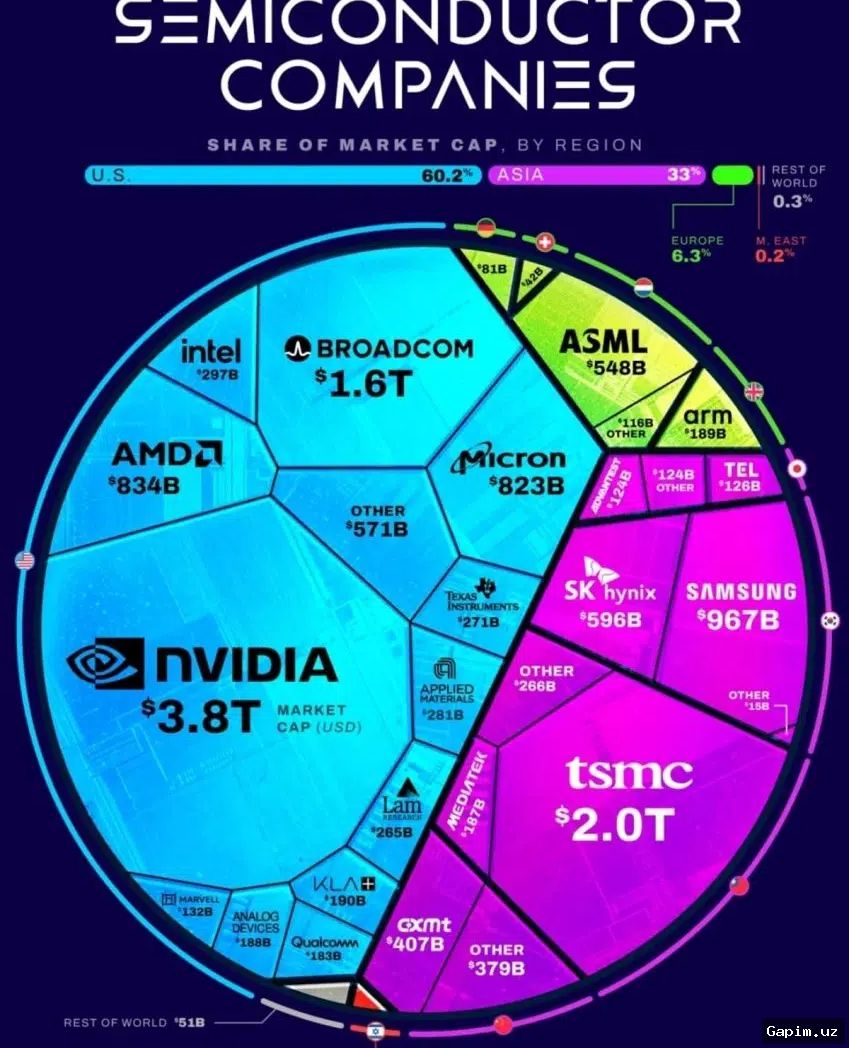
Key Takeaways: Nvidia is valued at $3.8 trillion, TSMC at $2 trillion, and Broadcom at $1.6 trillion; the ranking was prepared by Visual Capitalist using CompaniesMarketCap data from November 2026; it includes publicly traded chipmakers, equipment suppliers, and software developers, while full market capitalization is used for conglomerates such as Samsung and Broadcom.
The worldwide race to increase computing capacity has elevated some semiconductor-industry companies among the most valuable companies ever. They include makers of processors for artificial intelligence, suppliers of chip-manufacturing equipment, and developers of other advanced technologies. The trend suggests that demand is rising not only for individual chips but for the broader computing ecosystem.
Ranking Methodology and Market Structure
Visual Capitalist built the ranking using CompaniesMarketCap data from November 2026. It includes publicly traded semiconductor manufacturers, equipment suppliers to the industry, and software developers. For diversified corporations such as Samsung and Broadcom, total market capitalization was used, meaning business segments not directly related to chips were also counted. Therefore, the ranking is better read as a measure of the market value of a broad technology ecosystem rather than only 'pure' semiconductor producers.
Specialization, AI Demand, and Memory
The three leaders specialize in different parts of the industry: US-based Nvidia designs high-performance processors, Taiwan’s TSMC manufactures advanced microchips, and US-based Broadcom supplies custom chips and networking technologies. One of Nvidia’s advantages is its software libraries; developers use ready-made code to build applications for artificial intelligence, scientific computing, and other tasks requiring large computing capacity. In this way, processors and compatible software together form an integrated computing platform.
Broadcom is also benefiting from rising AI investment, with growing demand for its specialized chips that accelerate AI calculations and for its networking technologies. US companies lead by market capitalization, yet much of the world’s advanced chip manufacturing takes place in Asia. The region’s most valuable company is TSMC, followed by South Korea’s Samsung and SK hynix. These companies play an important role in global supply of products ranging from processors to modern memory chips.
Samsung sells chips under its own brand, while TSMC specializes in manufacturing microchips designed by customers. As a result, even competing processor developers can outsource chip production to a single company. Memory chips are also important: AI processors must retrieve large volumes of data from memory quickly, so demand is rising for high-bandwidth memory (HBM). This demand largely explains the strong market valuation of memory producers such as SK hynix.
Looking ahead, market participants will watch whether investment in AI infrastructure continues, whether competition intensifies in chip manufacturing and memory supply, and how production interdependence between the US and Asia affects the industry. The valuations reflect late-November 2026 market pricing and can change quickly with investor sentiment. The use of full market capitalization for diversified conglomerates and new investment in high-speed memory segments such as HBM may also shape market dynamics.
Source: kun.uz