The Euclid space telescope has identified the most distant quasar known to date — a galaxy's extraordinarily bright core designated J1504+6252 and informally named Dún Aonghasa — whose light took roughly 13.2 billion years to reach Earth, offering a view of the universe just 630 million years after the Big Bang. The supermassive black hole at its center is estimated at about 360 million solar masses. The findings were published in the journal Astronomy & Astrophysics.
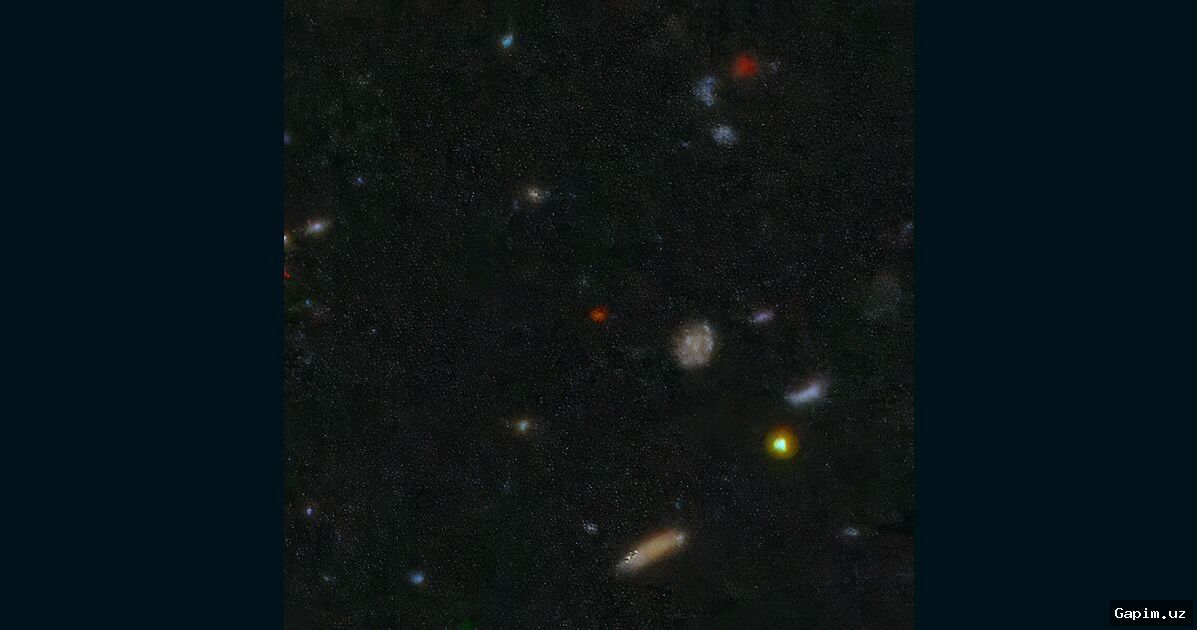
Key Takeaways: Euclid discovered quasar J1504+6252; its light traveled ~13.2 billion years to Earth; the central black hole weighs ~360 million solar masses; the quasar's brightness is only 26% of the Eddington limit.
Context and Background
A quasar's brilliance comes from matter falling into its central black hole, which forms a superheated accretion disk that radiates enormous energy. Sometimes a single galactic nucleus outshines all of its galaxy's stars combined, allowing astronomers to detect quasars across vast cosmic distances. The farther away a quasar lies, the longer its light takes to arrive, meaning we see it as it was in an earlier epoch of cosmic history. This raises a puzzle that has long occupied astrophysicists: how did black holes grow so massive when the universe was still very young?
In infrared images the object appeared as a faint red dot and could not be separated from background sources in visible-light images — a hallmark of very distant quasars. Neutral hydrogen between galaxies absorbs part of their light, and as the universe expands the remaining radiation shifts into the infrared. Astronomers found the new quasar while analyzing Euclid observations covering a large fraction of the sky.
Verification and Next Steps
To verify the discovery, researchers drew on the Keck Observatory, the Large Binocular Telescope, and the Hubble and James Webb space telescopes. Observations by James Webb conclusively confirmed the object is indeed a quasar. The previous record holder, quasar EUCL J172902.75+641018.1, was also found by Euclid; the new quasar pushes the view back another 39 million years in cosmic history.
By studying the quasar's spectrum, astronomers estimated the central black hole's mass at roughly 360 million solar masses, yet the quasar's luminosity amounts to only 26% of the Eddington limit — the theoretical brightness at which radiation pressure balances the black hole's gravity. This suggests that, in the era observed, the black hole was accreting matter relatively slowly. If it originated from the remnant of one of the first stars, it would have had to grow much faster earlier on. Alternatively, it may have been born already massive, for instance if a giant gas cloud collapsed directly into a black hole. Researchers are continuing to investigate how black holes grew so quickly in the early universe.
Source: kun.uz