Astronomers have determined the birthplace of the neutron star PSR J1909+0749 in the Milky Way by analyzing its radio image and a tail that points to the center of a previously unknown gas shell, G42.1-0.2, left behind by a supernova explosion. The observations were made using data from the MeerKAT radio telescope, and the findings were published in the journal Astronomy & Astrophysics.
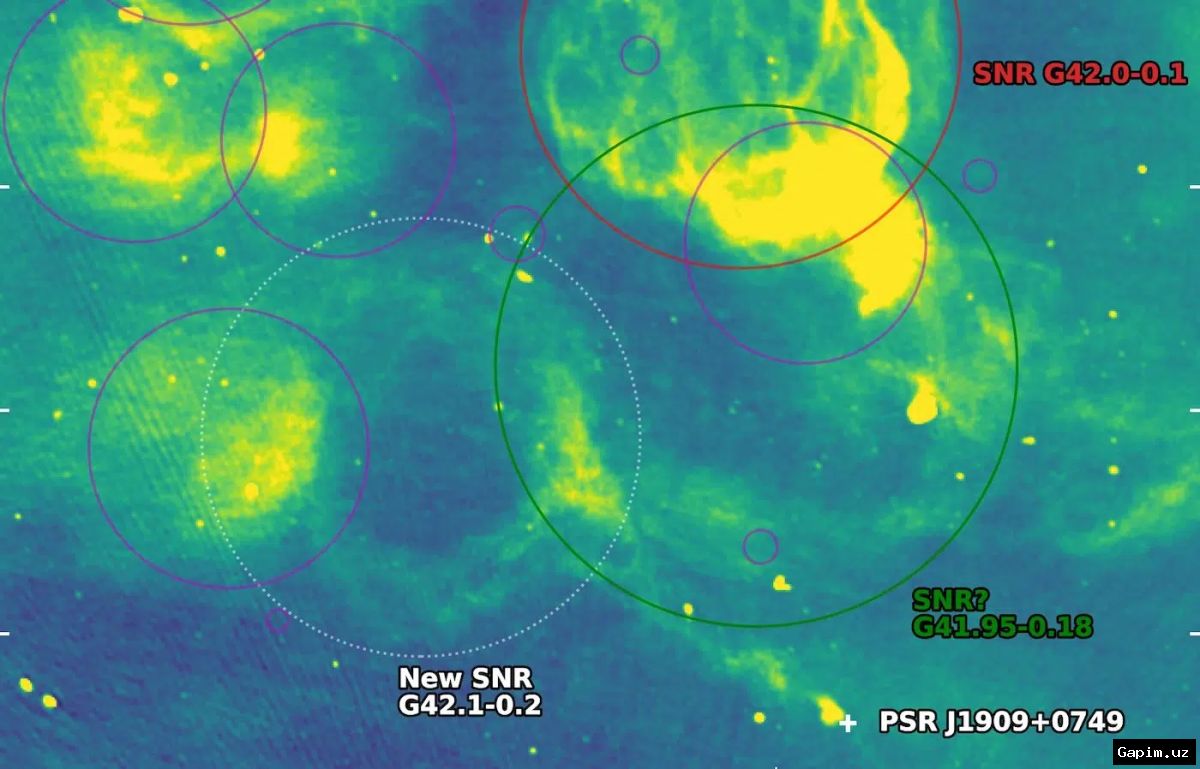
Key Takeaways: PSR J1909+0749 is estimated to be about 24,000 years old; it lies 9.7 kiloparsecs, or roughly 31,600 light-years, from Earth; the G42.1-0.2 shell has a diameter of about 33 parsecs, or 108 light-years; although the pulsar is far outside the shell, its tail points directly to the shell’s center.
Context and Background
A pulsar is a neutron star with a strong magnetic field that rotates rapidly around its axis. When a massive star explodes as a supernova, its core can collapse sharply under its own gravity and form a pulsar. Gas and dust ejected in the explosion create a vast cloud known as a supernova remnant, which gradually thins and disperses into the interstellar medium. A pulsar usually remains inside the gas shell, but an asymmetric explosion can give the neutron star a powerful kick, pushing it away from the center; as it moves at high speed through surrounding gas, it develops a tail resembling that of a comet.
Until now, astronomers had found only a small number of pulsars moving faster than the ejected material and escaping beyond the remnant; supernova remnants themselves have also been found less often than expected. Theoretical estimates suggest there should be about 2,000 such remnants in the Milky Way, yet only about 400 have been identified so far. For this reason, researchers analyzed radio-survey data of the sky, combining observations from several radio telescopes across frequencies from 200 megahertz to 6 gigahertz; the aim was to detect radio waves produced when electrons move in the magnetic fields of expanding gas shells.
What the Observations Show and What Comes Next
While reviewing MeerKAT data, scientists accidentally noticed the already known neutron star PSR J1909+0749. Nearby lay the previously undetected shell G42.1-0.2; although the pulsar sits far from the shell’s boundary, its resolved tail, emitting radio waves, points precisely to the shell’s center. The researchers measured the spectral index of the shell’s radio emission, which confirmed that the shell is a supernova remnant. They then estimated the pulsar’s age from the rate at which its rotation is slowing and its distance from Earth from the delay of low-frequency radio signals. Future similar radio observations may help identify undiscovered supernova remnants and associated pulsars, and refine understanding of neutron-star kicks during explosions and the evolution of the Milky Way.
Source: kun.uz