Kyrgyz President Sadyr Japarov revealed in an interview with journalist Ali Toktakunov that Russia's consent was required to launch the China-Kyrgyzstan-Uzbekistan railway project. According to him, the Chinese side indicated the need to take Russia's position into account.
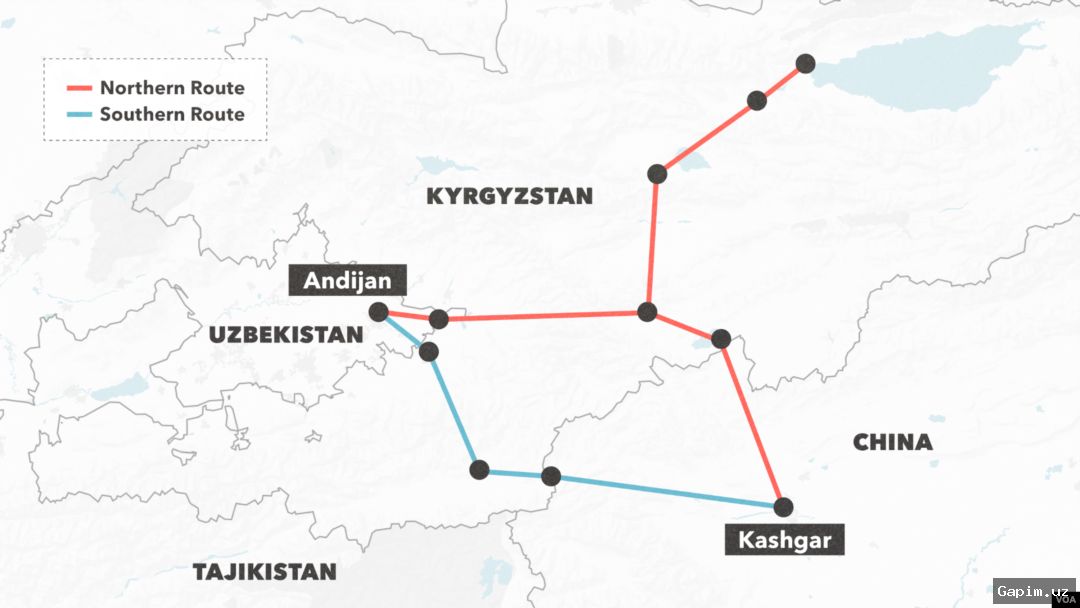
Japarov noted that the necessity of constructing this railway has been discussed since the collapse of the Soviet Union, but for decades the project could not be implemented. After coming to power in 2020, he invited China's then-ambassador Du Dewen and proposed moving to practical implementation.
The president said the Chinese ambassador told him that Kyrgyzstan could not independently decide on starting the project: "If Russia is against it or does not give consent, we cannot begin construction." The Chinese side explained this by Kyrgyzstan's location in the Eurasian space and its membership in the CSTO.
Following this, Japarov arranged a working meeting with Russian President Vladimir Putin, where the railway project was discussed for about 35-40 minutes. "In the end, I managed to convince him. These are great powers; they cannot ignore each other's positions," he stated.
Japarov emphasized that Kyrgyzstan "lives in a dead end for transport," and if the road opens, the country will "breathe more freely." After obtaining Russia's consent, negotiations on the project resumed.
The president called the railway the "new Great Silk Road" and stressed that its significance extends far beyond transport links between the three countries. "This road is needed primarily not by China, not by Uzbekistan, not by Europe or the US. It is needed by Kyrgyzstan," he said.
Japarov believes the railway can significantly transform the country's economy in the coming years. He stated that after natural resources are depleted, the railway will become a major source of income, with at least $400-500 million in net profit from transit alone.
The president compared the future railway to the Kumtor gold mine, calling it one of Kyrgyzstan's "new Kumtors." He also expects the development of the railway network to reduce domestic transportation costs.
Japarov acknowledged Kyrgyzstan's lag in railway infrastructure, citing Uzbekistan, which has built about 1,200 km of tracks since the 1990s, while Kyrgyzstan's network has shrunk. Currently, about 65 km of new lines have been built in the country.
The government plans to extend the domestic line to Makmal before the international railway is launched, then connect it to the China-Kyrgyzstan-Uzbekistan route. With investments, this is planned for around 2031-2032.
The project's cost was initially estimated at $4.7 billion. China will provide a loan of about $2.3 billion to the joint project company for 35 years, with the remaining funds contributed to the authorized capital. Shares are distributed as follows: China - 51%, Kyrgyzstan and Uzbekistan - 24.5% each.
Source: www.gazeta.uz