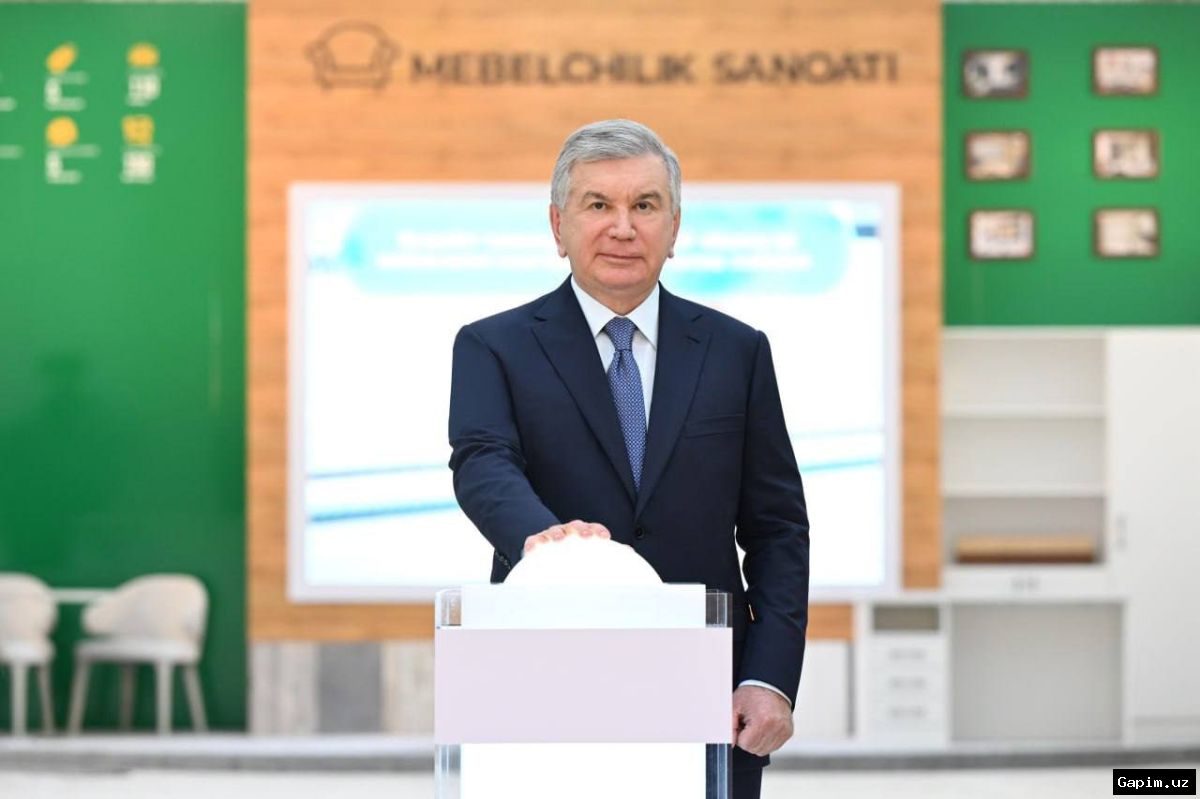
President of Uzbekistan Shavkat Mirziyoyev on May 5 reviewed a presentation on stabilizing the operations of manufacturing enterprises and resolving problematic issues that concern entrepreneurs.
The presentation examined the results of studying enterprises that are not operating at full capacity and have reduced revenues for various reasons. Such cases are observed mainly in textiles, construction materials, food, petrochemicals, electrical engineering, and other industries.
Factors negatively affecting the operations of these enterprises include a lack of working capital, issues with utility infrastructure, project delays, outdated equipment, disruptions in the raw material supply chain, and declining demand for products.
It was found that resolving these problems would allow restoring production at enterprises and fully utilizing existing capacities, enabling the production and export of an additional 65.6 trillion soums worth of products.
Therefore, a new system will be introduced to study the situation of each enterprise individually and bring them to full capacity. A Republican headquarters will be established with the participation of responsible agencies and banks. Headquarters representatives will visit the regions and, within two weeks, identify issues hindering enterprise operations and take measures to resolve them on the spot.
Banks and responsible agencies will work together to allocate necessary credit funds to enterprises with the potential to restore operations, provide working capital, and resolve infrastructure and raw material issues.
The presentation also focused on the issue of large assets on the balance sheets of commercial banks. Currently, banks hold 70 properties worth over 10 billion soums each. Separate mechanisms will be developed to return these assets to the economy, find investors, and convert them into production facilities.
The presentation addressed the issue of accounting for projects launched under investment programs and assessing their effectiveness. It was noted that some enterprises launched as a result of about 17,000 projects implemented in 2021-2025 do not fully reflect their activities in tax and statistical reports. Responsible officials were tasked with studying each project and ensuring their correct reflection in taxation and statistical reporting.
Additionally, some issues negatively affecting the business environment and causing complaints from the population and business entities, as well as proposals for their resolution, were considered.
In the area of tax administration and financial penalties, proposals were made to eliminate disputes in the application of tax benefits, introduce a norm that penalties on tax arrears should not exceed the principal debt, prevent abuse of the notification system for non-issuance of receipts, and improve the procedure for suspending VAT certificates.
Temur Ismailov, head of a department at the Tax Committee, noted that entrepreneurs have experienced cases where the amount of penalties exceeded the tax debt itself.
“There were situations where the amount of penalties on tax arrears of business entities exceeded the principal tax debt. This created inconveniences for business entities. It is now being established that the penalty amount on tax arrears should not exceed the principal tax debt. This, in turn, will ease the burden on business entities,” he said.
According to him, changes are also proposed to the procedure for suspending the VAT payer certificate. Previously, this process was carried out automatically, which complicated the issue of liability in cases where the decision was later declared invalid by a court.
“Today, courts are declaring [automatically] adopted decisions invalid, and the issue of liability remains open. Because after the automated procedure, it was difficult to determine who made the decision. In this regard, the task of assigning the head or deputy head of the tax authority to be responsible for suspending the VAT certificate is being introduced,” said the Tax Committee representative.
He emphasized that this should increase the personal responsibility of tax authorities.
“What does this give? First of all, it gives responsibility. The head or his deputy takes personal responsibility for canceling the VAT certificate of a business entity,” Ismailov said.
It is worth recalling that following the meeting with the president, measures were supported to postpone the introduction of aggregation in the digital labeling system for water and soft drinks, reduce fines for violating labeling rules, introduce fixed sanctions for the catering and trade sectors, and simplify the procedure for refunding up to 40% of VAT for cafes and restaurants regardless of the share of non-cash payments.
Other planned measures include revising the rules for signage and outdoor advertising, abolishing commissions for transfers between one's own cards, imposing a moratorium on some fines for entrepreneurs, easing the procedure for environmental expertise and compensation payments for a number of retail facilities, and other steps.
Source: www.gazeta.uz