In June, a group of around 20 young German musicians — members of the Federal Youth Orchestra and Federal Youth Choir — arrived in Tbilisi, the capital of Georgia. They were immediately captivated by the Caucasus metropolis and its overwhelming atmosphere of relaxed freedom. But that freedom can be deceptive. Everyone was aware of Georgia's tense political and social situation and had seen images of the pro-European protests in Tbilisi.
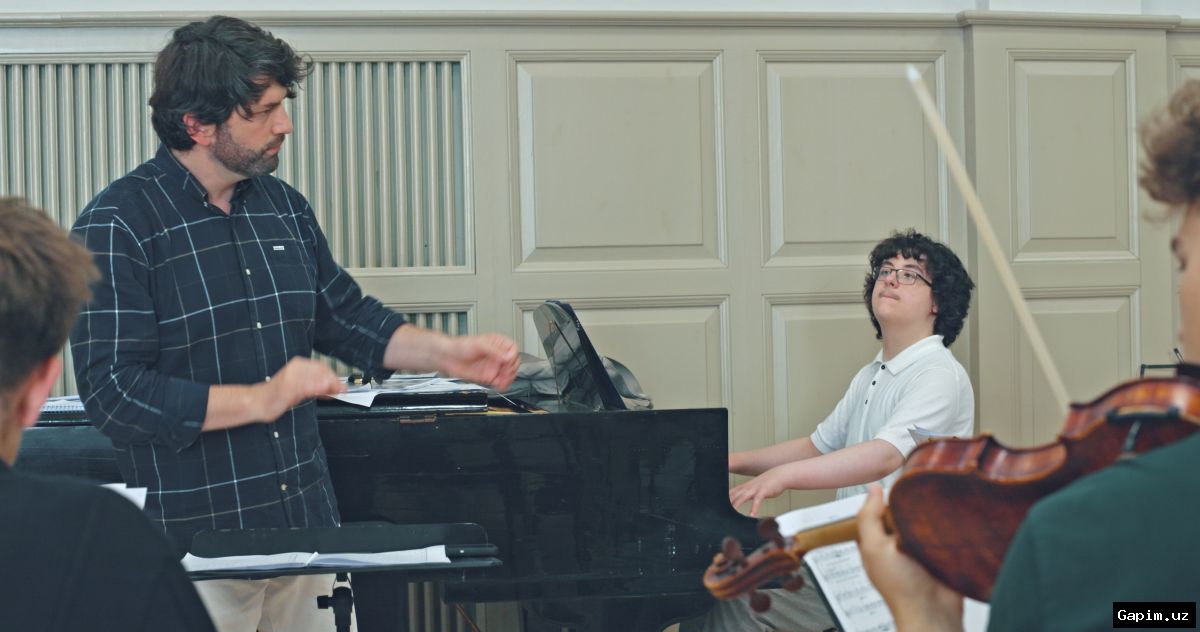
The next morning, the German musicians gathered in a simple room in central Tbilisi with an equally sized group of young Georgian musicians from the Tbilisi Youth Orchestra as well as singers from the independent music scene. Conductor and artistic director of the project, Mirian Kokhunaishvili, said: "We Georgians are known as hot-blooded Southerners with a lot of raw emotion. Sometimes the intensity of our emotions is higher than in German music. But once you listen to German music, you understand that people are full of emotions there, too, but there's different approaches to how we express them. In music, I couldn't see any differences."
After final rehearsals in Bonn, joint concerts will take place on Sept. 23 and 24: first at the Beethovenfest in Bonn and the following day in Berlin. DW will broadcast the concert live on the DW Classical Music YouTube channel. According to Kokhunaishvili, the concert is about the geopolitical reality we live in. "We want to express our hope for Europe — not just the hope of joining something somewhere, but that this is our shared home. We are fighting to belong there. The core message is that in Georgia, we share Western European values of human rights."
A highlight of the program is a new synthesis arranged by Georgian composer Mika Mdinaradze. The composition combines Beethoven's choral piece "Europa steht!" ("Europe Stands!") from the cantata "The Glorious Moment" with traditional Georgian songs. "Beethoven naturally remains unmistakable, while the Georgian polyphonic structures preserve their own identity," Mdinaradze explains in an interview with DW. "Together, they create a sonic model of Europe — a dialogue instead of forced unity — a musical declaration of where Georgia belongs."
Since 2001, the Beethovenfest Bonn has organized the Campus project, a platform for exchange among young musicians, with a focus on countries experiencing historic transformation. "Previous projects have included Ukraine, Afghanistan, Iran and now, for the second time, Georgia — after first participating in 2003," says Thomas Scheider, who leads the Campus project team at the Beethovenfest. "These are places where culture is not simply a side effect of history, but becomes a central field where history is understood, negotiated and questioned." For the Federal Youth Orchestra (BJO), which has been a partner in shaping the Campus project for 10 years, the encounter also went far beyond music. "Although music is naturally at the center, the exchange showed so much more: personal connections, cultural richness, significant history, impressive nature and also the challenging current political situation," says Sönke Lentz, orchestra director of the BJO and one of the project organizers. "Pro-European artists and what is likely the vast majority of the population need our solidarity and support." The BJO also incorporated the Campus project into this year's international tour, performing three concerts in Georgia under the direction of Mirian Khukhunaishvili and featuring soloist Giorgi Gigashvili. "Sold-out venues in Tbilisi and Kutaisi, with standing ovations, impressed us and showed us the importance of a project like this," says Lentz.
Tsotne Zedginidze: Georgian Prodigy and Campus Composer. "The new Mozart" — that is how none other than conductor Daniel Barenboim described Georgian pianist and composer Tsotne Zedginidze when he was just 16 years old. Zedginidze has just turned 17, making him the project's youngest commissioned composer in its history. He composed "Chmebi: Georgian Fantasia" for piano and chamber orchestra. The Georgian word "chmebi" means "voices." The young composer himself will play piano at the world premiere in Bonn and the subsequent performance in Berlin. "Beethoven would be completely shocked, but it would inspire him," Tsotne says with a smile about his work and the project as a whole. In his score, Zedginidze draws on ancient, complex Georgian folk traditions for the first time, combining them with unconventional harmonies and fiery folk dance elements. "About my Georgian Fantasia, I tried not to be artificial. It resembles as much as possible Georgian music — all genres and styles. But at the same time, it's my individual understanding, my own interpretation of Georgian music," he tells DW.
Star violinist Lisa Batiashvili is eagerly awaiting the premiere of Tsotne's work. Through her foundation, the musician, who moved from Georgia to Germany at age 12, supports young artists in her home country. Tsotne is among the foundation's scholarship recipients. "Over the past 20 years, I have been able to witness how the friendship between Germany and Georgia has grown and how openly and with such interest people here have approached my home country," says Batiashvili. "It is especially beautiful to see young musicians from both countries making music together, learning from each other and inspiring one another." And perhaps, Batiashvili says, something greater than music can emerge from this: a vision of a shared future.
Source: www.dw.com