Researchers at Macquarie University in Australia have captured footage showing how a detached honeybee stinger continues to inject venom even after separating from the insect's body. Observations revealed that the organ continues to function autonomously for one to two minutes after detachment, presenting a fascinating biomechanical puzzle.
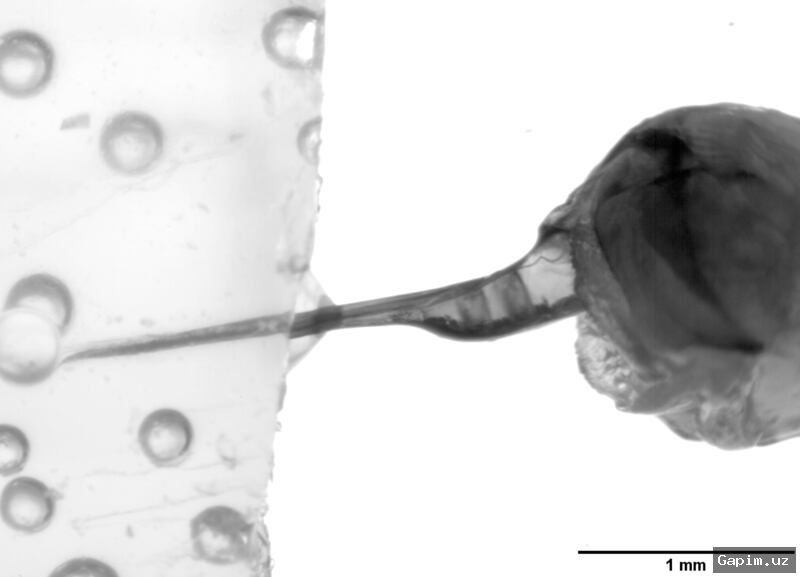
To observe this hidden internal mechanism, the scientists induced honeybees to sting a transparent gel designed to mimic human skin. Using high-speed micro-imaging, they closely monitored the movement of microscopic components inside the stinger. The details of this intriguing research were outlined in a publication by The Conversation.
Video recordings and three-dimensional scanning demonstrated that two tiny, flexible valves move alternately within the stinger. When one valve moves downward, it opens like a parachute to push the venom forward. Upon returning upward, it folds like an umbrella, passing the second valve and clearing a path for a fresh batch of venom.
In this manner, the mechanism operates precisely like a dual-piston pump. The coordinated movement of the valves ensures a steady and continuous delivery of venom. When a stinger remains embedded in skin, the attached venom sac and driving structures may also detach, resulting in fatal injury to the bee while the stinger mechanism continues its independent operation for a short period. * To rigorously test the mechanics, the researchers also fabricated a scaled-up, working replica of the structure using a 3D printer, employing both rigid and flexible polymer materials. The authors emphasize that this natural architecture could eventually inspire the development of compact medical micropumps and precise targeted drug delivery devices.
Source: kun.uz