In May, the Uzbek som slightly weakened against the US dollar after a significant strengthening the previous month, according to data from the Central Bank reviewed by Gazeta.
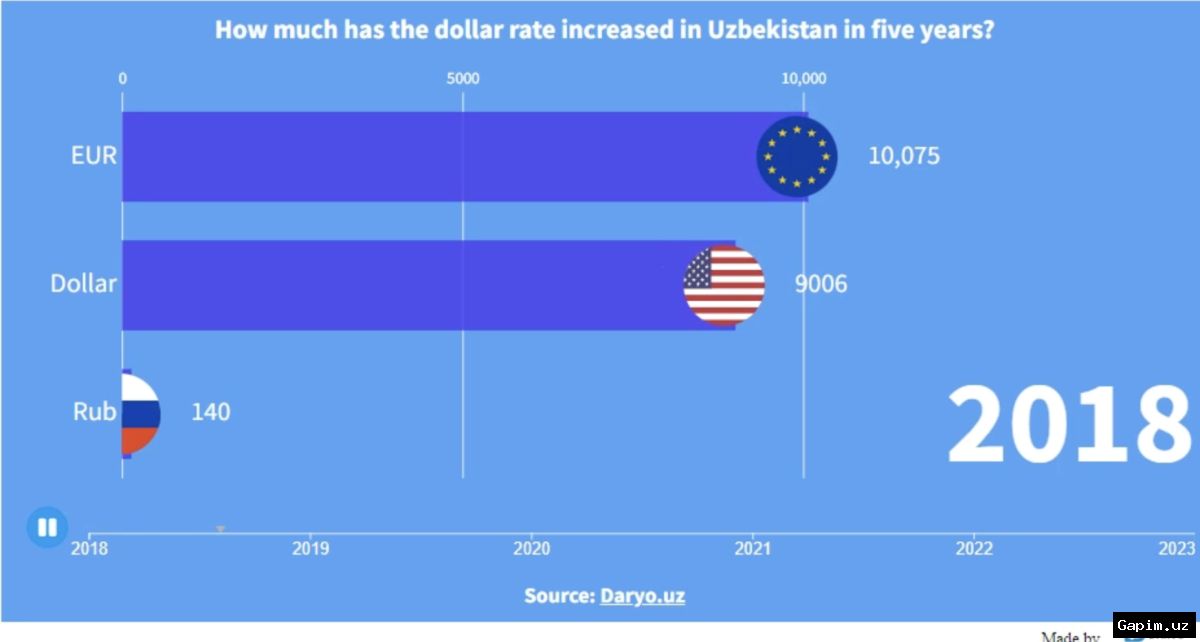
On April 30, the official dollar exchange rate was 11,937.6 soums, while by May 31 it had reached 11,997.83 soums. Thus, the dollar appreciated by 60.23 soums, or 0.5%, over the month.
For comparison, in April the som strengthened by nearly 2% against the dollar. Nevertheless, since the beginning of the year, the som remains slightly stronger. As of January 1, the rate was 12,025.33 soums, and by the end of May it was 23.39 soums, or 0.19%, lower.
Economist Mirkomil Kholboyev, a master's student at Chonbuk National University (South Korea) and author of the Telegram channel Mirkonomika, noted that the dollar's strengthening in May was observed not only against the som but also against many other currencies. Specifically, in April the dollar weakened against 32 of 39 selected currencies, while in May 25 of the selected currencies weakened against the dollar.
The Kazakh tenge, one of the strongest performers in April, weakened by 5% against the dollar in May. The Russian ruble, on the other hand, continued to strengthen: after an 8.1% gain in April, it rose another 5.1% against the dollar in May.
Among major currencies, the British pound and Japanese yen weakened by 1.4% each against the dollar, the Swiss franc by 0.6%, and the euro by 0.5%.
Kholboyev also noted that the daily volatility of the som in May was 0.31%, significantly higher than in April. However, compared to May 2025, volatility was 9.2% lower.
According to the economist, compared to other selected currencies, the som remains one of the currencies with relatively low volatility. However, significant changes occurred compared to April: in April, the som had higher volatility against only 9 currencies, while in May its volatility was higher against 16 currencies.
Among the selected currencies, the Chilean peso showed the highest volatility over the month, with daily fluctuations of 0.62%. High volatility was also observed for the ruble (0.54%) and the tenge (0.47%).
Among major currencies, the yen (0.29%) and the euro (0.19%) showed lower volatility compared to the som.
The economist also highlighted a sharp increase in the difference between volatility on som strengthening and weakening days. "In no month did the average daily volatility on som strengthening days exceed 0.51% (even in June-September, when som volatility expanded sharply). That is, in May, the highest volatility was recorded on som strengthening days," he emphasized.
On som weakening days, the average volatility was 0.23%. "It should be noted that the positive difference between the volatility of strengthening and weakening has never been so large," Kholboyev wrote.
Source: www.gazeta.uz