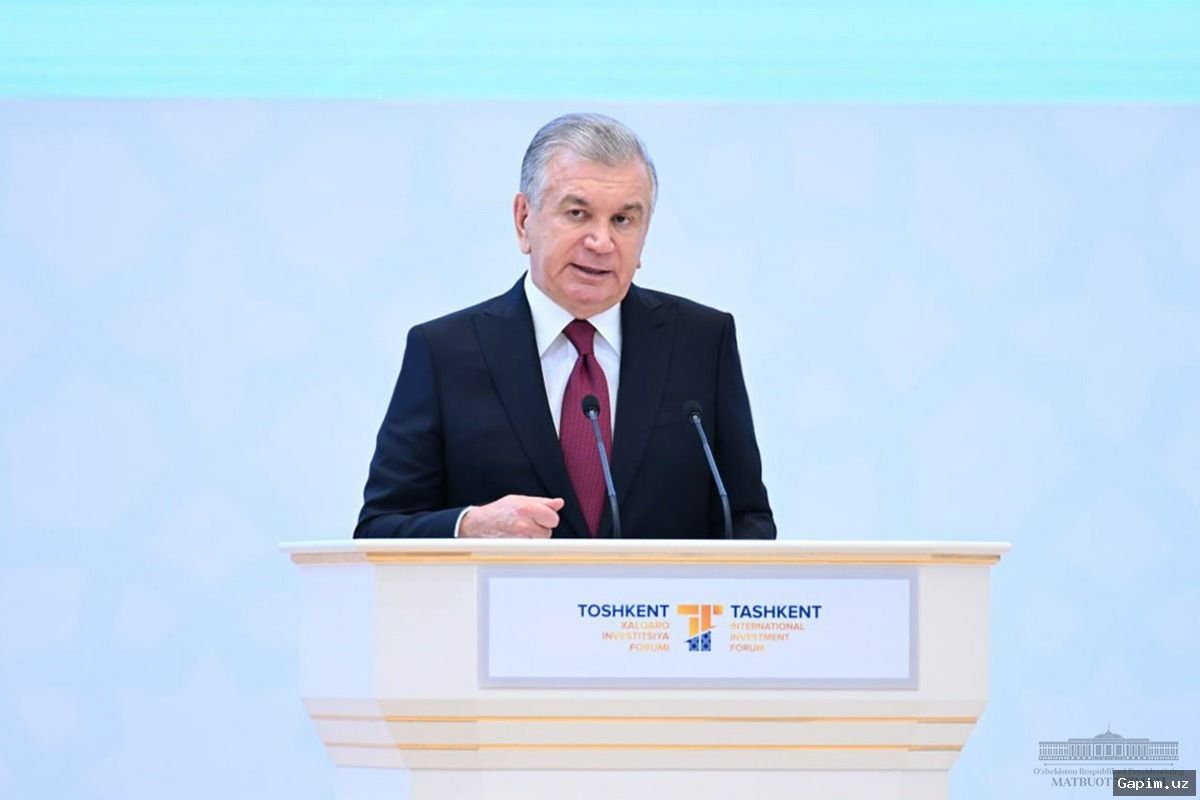
Uzbekistan, Tashkent – Podrobno.uz. At the fifth Tashkent International Investment Forum, President Shavkat Mirziyoyev outlined key directions for deepening the country's investment policy and presented new initiatives for developing the financial system, industry, and high-tech sectors.
One central direction is the establishment of the Tashkent International Financial Center. A special legal regime based on English law will be introduced, along with an independent International Trade Court of Tashkent, involving authoritative foreign judges and international experts.
Additionally, the country will develop an investment mediation system. Uzbekistan intends to join the UN Singapore Convention on Mediation, which is expected to provide investors with guaranteed international legal protection directly within the republic.
The next direction is capital market development and expanding access to alternative financial instruments. In recent years, Uzbekistan has placed over $16 billion in bonds on international markets and listed 30% of the National Investment Fund's shares on the Tashkent and London Stock Exchanges. This listing was the largest IPO on the London Stock Exchange in the last five years.
Further reforms include adopting laws "On Capital Market" and "On Alternative Investment Funds," as well as expanding the activities of international clearing companies. Additionally, a sovereign Islamic bond (sukuk) program will be launched. These measures are expected to attract at least $10 billion in additional capital.
A separate block of initiatives concerns privatization: this year, state assets, real estate, and land plots worth about $6 billion are planned to be put up for auction.
Another strategic direction is developing high value-added chains. The president noted that Uzbekistan's resource potential is estimated at around $3 trillion, including gold, copper, uranium, tungsten, and natural gas. To effectively use these resources, an open digital geological database will be created, and the number of deposits put up for auction will increase fourfold.
Technoparks "Metals of the Future" are planned in Tashkent and Samarkand, focusing on projects "from extraction to finished products." Joint investment projects in mechanical engineering, robotics, pharmaceuticals, and other sectors worth about $20 billion have also been proposed.
The fourth direction is the development of green energy and artificial intelligence. Investors are invited to participate in projects for energy storage systems, grid modernization, and data centers based on renewable energy sources.
Special attention is given to AI development: experts predict that this sector could create at least $10 billion in additional value for Uzbekistan's economy over the next five years. In Karakalpakstan, a special zone for AI and data center projects has been created, where investors are exempt from all taxes until 2040 and enjoy preferential electricity tariffs.
Additionally, the International Center for Digital Technologies of Uzbekistan will be established with a special legal regime.
The president called on foreign and local investors to actively use the new opportunities being created in the country and participate in large-scale projects within the new investment ecosystem.
The fifth direction is developing regional transport and logistics connectivity. It was noted that access to international trade markets is key for investors, and Central Asia is becoming a unified, dynamically developing space open to global economic ties.
Specifically, construction of a strategic railway continues jointly with China and Kyrgyzstan. Simultaneously, the Trans-Afghan corridor project is being actively developed, which will provide direct access to southern seaports. The "Middle Corridor" transport route, passing through the Caspian Sea and connecting Asia and Europe, is also being developed.
These projects will allow Uzbekistan to integrate into the system of key international transport routes.
It was also noted that large infrastructure initiatives are already being implemented. In particular, a new Tashkent international airport is being built jointly with Saudi partners, designed to handle up to 20 million passengers annually.
The investment forum also presented projects for high-speed highways, multifunctional logistics centers, and "dry ports." Investors were invited to actively participate in these initiatives.
Source: podrobno.uz