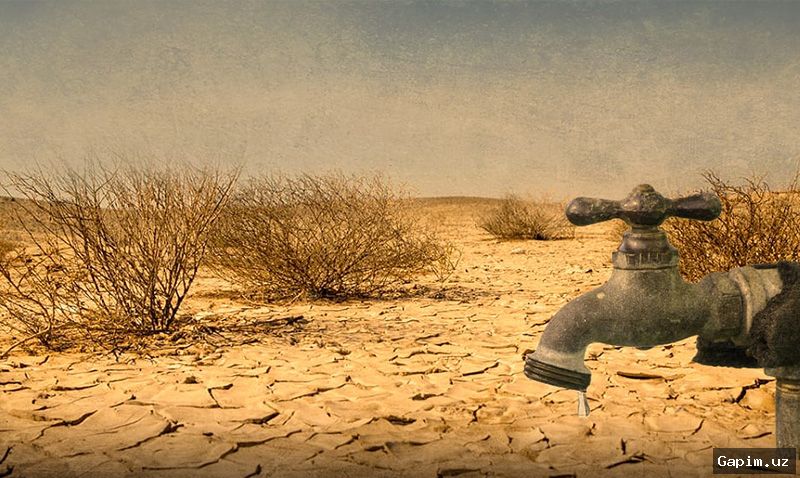
Uzbekistan has entered the list of countries with the most significant reduction in water scarcity. According to data from the UN-Water mechanism, which monitors the Sustainable Development Goals indicators, the ratio of freshwater withdrawal to renewable water resources in the country decreased from 169% in 2017 to 122% in 2022. That is, over five years, the water scarcity level dropped by 47 percentage points. By the end of 2026, this indicator is expected to decrease to 117%.
For comparison, over the same period, Pakistan reduced this indicator by 24.6 percentage points, Turkmenistan by 13.6, Armenia by 6.1, and Azerbaijan by 1.8. These and other results of reforms in the water sector, as well as current problems and future plans, were presented at the first meeting of the Expert Council organized by the Center for Sustainable Development in the Water Sector in Tashkent.
The meeting was opened by Timur Butunbaev, deputy head of the Presidential Administration for reforming the water supply system. He recalled that over the past eight to nine years, systemic changes have been implemented in the sector: the Water Code was adopted, and the Concept for the Development of Water Management until 2030 was approved. "If this concept is analyzed, it can be seen that each indicator is being fulfilled ahead of schedule. That is, some goals planned for 2030 have already been achieved today," Butunbaev said.
Abdulkhakim Salohiddinov, vice-rector of the Tashkent Institute of Irrigation and Agricultural Mechanization Engineers (TIIAME) National Research University, spoke about a new direction in personnel training. According to him, in execution of the presidential decree of April 2 this year, a master's program in international water diplomacy was opened for the first time in Uzbekistan. Not only citizens of Uzbekistan but also of neighboring countries, including Afghanistan, will study there on a scholarship basis.
Sherzod Muminov, deputy director of the Scientific Information Center of the Interstate Coordination Water Commission (ICWC), said that after the adoption of the Water Management Development Concept, water-saving technologies were introduced on 60% of the country's irrigated lands, and 40% of irrigation canals were concreted. Thanks to the modernization of pumping stations, their electricity consumption decreased by almost 30%. Also, a unified digital database was created covering more than 600,000 water users and over 4 million hectares of irrigated land. He noted that these measures save over 10 billion cubic meters of water annually. By 2030, it is planned to increase this figure to 15 billion cubic meters.
Muminov also touched upon specific regional problems. In his opinion, the construction of the Qosh Tepa canal in Afghanistan could create a risk of water shortage in the lower reaches of the Amu Darya in low-water years. Another factor is Tajikistan's plan to expand the area of irrigated land by an additional 50,000 hectares by 2040. This also means additional use of water from the Amu Darya and Syr Darya basins.
Professor Bakhriddin Khasanov, dean of the Faculty of Hydraulic Engineering Construction, presented a report on the expedition of the TIIAME National Research University. A group of teachers, researchers, and students spent a month in the Kashkadarya region studying the implementation of reforms on the ground. By the end of 2026, a total of 538 million cubic meters of water were saved in the region, of which 215 million came from water-saving technologies and 323 million from repair and modernization of irrigation networks.
Independent expert Dilshod Shodiev believes that reforms in the water sector rely on a very limited scientific base. "Over the past five years, about 20,000 scientific works have been defended in Uzbekistan, but only 48 of them, i.e., less than 1%, relate to the water sector," Shodiev said. In his opinion, the main reason is insufficient funding for scientific research over many years. The share of R&D expenditures in Uzbekistan's GDP is about 0.1% or even lower, while in Israel this figure is 5.7%, in South Korea 3.5-4%, and in neighboring Kazakhstan 0.7%.
Shodiev also addressed the issue of farmers' land rights. He emphasized that although much is said about the introduction of water-saving technologies, in practice this is done by water users — farms and dehkan households. According to the current Land Code, the right to lease land for farms can be terminated by the state on 11 grounds. One of them is "inefficient use of land," and in practice, this concept is assessed by the local governor. According to Shodiev, over the past three years, 33% of farms in the country have had their land plots confiscated.
Diyorakhon Toshmatova, deputy director of the Center for Sustainable Development in the Water Sector, spoke about the activities of the center, established by presidential decree on October 13, 2025. The main tasks of the center are analytical support for reforms in the sector, strategic planning, improvement of the regulatory framework, development of international cooperation, and introduction of innovative solutions.
Iskandar Abdullaev, an expert from the International Water Management Institute, noted that attention should be directed not only to infrastructure and technology but also to the trust of water users in reforms, their assessment of the openness of relations with the state and the quality of services, as well as the operation and maintenance of systems.
Source: www.gazeta.uz