In the heart of Tashkent, between the Yunus Rajabiy and Beshagoch mahallas, lies an embankment along the Burdzhar canal that could become one of the capital's key attractions. However, a dilapidated descent, lack of lighting, benches, and regular maintenance have turned it into a nearly abandoned space.
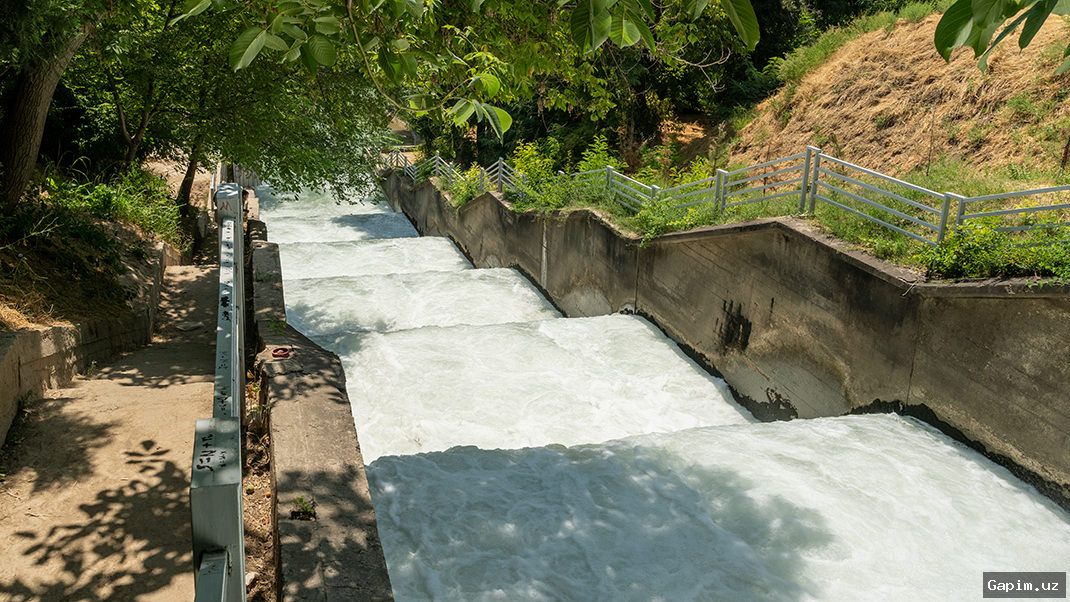
Just a few steps from the usual city route, there is a place most passersby simply do not notice. Behind the bustling upper path hides a quiet trail along the Burdzhar canal – with water, mature trees, and coolness that the city desperately needs on hot days. There is almost no typical street noise here: instead of traffic, only the sound of water is heard, and the dense shade of trees turns the canal-side area into a natural shelter from the sun. By its natural conditions, this is already a ready-made space for walks – it just needs to be made accessible to people.
The paradox of this territory is that people are already nearby. Every day, dozens of pedestrians pass along the upper path, athletes run, and local residents use it as a regular route. But this flow barely reaches the water itself. The main reason is the state of the area. The descent to the water has long failed even basic safety requirements: part of the steps are destroyed, and the path down looks abandoned. There is no lighting, benches, or other amenities along the canal. The lack of regular care and accumulated garbage only reinforce the feeling that this space has long fallen out of urban life.
Currently, Burdzhar remains one of those places where the potential is significantly greater than its current state. A few thoughtful solutions – restoring the descent, installing lighting, providing rest areas, and regular maintenance – could return this territory to residents and turn a forgotten canal section into a full-fledged urban embankment.
How can the embankment be improved? Today, instead of a full-fledged promenade, the embankment is gradually losing its potential. The absence of lighting, benches, trash cans, and other basic amenities is turning it into a neglected stretch along the canal. As a result, the area, located next to a busy pedestrian route, is used far less than it could be.
However, its development does not require large-scale reconstruction. The basic conditions are already in place – it is only necessary to ensure convenient access, safety, and basic care for the territory. Restoring the descent, installing lighting, placing amenities, and regular maintenance could return this space to residents and make it part of the urban walking environment.
One of the most important elements is lighting. This is not just about lamps, but about properly organized light. Supports can be installed at equal intervals to avoid dark spots. The light should be directed downward onto the walking path, not scattered to the sides. This allows a person to see the surface, other pedestrians, and the surrounding space, without creating light pollution or disturbing the trees.
One solution could be autonomous LED lamps. Each support would have a solar panel and battery. During the day, the system accumulates energy, and in the evening it automatically turns on the lighting. If the area is in the shade for most of the day, a hybrid system could be used: part of the energy would come from solar panels, and if necessary, the lamps would connect to the city grid. This would increase reliability and reduce operating costs.
The next element is benches. They are needed not only for rest. In an urban environment, a bench is a reason to stop. As long as a person has nowhere to sit, they perceive the space solely as a road. But as soon as there is an opportunity to stop, look at nature, wait for friends, or just rest, the route turns into a place of stay. This is what distinguishes a public space from a simple passage.
Trash cans are equally important. When they are placed at short distances from each other and regularly serviced, the likelihood of litter ending up on the ground is significantly reduced. Cleanliness is not only a matter of culture but also of infrastructure. If it is convenient for a person to throw away garbage, they will do it much more often.
When all these elements start working together, the very logic of using the territory changes. Runners, cyclists, parents with children, and elderly people who need a place to sit during a walk appear here. The space begins to live throughout the day, not just during peak hours.
There is another effect that is often underestimated. In urbanism, there is a principle of "eyes on the street," formulated by Jane Jacobs. Its meaning is simple: the more ordinary people regularly use public space, the safer it becomes. Lighting, the constant presence of residents, and good visibility create natural control without additional security measures. People feel more confident, and the likelihood of vandalism and crime decreases.
How much will it cost? Podrobno.uz examined current offers from street furniture manufacturers, equipment suppliers, and construction work rates in Tashkent. Even with a budget option, improving this territory would cost about 250 million soums. This amount includes cleaning the area, repairing the existing path, installing five benches, five trash cans, and eight lamps, as well as minimal landscaping of the adjacent area.
For comparison: in 2026, according to the president, each mahalla will receive an average of about 5.5 billion soums for infrastructure development and improvement. That is, bringing the Burdzhar embankment into order can be done for less than 5% of this budget.
Moreover, the result is disproportionate to the costs. From an ordinary concrete path that people try to avoid today, the embankment could turn into a full-fledged urban route – a place where people come to walk, exercise, and simply breathe cool air on a hot day. This is a good example that the quality of the urban environment does not always require large-scale construction – sometimes it is enough to carefully refine what already exists.
Source: podrobno.uz