In March, a retaining wall of the overpass located at the intersection of Temur Malik and Buyuk Ipak Yoli streets in Tashkent's Mirzo Ulugbek district collapsed. No injuries were reported, but the incident sparked public concern. On July 31, the criminal court of Mirzo Ulugbek district delivered its verdict.
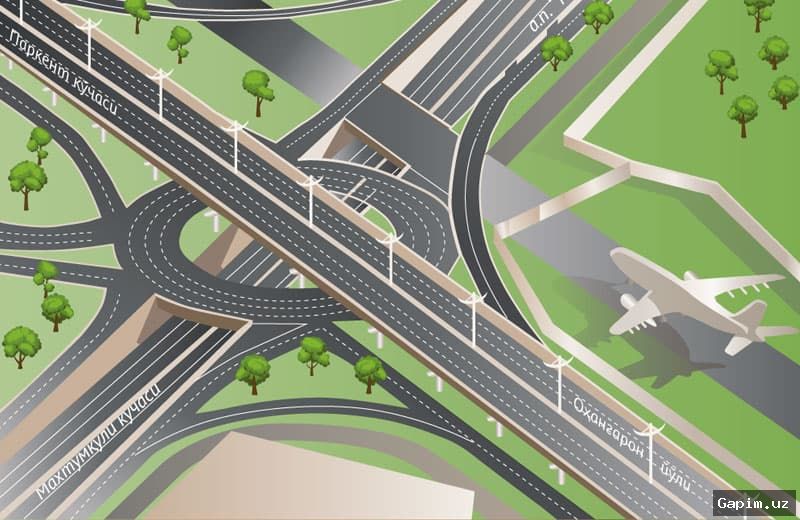
The construction was carried out by the Tashkent regional branch of the state cluster 'Uzyulkuprik' under the Committee of Automobile Roads. The customer was the Directorate for Construction and Reconstruction of Automobile Roads, and the designer was 'Yul-loyiha byurosi'. Initially, the project was valued at 130 billion UZS, but after completion, the cost rose to 186.5 billion UZS. Court documents indicate that the contract for the first phase was 118.9 billion UZS, and with additional agreements for the second phase, the total exceeded 94 billion UZS. The overall cost reached 213 billion UZS, nearly 64% higher than initial estimates.
The overpass was opened on August 29, 2024, ahead of Independence Day, although it was originally scheduled for commissioning in the first quarter of 2025. Officials claimed that the technology used would halve construction time and ensure a lifespan of over 100 years. However, an investigation revealed significant deviations from design and construction norms. Specifically, 'cold joints' were left between concrete sections, anchor reinforcement was placed at a depth of 40-45 cm instead of the designed 75 cm, the spacing between reinforcement bars did not meet requirements, and the rainwater drainage system was ineffective.
Experts concluded that the wall deteriorated precisely along the 'cold joints'. They estimated that if design solutions and construction norms had been followed, the collapse could have been prevented. The defendants included employees of contracting, design, and supervisory organizations: Akmal Murodov, deputy director of the Tashkent regional branch of 'Uzyulkuprik'; Abdumutal Isropilov, a work supervisor; Sanjar Mannonov, deputy director of the Directorate; Zafar Sharakhmedov, chief specialist of the technical supervision department; Nurshod Mavlonov, chief project engineer of 'Yul-loyiha byurosi'; and Obid Adilov, head of the subcontracting company 'Grand Nur Yul Qurilish'.
The court found that the defendants had included false information in reports on completed works (Form No. 3). According to an expert examination, works worth over 6.17 billion UZS were performed poorly in four retaining walls. Wall PS-3 collapsed, and wall PS-4 did not meet requirements and was completely dismantled. In the other two walls, soil subsidence and structural deformations were recorded. Additionally, reports claimed that basalt geogrid was laid in seven rows worth 599.7 million UZS, but inspection revealed only one row (about 166 million UZS). A total of 8,880 cubic meters of sand-gravel mixture worth over 766 million UZS was not filled into the retaining walls, although these works were also included in the reports. The total damage amounted to approximately 7.38 billion UZS.
The defendants did not admit guilt or only partially admitted it. They argued that the construction works were not so defective as to render the facility unusable, and that deficiencies could be eliminated within the warranty period. The defense also noted that part of the design and estimate documentation appeared after the construction was completed: the sand-gravel mixture and basalt geogrid were not initially included in the estimate but were added only in the summer of 2025 in documents on additional works. Lawyers attempted to challenge the authority of auditors and experts, citing their lack of specialized certificates in road construction.
The court considered the guilt proven based on acts of working and state acceptance commissions, reports in forms 2 and 3, materials from the scene inspection, control measurements, and the conclusion of a forensic construction examination. Akmal Murodov, Sanjar Mannonov, Zafar Sharakhmedov, and Abdumutal Isropilov were found guilty under paragraph 'a' of Part 3 of Article 167 of the Criminal Code (embezzlement on an especially large scale) and paragraphs 'a' and 'v' of Part 2 of Article 209 (official forgery). Nurshod Mavlonov was found guilty of complicity in embezzlement, and Obid Adilov was found guilty of complicity in embezzlement and official forgery.
The court sentenced all convicts to an additional penalty of deprivation of the right to hold positions related to material responsibility and organizational-administrative functions for one year. Akmal Murodov and Sanjar Mannonov were fined 116.25 million UZS each, and Obid Adilov was also fined 116.25 million UZS. Zafar Sharakhmedov and Abdumutal Isropilov were initially fined 116.25 million UZS each, but the court took into account the 39 days they spent in custody and reduced the amount to 108.9375 million UZS. Nurshod Mavlonov was fined 112.5 million UZS, which was also reduced to 108.9375 million UZS after accounting for 39 days in custody. The damage was compensated on April 23 by transferring funds to the deposit account of the Prosecutor General's Office, and the court ordered these funds to be transferred to state revenue.
Source: www.gazeta.uz