Media in Uzbekistan regularly report incidents where drivers fail to yield to ambulances. The scenario is typically the same: traffic police identify the driver, conduct a "preventive conversation," impose penalties, and the driver promises not to repeat the offense. However, the problem cannot be solved by fines alone. Until traffic rules establish a clear algorithm for actions when operational and special service vehicles approach, this situation will persist.
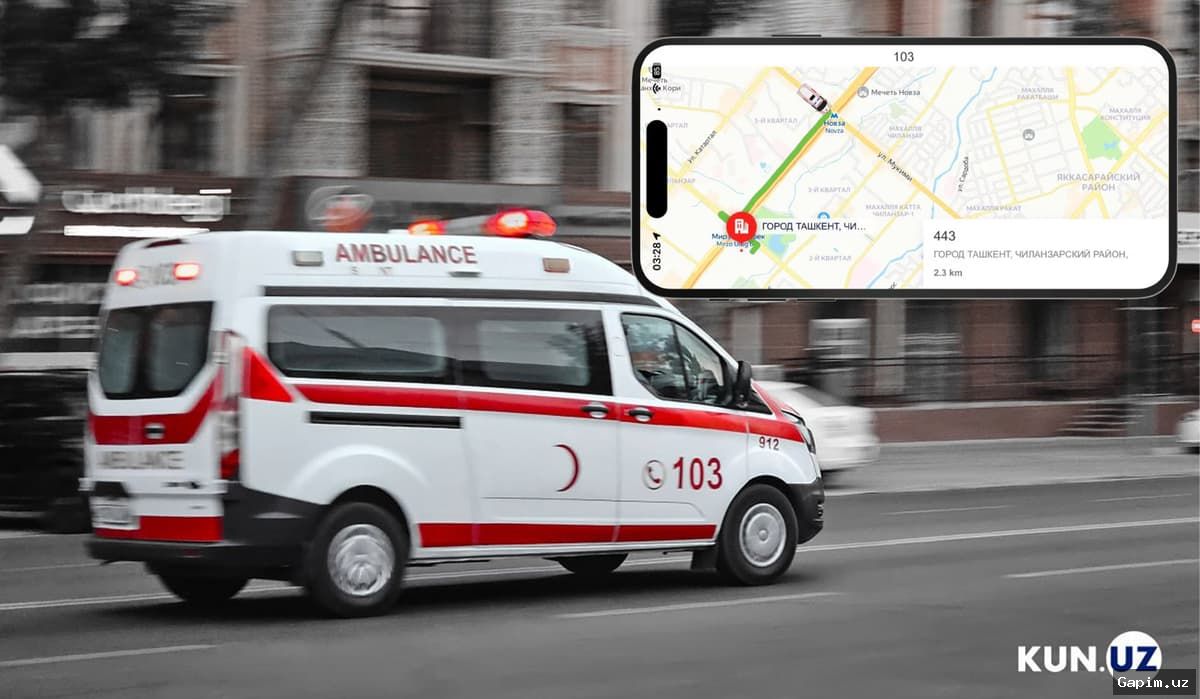
Currently, Uzbekistan's traffic rules effectively set only a final requirement: drivers must "give way" to operational and special service vehicles with special sound signals and flashing beacons activated. However, the rules do not explain how exactly to do this in various road situations. As a result, in dense traffic, drivers make independent decisions: one tries to move right, another left, a third stops in place and waits for the car ahead to move. Even if every driver tries hard to yield, a single and orderly corridor for special transport may not form.
"In Uzbekistan, there is no clear and understandable algorithm for collective actions of drivers in such a situation. In a number of countries, this issue is regulated in much more detail. For example, in two-lane traffic, cars shift to opposite edges of the roadway, forming a free corridor between the lanes," says Bobur Sirojov, an expert on sustainable mobility and infrastructure policy. "With three or more lanes, the principle is the same: cars in the leftmost lane shift as far left as possible, and cars in the remaining lanes shift right. Thus, the corridor is formed between the leftmost lane and the adjacent lane. The driver does not have to decide independently which way to move; this is predetermined by the rules," he emphasized.
Such rules are applied differently. For example, in Germany, the mandatory formation of a Rettungsgasse (rescue corridor) is primarily envisaged on autobahns and multi-lane suburban roads when moving at pedestrian speed or when traffic stops. In Poland, this rule is broader and applies to roadways with two or more lanes in one direction, including in dense city traffic. In the UK, unlike Uzbekistan, drivers are prohibited from crossing the stop line on red — special transport bypasses cars along free (including oncoming) lanes due to a pre-formed corridor.
The most important aspect here is that the corridor must be formed not after the driver sees an ambulance in the mirror or hears a siren, but in advance, even in dense traffic jams. At the same time, the corridor must remain free for emergency service vehicles (there may be several of them), and ordinary transport must be prohibited from using it during this time. This significantly reduces the time needed to clear the way: when an ambulance, fire truck, or other special transport appears, drivers are not required to simultaneously and chaotically try to open a corridor.
A similarly clear procedure must be enshrined in Uzbekistan's traffic rules. The rules should take into account various situations: two, three, and more traffic lanes, intersections, traffic jams, dedicated public transport lanes, and areas bounded by curbs or physical dividers. After amendments are made to the traffic rules, a large-scale information campaign is needed: short videos, diagrams, materials in driving schools, on electronic boards, and on social networks. The rule should be so simple that a driver can recall it within seconds.
However, obligations must be clear not only to ordinary drivers but to everyone. It is also necessary to standardize the procedure for using special light and sound signals by drivers of ambulances, fire services, traffic police, and other operational services. In practice, there are cases when special transport drivers turn on the sound signal directly before an intersection. After passing the intersection, they turn off the signal and turn it on again before the next obstacle. In dense traffic, this leaves other drivers too little time to determine the direction of the special vehicle and in an organized manner to clear the way for it.
According to current traffic rules, operational and special service vehicles have an advantage over other road users only when blue or blue and red flashing beacons and a special sound signal are simultaneously activated. In most cases, special transport drivers also use other methods: approaching from behind cars stopped at an intersection, they may give a short sound signal or transmit instructions via a loudspeaker. Therefore, it is advisable to separately regulate the procedure for using special sound signals and loudspeakers: in which cases they are used, when the special transport driver should turn on the main signal, and how long in advance to warn the traffic flow.
"The system must be understandable in advance for both sides. An ordinary driver must clearly know what actions are required of him, and a special transport driver must understand how and how long in advance to announce his approach. Only then can dozens of individual cars act as a single flow," said Bobur Sirojov. Some ambulance drivers are already trying to organize movement on this principle independently. For example, in this video from Tashkent, an ambulance via loudspeaker suggests drivers move left and right. However, due to the lack of an algorithm enshrined in traffic rules, such instructions may naturally be unclear to some drivers.
Therefore, it is necessary to develop both the rules of movement for ordinary drivers and the work procedure for special transport drivers. Only after a clear and unambiguous algorithm appears will it be appropriate to discuss increasing liability for deliberately obstructing the movement of emergency service vehicles.
Source: www.gazeta.uz