At the World Chess Olympiad in Samarqand, host nation Uzbekistan has fielded three teams in the open and women's sections. Among them, the second men's team has drawn particular attention: ranked 30th at the start, it has already become one of the tournament's discoveries in the first half.
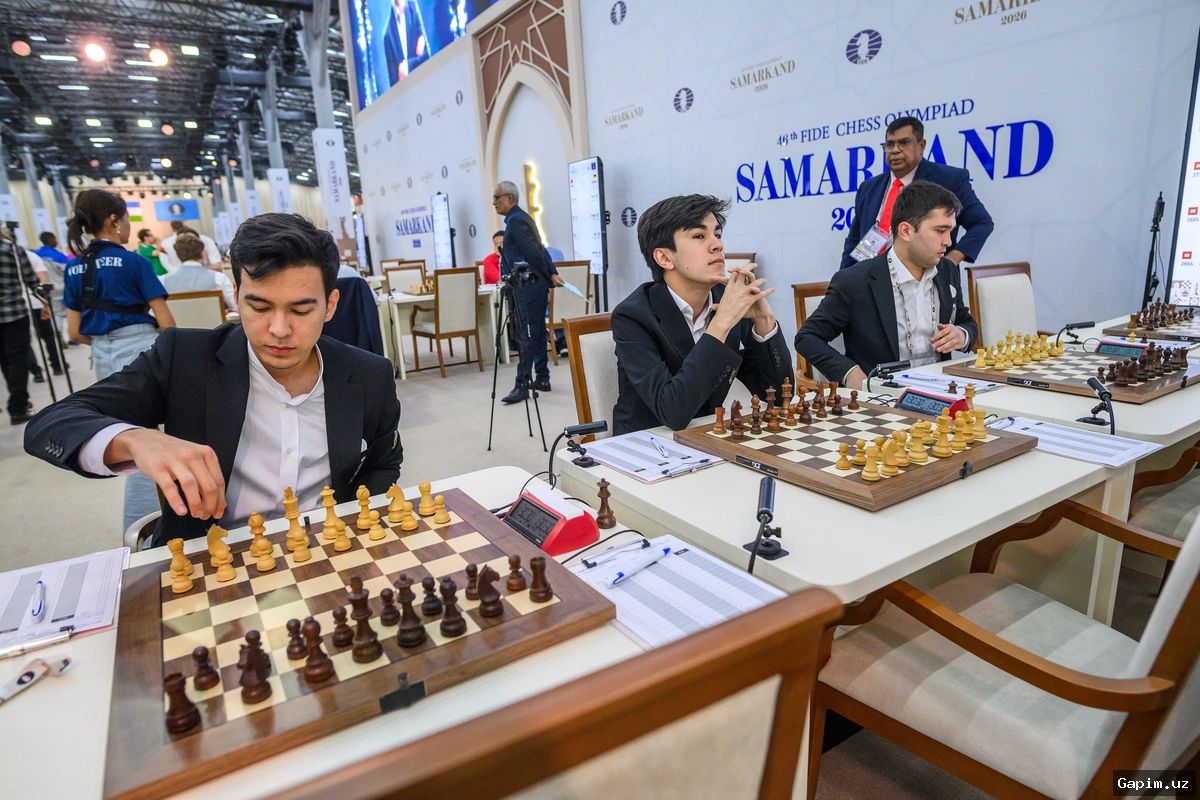
At the outset, the average rating of Uzbekistan's second team was 2532 points. The squad includes five grandmasters: Jahongir Vohidov (2527), Abdimalik Abdisalimov (2548), Muhammadzohid Suyarov (2540), Humoyun Begmurotov (2514), and Ortiq Nigmatov (2484). The team's coach and captain is Ukrainian grandmaster and two-time Olympiad champion Pavel Eljanov. In an interview with Gazeta observer Georgiy Shvanov, he discussed the young Uzbek grandmasters, team play principles, his reluctance to set overly ambitious goals, and state support for chess.
Eljanov noted that he played for the Ukrainian national team for many years and coached the Georgian women's team, but this is his first time as captain of a team at the Olympiad. "For me, this is a very interesting, new challenge. I eagerly awaited the start of the Olympiad and remain in high spirits," he said. According to him, the most important rounds usually come at the end, so the team is already preparing for clashes with strong opponents.
The coach emphasized that the team is very young, but all its members already hold the grandmaster title. "When I took over the team at the end of last year, the group consisted of six people, and only half were grandmasters. Now even our youngest players have achieved this title," Eljanov said. According to him, Muhammadzohid Suyarov and Humoyun Begmurotov raised their ratings by about 100 points within a year to become grandmasters.
Eljanov is not in favor of setting excessively high goals. "I advocate not setting overly ambitious goals. I told the guys that their task is to play each individual game at the highest level and raise their personal rating," he said. In his view, young players can quickly "burn out" and become psychologically exhausted, so maintaining balance is crucial.
The coach praised the level of support for chess in Uzbekistan. "In Uzbekistan, support for chess is organized at an incomparably high level. I don't mean to say everything is bad in Ukraine, although we know there is a war there. But overall, from the standpoint of the state and the federation, the support and its results are not comparable," he said. According to Eljanov, Uzbekistan has risen to the ranks of leading chess nations in recent years.
The interview took place on September 22, a rest day after six rounds. By that time, Uzbekistan's second team had recorded five wins and one loss, including a victory over Spain, and had accumulated 10 team points. In subsequent rounds, the team continued its successful run: in round 7, it drew with France (2-2); in round 8, it defeated England (2.5-1.5); in round 9, it crushed the Netherlands (3.5-0.5). However, in round 10, it suffered a heavy defeat to the reigning Olympiad champion, India (0.5-3.5).
Nevertheless, over the four rounds after the rest day, the second team scored 5 out of 8 possible points. After ten rounds, Uzbekistan-2 has 15 points. The team has become one of the main sensations of the Olympiad and has the potential to achieve even more impressive results.
Source: www.gazeta.uz