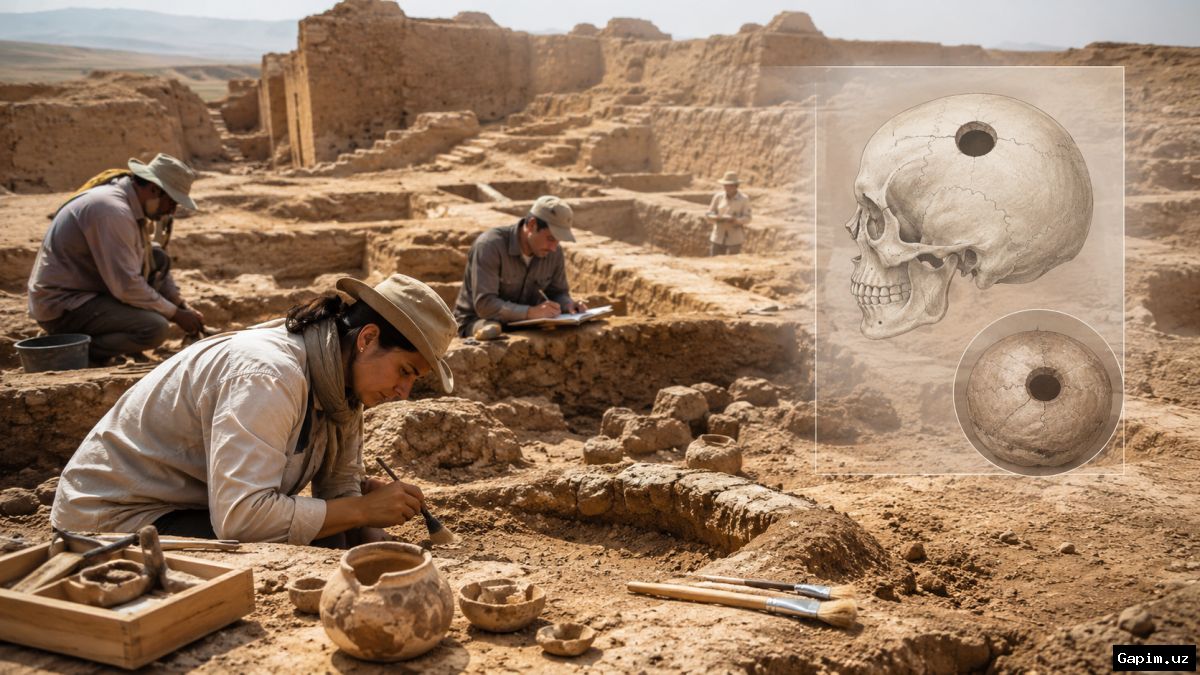
A joint Uzbek-Chinese archaeological expedition is continuing work at the ruins of the ancient settlement of Kyrkhudjra in the Pap district of Uzbekistan’s Namangan region, with researchers seeking to reconstruct the town’s layout, development and daily life. The team includes specialists from the Institute of Anthropology of the Academy of Sciences of Uzbekistan, the Institute of Archaeology of the Chinese Academy of Social Sciences, and faculty and students from Namangan State University. The expedition is led by Abdulhamid Anarbaev, doctor of historical sciences and professor, working with Chinese scholars Liu Tao, Ai Aisa and Wang Xin. Excavations are underway at four locations, including the citadel and the northern and western parts of the site.
Key Takeaways: The Kyrkhudjra expedition involves Uzbek and Chinese archaeologists plus Namangan State University students. Work is concentrated at four excavation areas, where ancient pottery, household items and building remains have been found. Researchers expect the finds to clarify the settlement’s chronology, planning and the history of the Pap district and Namangan region.
The project reflects growing international cooperation in Uzbek archaeology and broader efforts to study Central Asia’s urban culture, craft production, trade links and settlement patterns. Kyrkhudjra is significant because evidence from its citadel and residential quarters could help researchers compare local development with wider regional processes. The participation of the Chinese Academy of Social Sciences’ Institute of Archaeology allows the team to apply comparative methods and examine ceramic assemblages, stratigraphy and chronology within a broader framework. For Namangan region, the work may also support heritage protection and future educational or tourism initiatives if the site is properly studied and preserved.
At the excavation areas, specialists are recording fragments of ancient pottery, various household objects, remains of buildings and other artifacts. According to the researchers, these finds will help identify stages in the settlement’s development, features of its layout and aspects of everyday life. The citadel, as the central part of the site, is a particular focus, along with the northern and western districts, which should provide a more complete picture of construction and defensive arrangements. Field documentation and initial classification are being carried out before any laboratory dating or detailed cultural attribution.
The Kyrkhudjra work follows earlier archaeological discoveries in Uzbekistan, including rock paintings in the Koshrabad district of Samarkand region that are believed to date to the Mesolithic and Neolithic periods, and traces of a Bronze Age settlement in the Nurata mountains. Such finds underline the density and diversity of archaeological heritage across the country and the importance of systematic research. The new expedition may add to knowledge not only of the Pap district but also of the wider Namangan region and its place in ancient Central Asian networks.
Researchers are continuing field work and scientific processing of the material. Future steps are expected to include laboratory analysis, more precise dating and possibly expansion of the excavated areas. Final conclusions about Kyrkhudjra’s age, status and character will be possible only after the expedition is completed and results are published, so current interpretations should be treated with appropriate scholarly caution.
Source: podrobno.uz